
Before oil, the sea was not only where Kuwaitis earned a living; it was the thing the town was organised around. And the man at the centre of that organisation was the nakhoda, the captain.
The title was not granted. It was earned through experience, and it carried responsibility rather than rank: the nakhoda was the crew’s authority, the ship’s master, the man who read the stars, and the negotiator in the pearl markets.
The work before the sailing
A nakhoda’s voyage began long before he left. He had to fit out the ship, choose his crew, secure the food and water, and time the departure so as not to miss the diving season. Then came the moment of sailing, with prayers and the “yamal” work songs.
What he had to know
At sea every man aboard had his role, and the nakhoda was the centre of it. He decided when the ship dived and where, took her through storms, and came home with pearls if the sea gave them or empty-handed if it did not.
Which meant knowing the language of the winds, the direction of the currents, and the location of the hayrat, the pearl beds. None of that was written down; it was carried and passed on.
The crew
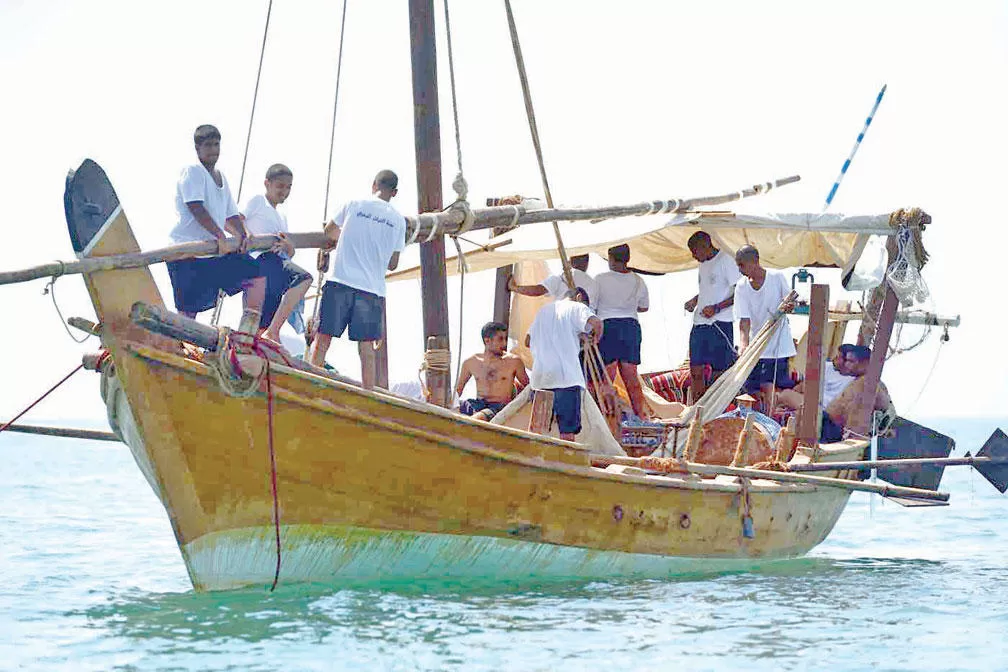
The diving season usually began in summer and ran several months, known as the great dive. A ship’s crew ran to between forty and sixty men, divided among the ghasa, the seeb, the majadima, the nabootiya and others.
The ghasa are the men who actually went down to the seabed to gather oysters. The seeb is the man who pulled them back to the surface on the rope. And the nakhoda watched all of it, recorded the take, and kept the crew’s spirits up.
The names people still repeat
The best-known Kuwaiti nakhodas are still named in majlis conversation and in popular history: Nakhoda Hussein bin Issa, Nakhoda Abdullah bin Nasser, Nakhoda Hamad Al-Duaij and many others. They were reference points for navigation in the Gulf, and the stories about them are told as lessons in command by judgement rather than by force.
Leaving and coming back
Mothers saw their sons off on the shore, and the ships were met on return with celebration even when the take was modest. Every return from the sea was a return from something that might not have happened.
And the heroes were not the captains alone: everyone who sailed with them, from the boy filling the water skins to the old man who knew the diving songs by heart. The ship was a floating household, and every job on it kept everybody else alive.
The pearl and the price
In the years before oil, the pearl was the whole point. A small thing brought up after hours underwater, later sold in the markets of Bombay, Basra or Bahrain. The nakhoda negotiated the price, divided the proceeds, and was expected to see that every sailor went home with a share of what the sea had given.
What happened to the trade
With the discovery of oil and the change in the economy, the profession contracted and the diving fleets went. Some of the old ships now stand in museums or sail at heritage festivals. But the vocabulary, the songs and the names have stayed in circulation, taught in schools and repeated at national occasions — because they belong to a period when everything was harder and entirely real.
Further reading: the National Council for Culture, Arts and Letters · the Center for Research and Studies on Kuwait
Kuwait One, once a week.
The most useful stories we published this week, in your inbox.
No spam. Unsubscribe anytime.