
In the heart of old Kuwait City, before the asphalt and the tall buildings, the inner souk was where the capital did its business: shops opening in the morning, sellers calling, and the smell of spice and perfume in the air.
The inner souk was not only a place of trade. It sat among narrow lanes branching off Sikkat Anza — a lane that started as a simple, slightly raised path. The name is said to have come from a herd of goats that passed along it every morning, and over time it became the formal name attached to the souk’s history.
How it was built
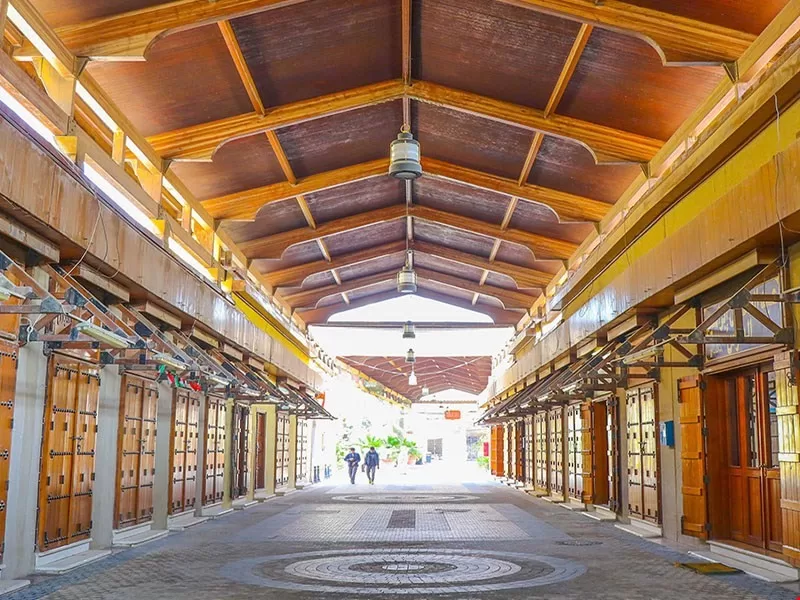
The inner souk was made of small shops built of mud and coral stone, packed side by side, separated by narrow passages sometimes roofed with palm trunks or timber to shield customers from the summer sun.
Every corner had its own colour, smell and sound. The cloth seller called out to passers-by, silk, cotton, shemagh and ghutra spread in front of him, turned over with practised hands. Near him sat the attar, his shelves full of bags of henna, bottles of perfume, spices arriving from India, and the traditional remedies he had inherited from his father.
The goldsmith and the date sellers
The goldsmith had a particular presence: seated behind a wooden table with a small balance and a locked box, surrounded by men and women bargaining over rings, pendants and bangles bought for occasions or given at weddings.
At the far end of the souk sat the date sellers, their produce spread in palm-leaf baskets, offering Kuwaiti, Najdi and Iranian dates and weighing them out by hand. Women passed with cloth wraps and bags, filling them with vegetables or fish and talking with the sellers as they went.
Sikkat Anza
The lane running alongside the souk was more than a way through. It was the artery feeding it: donkey carts came along it loaded with goods arriving from Basra or off the sea, and people took it toward the souk or home.
It was also known for small workshops — blacksmiths and carpenters — whose hammers sounded in the morning like an opening bar to the day.
Fridays
On Fridays the souk quietened and its gatherings became social rather than commercial. Older men sat in the shade of the shops, talking about the past, about what the ships had brought, and about what a captain had sold on his last voyage. Children wandered through with curiosity, buying sweets from a small shop, or standing in front of the bird seller.
What is left of it
Time took much of the souk’s fabric and the towers covered the lanes. The inner souk and Sikkat Anza survive in the Kuwaiti memory as shorthand for a period of straightforward trading and a particular kind of street life — and they mark the stretch when Kuwait went from a small coastal town to a working capital.
Further reading: the National Council for Culture, Arts and Letters · the Center for Research and Studies on Kuwait
Kuwait One, once a week.
The most useful stories we published this week, in your inbox.
No spam. Unsubscribe anytime.