
Before the derricks and the refinery lights, Kuwait was a maritime country living on pearling, trade and navigation. Under people’s feet lay something else entirely.
Before the discovery
At the start of the twentieth century, conditions were hard. The diving seasons were punishing and their returns uncertain. Wooden ships — the boom, the shu’ai, the baghla — crossed the Gulf carrying hopes and risks in equal measure. On land, people grew what palms they could, relied on caravan trade, and exchanged goods in plain markets such as Mubarakiya.
The concession
In 1934 the first oil concession agreement was signed between the Kuwaiti government and the Kuwait Oil Company Limited, owned equally by the British Petroleum Company and the American Gulf Oil Corporation.
The agreement carried large hopes and no guarantees. Oil was not confirmed to be there, the techniques were still primitive, and the climate and terrain were difficult.
Burgan
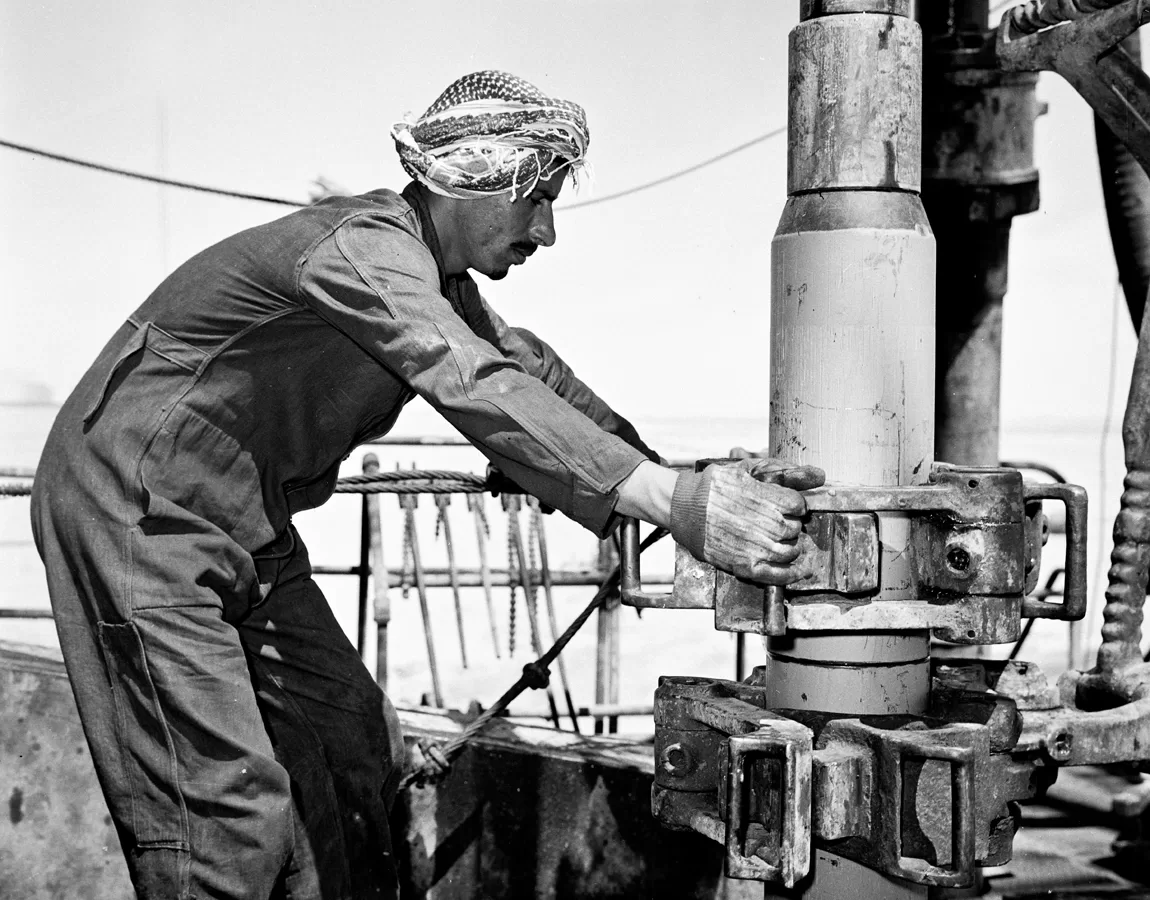
In 1938 the awaited news came: oil was discovered in commercial quantities at the Burgan field in the south of the country. It was not only a geological find but the announcement of a new era. Even so, the first export did not follow for years, as work was interrupted by the Second World War.
The first cargo
On 30 June 1946, in the presence of Sheikh Ahmad Al-Jaber Al-Sabah, the first tanker loaded with crude left the port of Ahmadi.
The country’s outline began to change:
- Paved roads were laid.
- Hospitals and schools were built.
- Modern infrastructure projects began.
- Kuwaitis were employed in the oil operations and given technical training.
The economy shifted from depending on the sea to depending on energy.
Ahmadi, the oil town
The town of Ahmadi was established as the centre of oil operations and as housing for staff. It was designed on English lines, with houses set in gardens and a modern layout. It became a marker of the change in how the country was built and lived in: it held the first cinema club, sports grounds, and the first modern street lighting outside Kuwait City.
Oil and society
The effect was social and cultural as much as economic. Electricity and fresh water reached houses, new administrative and technical jobs appeared, and living standards rose. And the state went on building its institutions in preparation for the independence that came in 1961.
Did oil change everything?
Since that first barrel, oil has been the backbone of the Kuwaiti economy. It also raises a standing question about diversification, the sustainability of the resource, and what the country’s next economy looks like.
Further reading: the Kuwait Oil Company · Kuwait National Petroleum Company
Kuwait One, once a week.
The most useful stories we published this week, in your inbox.
No spam. Unsubscribe anytime.