
Before it became a modern governorate of wide roads and housing estates, Jahra was a small version of the older Kuwaiti life: agricultural in character, tribal in composition, and positioned where large events happened to pass.
A green oasis at the desert’s edge
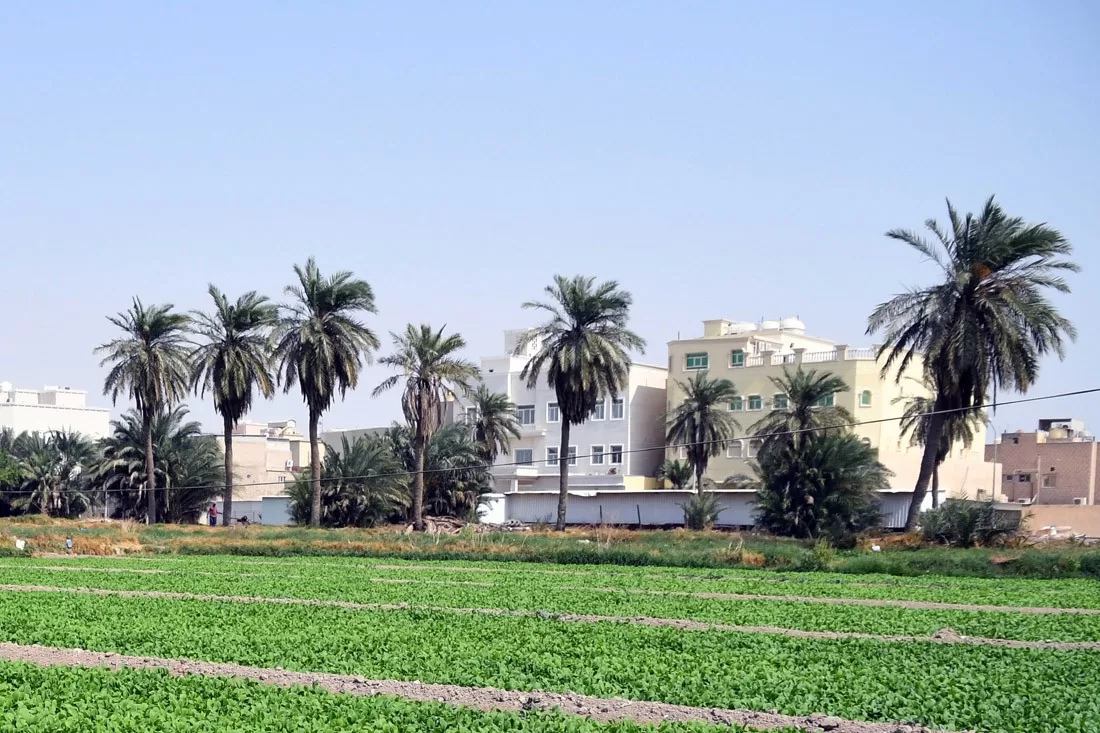
Jahra lies north-west of Kuwait City, and was formerly farming country. It was known for its groves of date palms, lemon and pomegranate, where fertile ground and groundwater watered the fields and gardens. A wall around Jahra protected the farms and houses from attack, which made it something like a fortified oasis inland.
Kuwaiti families, particularly in summer, went out to Jahra to escape the humidity of the city, building small summer houses among the palms.
The Red Palace
You cannot discuss Jahra without the Red Palace, the landmark built in the late nineteenth century in the reign of Sheikh Mubarak Al-Sabah. It is called red for the colour of its mud, and it served as a command position in the battle of Jahra in 1920, when Kuwait defended its sovereignty against the Ikhwan incursion.
The palace is now an archaeological and cultural site hosting events and national festivals.
Tribal life and the caravan road
Because Jahra sat on the caravan road running north toward Iraq and south to the rest of Kuwait, it was a working stop for trade and movement. It drew both bedouin and merchants, which gave it a clear tribal character and a life built on plainness and mutual support.
From farms to modern districts
With the discovery of oil and the building boom, Jahra’s palm groves contracted, replaced by housing and development projects. From the 1960s it expanded substantially, turning from a farming village into a fully serviced governorate with schools, hospitals, malls and residential districts.
Living memory
In the minds of older residents, old Jahra is still there in detail: the communal well, the Friday market, the early morning walks out to the fields, and the evenings under lamplight. Today its stories are told in the majlis, taught in the curriculum, and documented in photographs and heritage exhibitions.
Further reading: Kuwait Municipality · the Public Authority for Civil Information
Kuwait One, once a week.
The most useful stories we published this week, in your inbox.
No spam. Unsubscribe anytime.