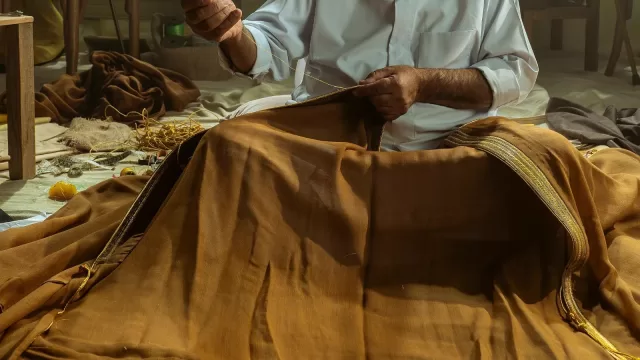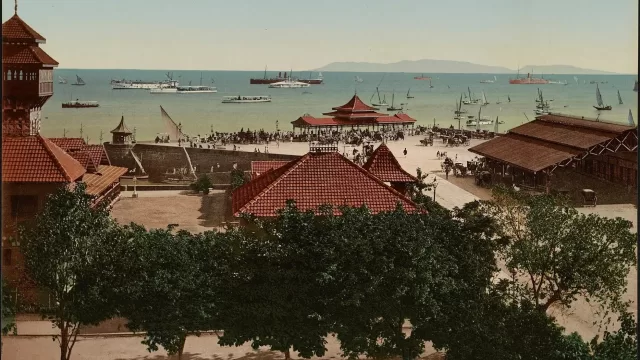
Some books call it Souq Ben Dueij and some call it Sikkat Ibn Dueij; it is the same place. Mohammad bin Dueij founded it in 1857 and endowed a free water sabeel inside it. The family’s houses and diwan stood there, and the shops sold imported cloth.
The shape of it
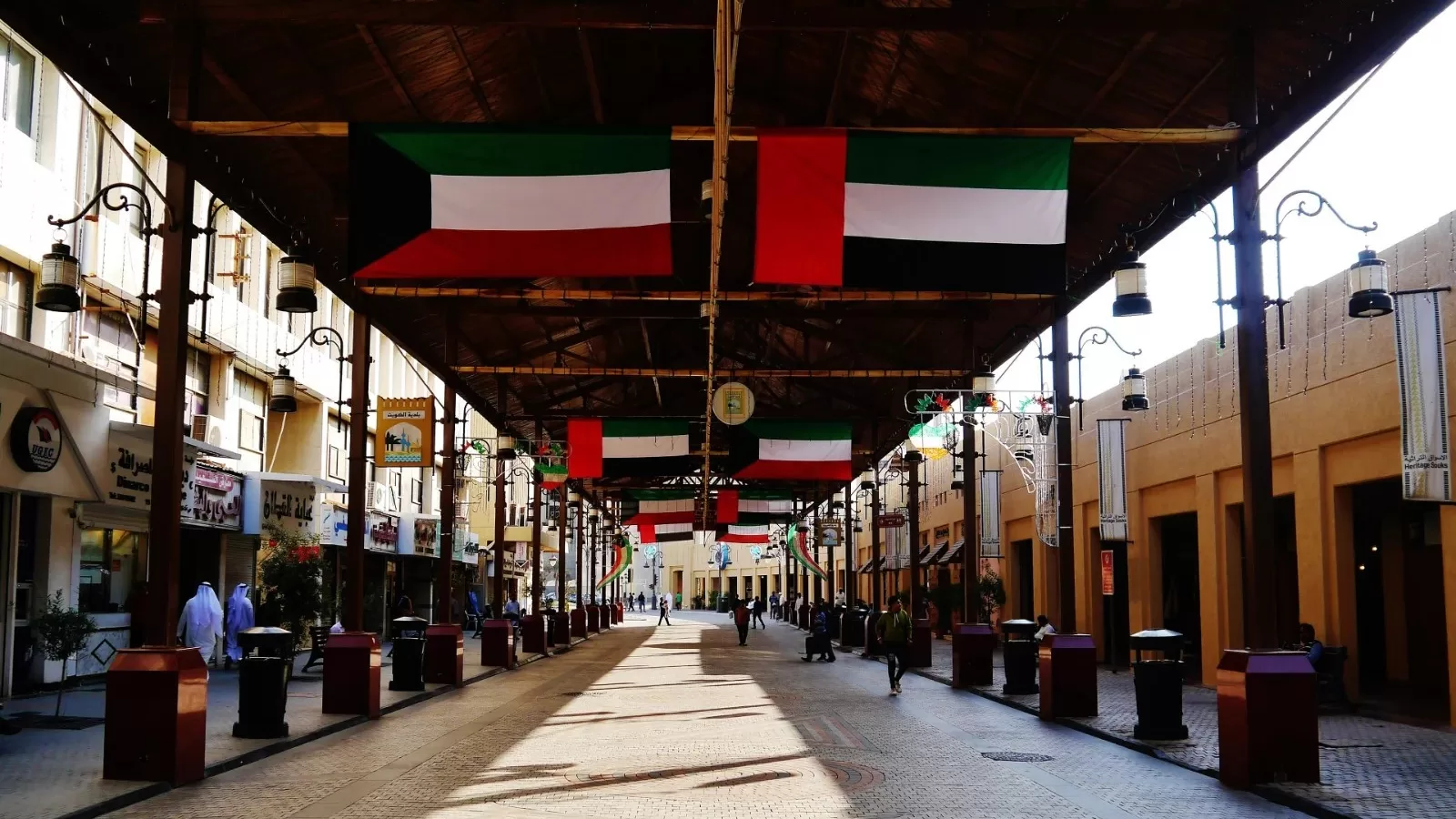
A narrow covered lane more than a kilometre long, roofed in wood and corrugated iron, with shops down both sides. The uncovered stretches filled with mud and water when it rained. It ran east from the Ibn Abdulrazzaq gate, once known as Al-Midfa, west to the Ibn Al-Dueij clearing, making it a crossing between two large quarters.
Who was in it
An inventory made by Mohammad Ali Al-Khars for the Centre for Folk Arts Care, published in Turathona magazine, issue five, 1997, shows the lane as it stood between 1940 and 1950: a seller of rihash sweets and baqsam biscuits, Fahad Al-Tannak the tinsmith, the Quran school of Mulla Zakariya Al-Ansari, greengrocers and salt sellers, tailors, barbers, and sellers of incense and sherbet.
Where a confectioner started
Mohammad Jaafar came from Iran in 1957 aged twelve, and told Al-Rai: the first thing I did was look for the sweet shops, so I went to Souq Dueij to ask and to watch. The lane was the address you went to if you wanted to learn the trade.
He names the men he knew: Abdulnoor, whose house made nothing but ghuraiba and paid every ten days; Abdullah Al-Halwani, with a shop on Istiqlal Street; and Rashed Jumaa Bu Fatin, whose shop moved into the souq and later became Al-Kawakeb Sweets.
An older root, on a family’s word
Ali Abdulhameed Khalaf Al-Halwaji told Al-Anba that his great-grandfather Mohammad and his son Khalaf were the first to make halwa in Kuwait, that Mohammad was known as Al-Halwaji from about 1800, and that the shop faced the Grand Mosque in the inner souq while the making was done at home. Among those who learned from them and then opened their own: the Ali Naqi family, Abbas Muqamis, and the sons of Mah Hussain.
This is a family speaking about its own ancestor, with no document behind it, and the date of 1800 is their claim. We report it as theirs and do not assert it.
How it was made
Old Kuwaiti halwa was sugar, cardamom, saffron, starch and fat. Rihash had no sugar in it at all: date dibs and sesame, the dibs boiled in the jidr over wood for eight hours until it turned pale, then sesame, rose water, cardamom and nigella added, and the whole portioned into trays, pots and dishes. The best dibs was Iraqi; the sesame came from India, Iran and Sudan.
Dandarma, the local ice cream, was sugar, water and milk, frozen with salt and ice packed around the vessel in wooden boxes, the milk bought fresh from Jahra and Fahaheel.
From the house to the factory
Before factories, halwa was cooked in houses over wood and kerosene with no electricity. Bu Fatin’s courtyard house had a living wing, a cooking wing and a fuel store. At its peak the operation turned out six to seven hundred kilos of rihash a day, supplied shops in Fahaheel, Farwaniya and Jahra, and went out by truck to Saudi Arabia and by container to Canada and America. The state later granted a thousand square metres in Shuwaikh for the factory, and Mohammad Jaafar became its manager in 1975. There were four branches before 1990, all lost in the invasion.
What is left
Al-Kawakeb Sweets still trades. Rashed Jumaa Bu Fatin founded it in the mid-1940s, first in the lane itself with production in Al-Rashaida and later Al-Hurriya, then moved in 1966 to a street address. Two sources disagree on which street: Osrati magazine says Salem Al-Mubarak, Al-Rai says Mubarak Al-Kabeer, Al-Mazraa building. We do not choose between them.
As for the lane, we do not know when it ended or whether it was demolished at all. What we do know is that an arch in Mubarakiya still carries the name. We are not writing that it went with the clearance of the old town, because that is not documented.
Photo: Souq Al-Mubarakiya in Kuwait City. By Zairon, CC BY 4.0 via Wikimedia Commons.
Sources: Turathona magazine, issue five, March 1997, on Mohammad Ali Al-Khars’s inventory; Al-Rai, 17 January 2011, on the old markets of Kuwait, and 26 October 2007, the Mohammad Jaafar interview prepared by Saud Al-Buaijan; Al-Anba, 29 May 2010, the Ali Al-Halwaji interview by Mansour Al-Hajri; and Osrati magazine on Al-Kawakeb.
Kuwait One, once a week.
The most useful stories we published this week, in your inbox.
No spam. Unsubscribe anytime.