An old Kuwaiti wedding was not one night but a chain of stages, each with its own name and its own moment. This is the order as Al-Jarida tells it in its feature on marriage customs, and as the book “Al-Kuwaitiyoun wa Adatuhum Al-Jameela” by Ghanem Al-Shaheen Al-Ghanem records it.
The dazza
After the engagement, the groom’s family carries the gifts and the mahr to the bride’s house, wrapped in a large decorated cloth called the bugsha. Inside it: fabrics, a qaz dress for the wedding, a jirjis, a masrah, a zarbaft or wanish cloak, and gold and silver coins in a pouch of white cloth.
The malja
The night of the contract, usually a Thursday evening, in the diwan of the groom’s family or in the mosque after the evening prayer. The bride is attended by the hafafa, a woman who manages and looks after her through the whole wedding period rather than for one night. The taggagat perform.
The sabahiya
The following morning. The groom stays a week at the house of the bride’s parents. Breakfast is boiled and fried eggs, milk, darabeel, quail eggs, batheeth and girs aqeeli.
The third, the tahwal and the zawara
Al-thalith is a small gathering three days on. Al-tahwal is the bride’s move to her husband’s house on the seventh day. Al-zawara is her visit back to her parents fourteen days after the marriage.
So the span from contract to a settled new household is about a fortnight, not an evening.
Borrowing was part of the system
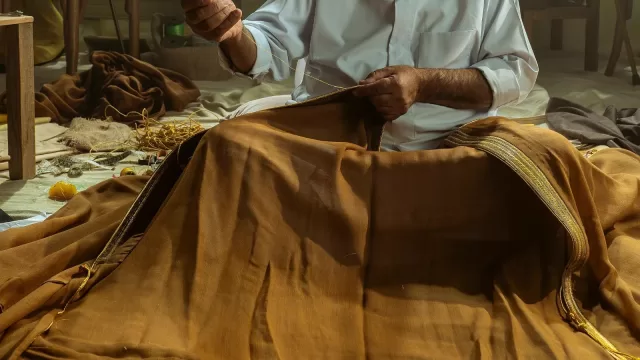
The men wore a bisht for the full week of the celebrations, and often it was borrowed. The women borrowed gold from better-off neighbours. That is not a quaint detail: it is how a small society carried the cost of a wedding no single household could carry alone.
And the henna
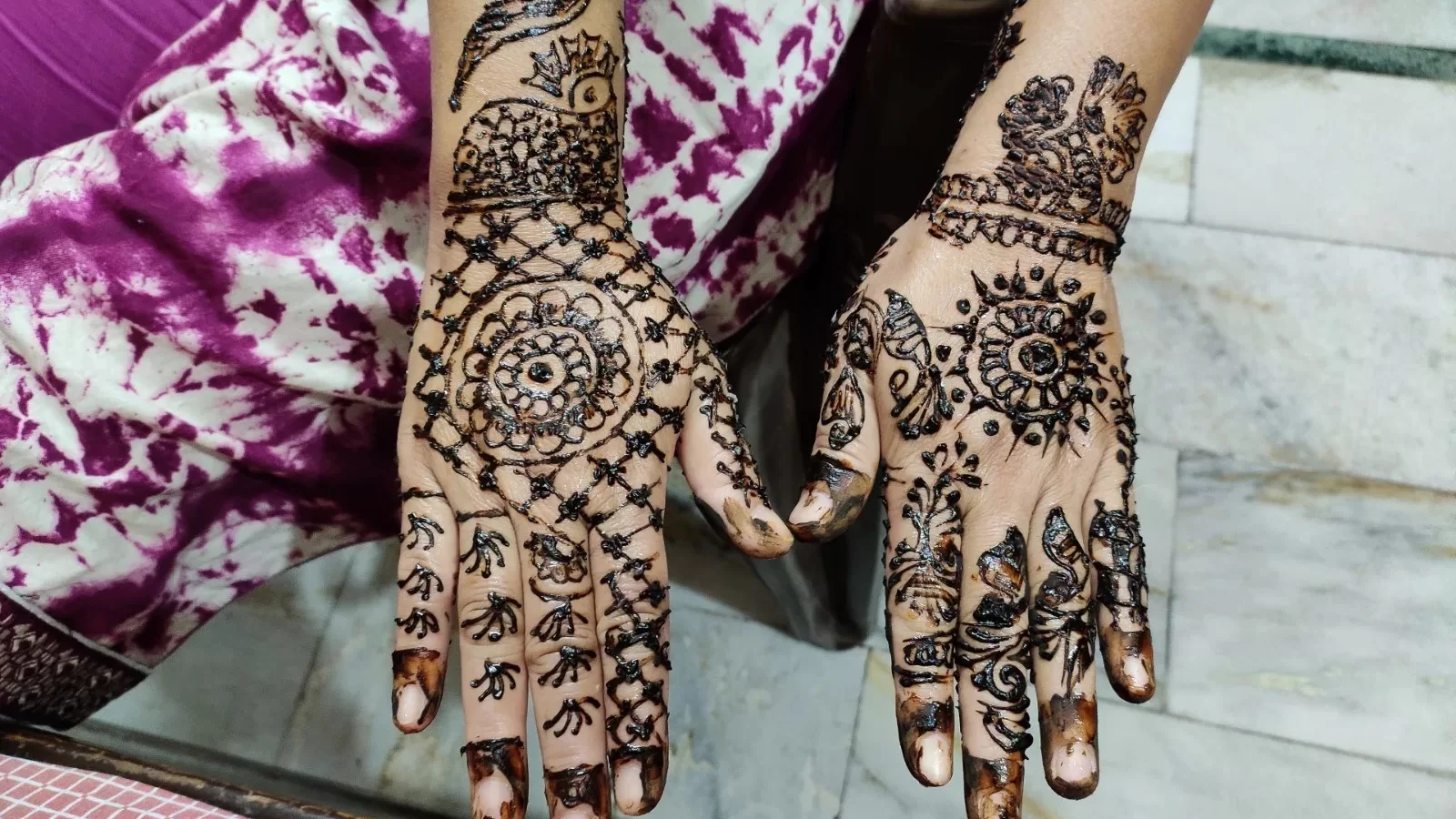
The henna that runs through these stages was inscribed by UNESCO in 2024 on the Representative List of the Intangible Cultural Heritage of Humanity as “Henna: rituals, aesthetic and social practices”, element 02116, on a file submitted by sixteen states including Kuwait.
Kuwait’s list at UNESCO also holds Al Sadu weaving in 2025, the bisht in 2025, the diwaniya in 2025, the date palm in 2022 and Arabic calligraphy in 2021.
A note on the source
The sequence of stages and the meanings of the words come from a single newspaper feature that names no researcher and no reference. We report it as theirs rather than assert it as documentation. The UNESCO file, by contrast, is a primary document.
Photo: henna on the hands. By Ishan Mittal, CC BY-SA 4.0 via Wikimedia Commons.
Sources: Al-Jarida, 22 December 2016, on the dazza, malja and zawara, and 29 July 2013 on the book “Al-Kuwaitiyoun wa Adatuhum Al-Jameela” by Ghanem Al-Shaheen Al-Ghanem, Dar Dhat Al-Salasil; and the UNESCO intangible cultural heritage lists.
Kuwait One, once a week.
The most useful stories we published this week, in your inbox.
No spam. Unsubscribe anytime.