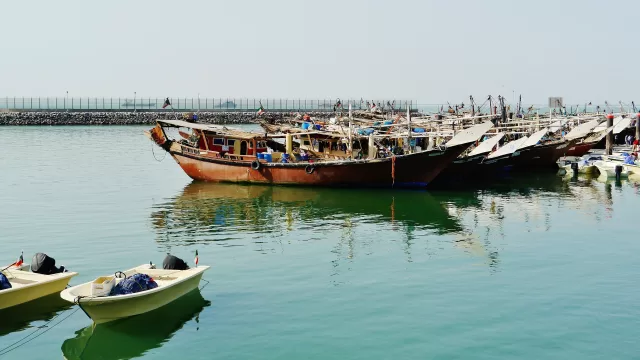
In Kuwaiti Arabic, seif means the shoreline. The palace is named for exactly that: it was built right on the water, closer to the sea than anything else in town.
The plot was not empty. It was a horse stable in front of Sheikh Mubarak Al-Sabah’s house on the shore, a few steps from the sea customs house where duty on every cargo was collected, and the ruler wanted to stay close to it. So the stable went, and the palace went up in its place.
An architect from Baghdad and a boatload of brick
According to the Crown Prince’s Diwan, Mubarak asked his friend Sheikh Khazal, who lived at Mohammerah on the eastern bank of the Shatt al-Arab, to find him an architect worthy of a ruler’s palace. Khazal sent a Baghdadi master builder, Ustad Mohammed Al-Kadhmawi. Mubarak also asked for a shipment of yellow fired brick, which arrived on a sailing ship.
The walls themselves were mud and coral stone — “sea stone” — built with Islamic arches and ornament and the details of the old Kuwaiti house. Mubarak’s own diwan sat at the centre.
The dates do not quite agree. The Diwan gives 1904, but its own account places the request for an architect in 1324 AH, which is 1906–1907. The Amiri Diwan’s book on the palace, as quoted by KUNA, says construction was ordered in 1906, and that in 1908 the new palace hosted the wedding of Mubarak’s son Hamad, with half the town gathered outside.
Every ruler added something
Three years after it was built, Mubarak added a west wing in the same style. In 1917 Sheikh Salim Al-Mubarak joined the ground and first floors with a staircase whose door carried a carved line: “Had it lasted for others, it would never have come to you.” In 1921 Sheikh Ahmad Al-Jaber added a round staircase in the west wing, rising from the main courtyard.
The oddest addition came in 1936. A steamer belonging to the British Government of India replaced the lamp on the west wing’s roof with a better one — green, about 45 feet above the water and visible from two miles out. From then on, sailors coming in after dark steered for the palace.
The clock tower
The second major rebuild began under Sheikh Abdullah Al-Salem in 1961 and finished at the end of 1962, when the building became known as the Amiri Diwan. The clock tower that now defines it came in 1964: blue ceramic walls, a crown plated in gold, small glass windows below, and a clock that strikes on bells.
Two fires
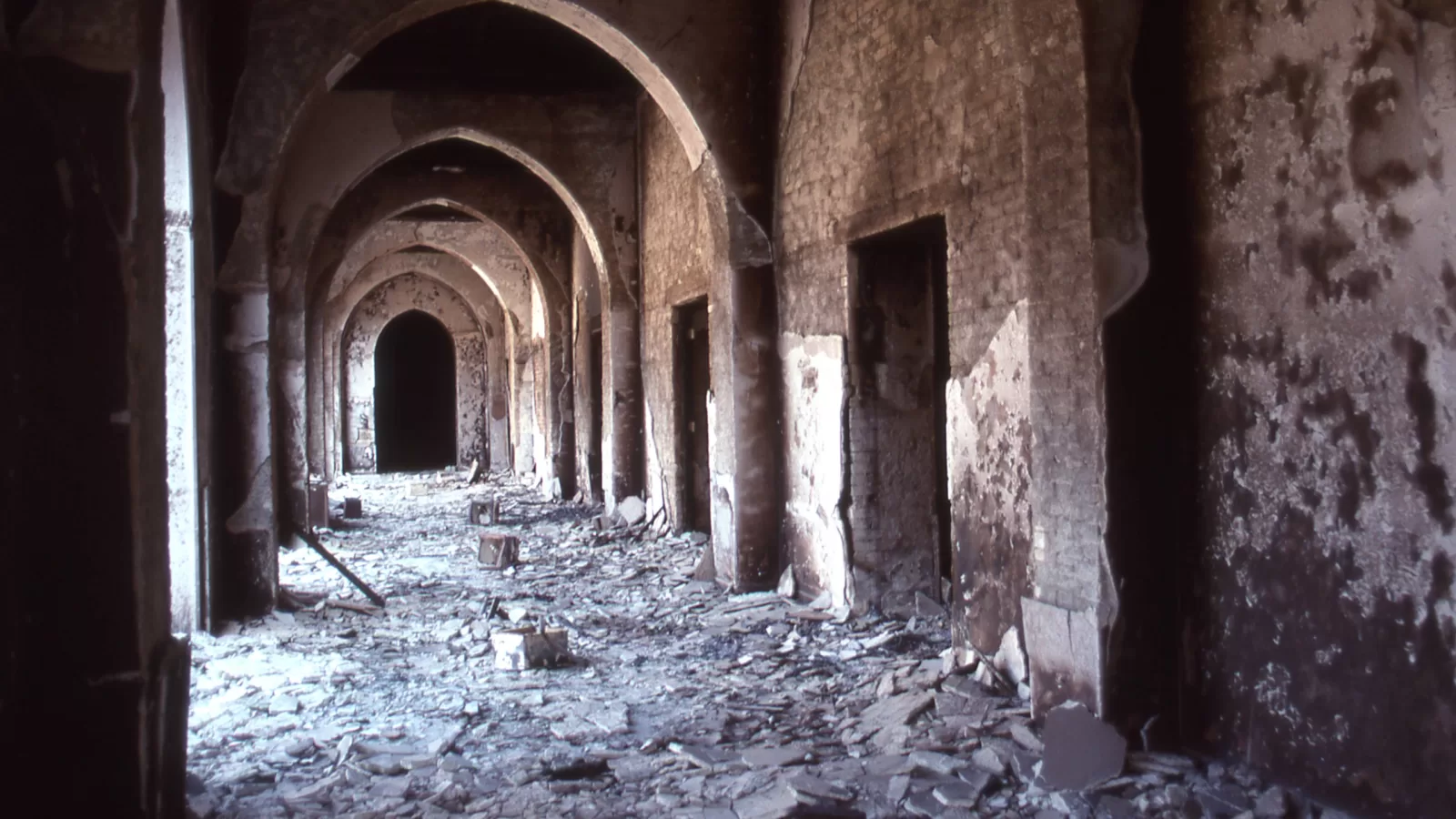
On 23 July 1983 an electrical fault started a fire in one of the old buildings. Seven years later the invasion brought looting, burning and demolition, and the clock tower building was among what was destroyed. The photograph above shows one of the arcades a month after liberation.
A project for new Diwan buildings had started in 1987 and stopped with the war. It resumed afterwards, the offices moved in the meantime to Bayan Palace — originally built for conferences and state guests — and Seif Palace was back in use in July 2000.
The palace in numbers
Rebuilding cost about KD 156 million including design, construction and furnishing. The natural ground covers 44,000 square metres, with another 166,000 reclaimed from the sea. There are ten buildings linked by two internal corridors, a moving walkway about 800 metres long, five gates on Arabian Gulf Street and an artificial lake on the sea side, plus 20,000 square metres of gardens holding 45,000 shrubs and 85,000 plants.
Seven rulers governed from it: Mubarak Al-Sabah, Jaber Al-Mubarak, Salim Al-Mubarak, Ahmad Al-Jaber, Abdullah Al-Salem, Sabah Al-Salem and Jaber Al-Ahmad.
Photo: an arcade inside Seif Palace, 25 March 1991. Photograph by Jonas Jordan for the US Army Corps of Engineers, public domain, via Wikimedia Commons.
Sources: Crown Prince’s Diwan, Seif Palace page; Kuwait News Agency, “Seif Palace, the seat of rule in Kuwait”, 21 February 2004 — KUNA.
Kuwait One, once a week.
The most useful stories we published this week, in your inbox.
No spam. Unsubscribe anytime.