The International Space Station circles the Earth sixteen times a day, and every so often it passes over Kuwait at a time you can see it with the naked eye — no telescope, no binoculars. It looks like a very bright star that moves: it does not blink the way an aircraft does, it does not change direction, and at about 28,000 km/h it crosses the sky in a few minutes.
The next passes over Kuwait City
This is what NASA’s sightings tool lists for Kuwait City at the time of writing. Times are Kuwait time.
- Saturday 26 September, 19:19 — visible 1 minute, maximum height 17°. Appears in the north-northwest, disappears in the north.
- Sunday 27 September, 18:32 — 3 minutes, 14°. North to northeast.
- Monday 28 September, 19:21 — 2 minutes, 39°. Appears and disappears in the northwest.
- Tuesday 29 September, 18:34 — 4 minutes, 43°. North-northwest to east.
- Wednesday 30 September, 19:24 — 3 minutes, 21°. West-northwest to southwest.
- Thursday 1 October, 18:36 — 6 minutes, 40°. West-northwest to south-southeast. The longest pass on the list.
NASA recalculates the station’s trajectory about three times a week, because even the thin air at its altitude slows it slightly, so times can drift by a minute or more. Check again on the day.
Reading the table
- Time is when the pass begins, in the local time of the city you picked.
- Visible is how long the station stays above the horizon.
- Max height is in degrees: the horizon is 0 and directly overhead is 90. A 43° pass climbs about halfway up the sky; a 14° pass hugs the horizon and needs a clear view with no buildings in the way.
- Appears / Disappears tell you where it comes up and where it leaves your view.
How to catch it
- Open NASA’s Spot the Station page, go to the sightings-by-city section and choose Kuwait, then Kuwait City — or install NASA’s official Spot the Station app.
- Pick a pass with a high maximum and a long duration.
- A few minutes before, go somewhere open and face the direction it appears from.
- Look for a steady, fast-moving point of light. It will cross towards the disappear direction.
Why always the evening (or dawn)? NASA explains that sightings happen within a few hours of sunset or sunrise, when your sky is dark but the station, high above, is still lit by the Sun. The app will send an alert before each pass if you switch notifications on.
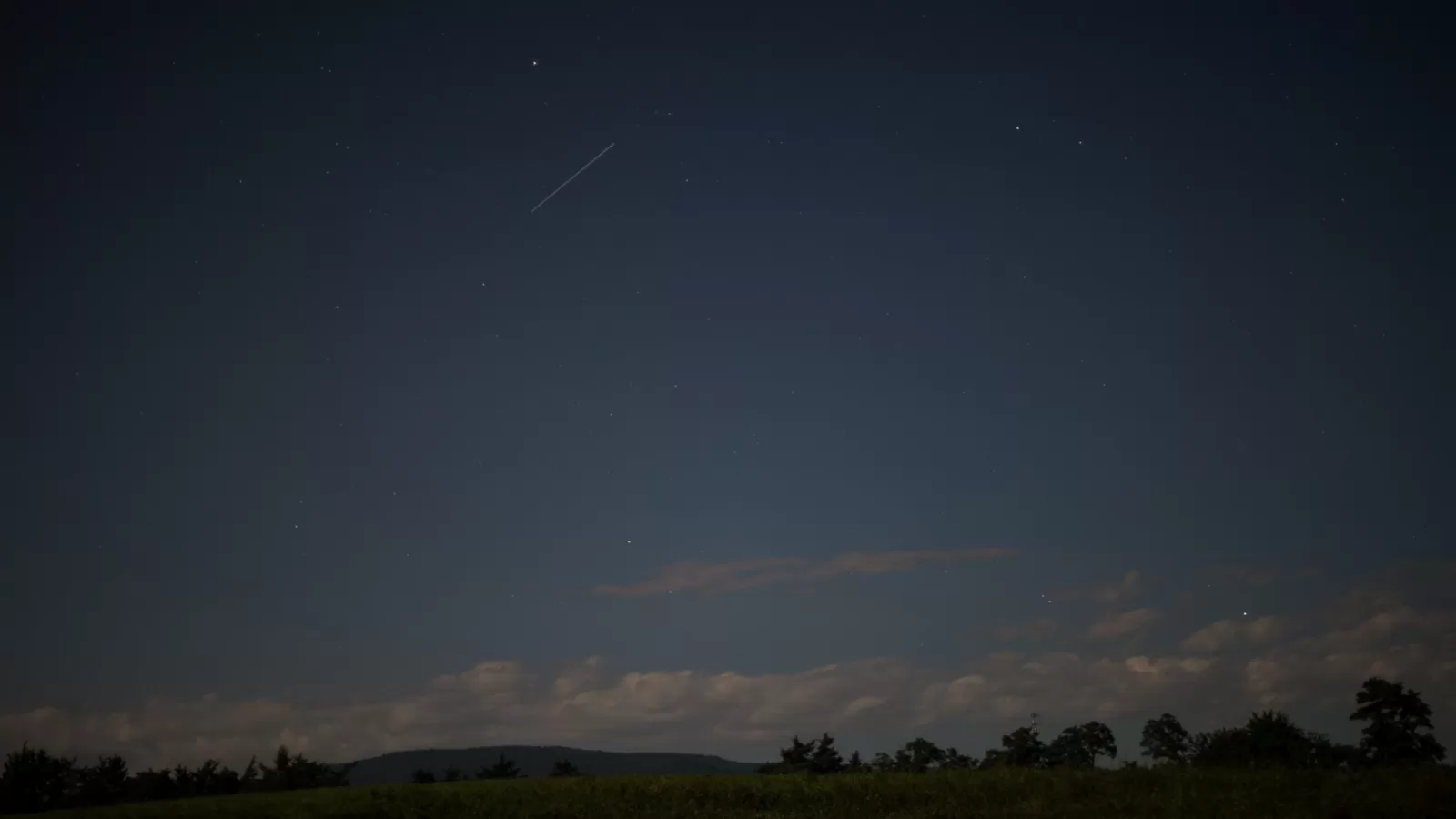
Photo: the International Space Station’s trail in a 30-second exposure, Virginia, 1 August 2015. Photograph by Joel Kowsky for NASA, public domain, via Wikimedia Commons.
Source: NASA, Spot the Station, and its sightings-by-city tool for Kuwait City as shown on 21 September 2026.
Kuwait One, once a week.
The most useful stories we published this week, in your inbox.
No spam. Unsubscribe anytime.