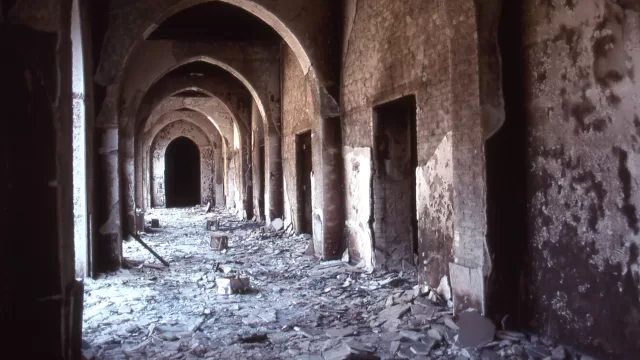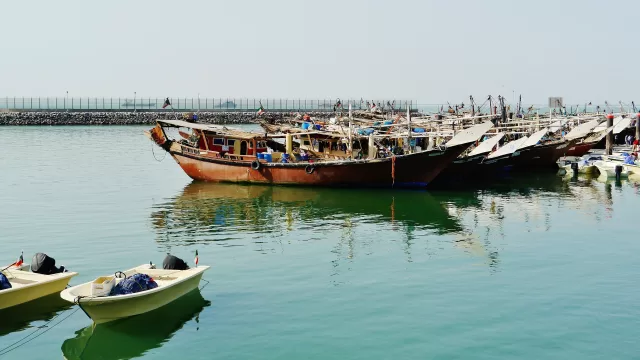
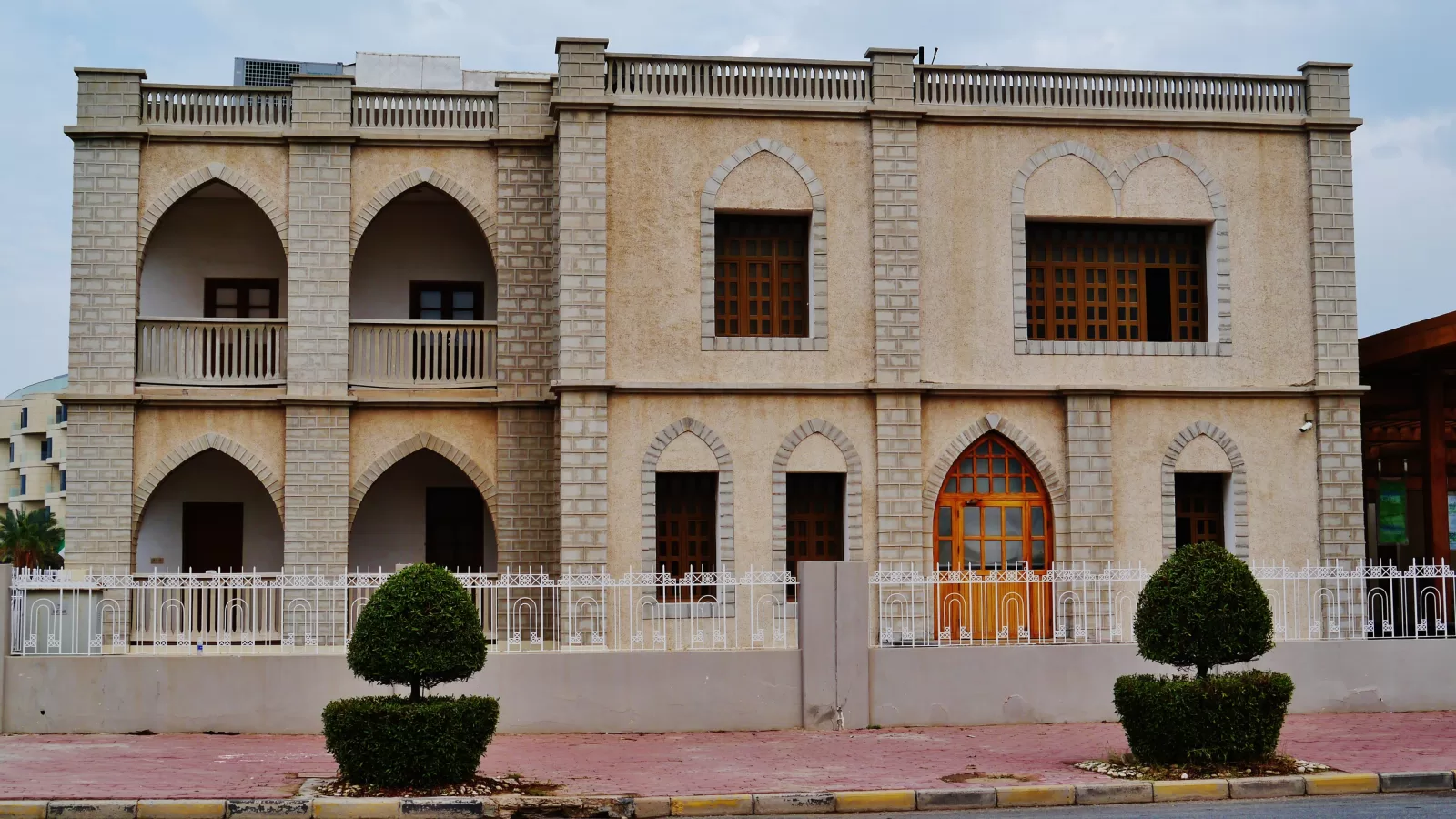
The buildings that house the Amricani Cultural Centre in Kuwait City were the country’s first modern hospital. It did not begin as a building at all — it began in an old rented house in the middle of town.
An invitation from Sheikh Mubarak
Early in 1910 Sheikh Mubarak Al-Sabah invited the Arabian Mission to open medical work in Kuwait. The mission sent Dr Arthur Bennett and the Reverend John Van Ess up from Basra; Mubarak’s eldest son Jabir received them, the party was lodged a week in the ruler’s castle, and a large derelict house was then assigned to them. Its floors were re-cemented, its walls whitewashed and windows were cut into it. The five-year lease was registered at the British Political Agency — at Mubarak’s own suggestion.
Writing in the mission’s quarterly, the Reverend Pennings recorded fifty and sixty patients a day, ninety-five on one day, and some 1,500 treated in the first two months. Kuwait was made an independent mission station the same year.
The material nobody had seen
Construction began in 1912 under the engineer Charles Shaw and finished in 1914. The mission’s 1913 report describes townspeople crowding to watch a soft substance mixed with sand and water turn hard as stone within hours — so many of them that they got in the way of the work, and some asked for a handful to take home. It is regarded as the first building in the region raised in steel and concrete, at a time when Kuwait built in mud brick and sea stone.
The first in-patient was admitted on 9 November 1914 and the first out-patient clinic held on 25 November. The hospital stood west of the town near the shore, at the edge of the built-up area. Dr Stanley Mylrea noted in his annual report that it sat barely twenty feet from the road, separated from it only by an open wire fence.
Who worked there
Dr Paul Harrison held the Kuwait post from 1912 to 1914, followed by Dr C. Stanley G. Mylrea, who signed the annual medical reports and ran the work for years. Women’s medicine began with Dr Eleanor Taylor Calverley, who arrived on 1 January 1912 as Kuwait’s first woman doctor and was known locally as Khatun Halima. She wrote of sitting day after day in an empty clinic waiting for a patient, and of women arriving to interrogate her credentials: who taught you to treat the sick — your father, or your husband?
For 1915 Mylrea logged 58 in-patients, 6,674 dispensary treatments and 165 surgical operations, and recorded that patients came from every class, from the ruler’s family to Bedouin passing through. In 1919 the ruler granted the mission a strip of land alongside its compound, and the first separate women’s hospital was begun that same year.
How it ended
The state took over health care by stages: a Department of Public Health in 1936, then the Amiri Hospital, opened on 18 October 1949 with 45 beds. In October 1955 a new men’s hospital opened, named the Mylrea Memorial. On 1 April 1967 the hospital passed to the Ministry of Health, the mission’s own letter noting that Kuwait now had many doctors and several hospitals treating everyone free.
Today the old men’s hospital, still called the Stanley Mylrea Building, holds galleries, a conservation laboratory and a theatre, while the former women’s hospital houses Dar al-Athar al-Islamiyyah.
Photograph: the Amricani compound in Kuwait City as it stands today. Photo by Zairon, licence CC BY 4.0 via Wikimedia Commons.
Source: Neglected Arabia, the quarterly of the Arabian Mission, issues 73, 74, 86, 87, 88, 90, 96, 102 and 108; Kuwait Ministry of Health, About Us; Dar al-Athar al-Islamiyyah, Amricani Cultural Centre; Al-Rai, 23 March 2026.
Kuwait One, once a week.
The most useful stories we published this week, in your inbox.
No spam. Unsubscribe anytime.