Electricity did not arrive in Kuwaiti homes as a public utility. It arrived as a product, sold by a private firm, generated by exactly two machines.
In 1934 the National Electricity Company opened a small station with two diesel generators of thirty kilowatts each, distributing direct current. Supply went on sale on 1 April that year. By the end of the first year the company had sixty subscribers.
Sixty households in the whole country. The number reached roughly four hundred within a few years and about seven hundred by 1940, when installed capacity stood at 340 kilowatts — less than a single modern apartment block draws today.
After the Second World War the company moved off direct current. The Mirqab station entered service in 1949 with two 200-kilowatt sets running alternating current at 380/220 volts and fifty hertz, which is still what comes out of the wall. Direct current was dropped entirely in 1950.
Ownership changed in 1951, when the government bought the company’s shares and formed the General Electricity Department. The first steam station followed at Shuwaikh in 1952, because demand had already outgrown what diesel could carry.
The two published accounts of the very first generator disagree. The Ministry of Electricity and Water dates it to an agreement signed on 13 October 1913 to light four hundred lamps in the ruler’s palace at a cost of seven thousand rupees. Al-Jarida records Mubarak Al-Sabah buying a small generator in 1908 to light his son’s wedding. Both agree on the shape of it: the first electric light in Kuwait was for an occasion, not for a market.
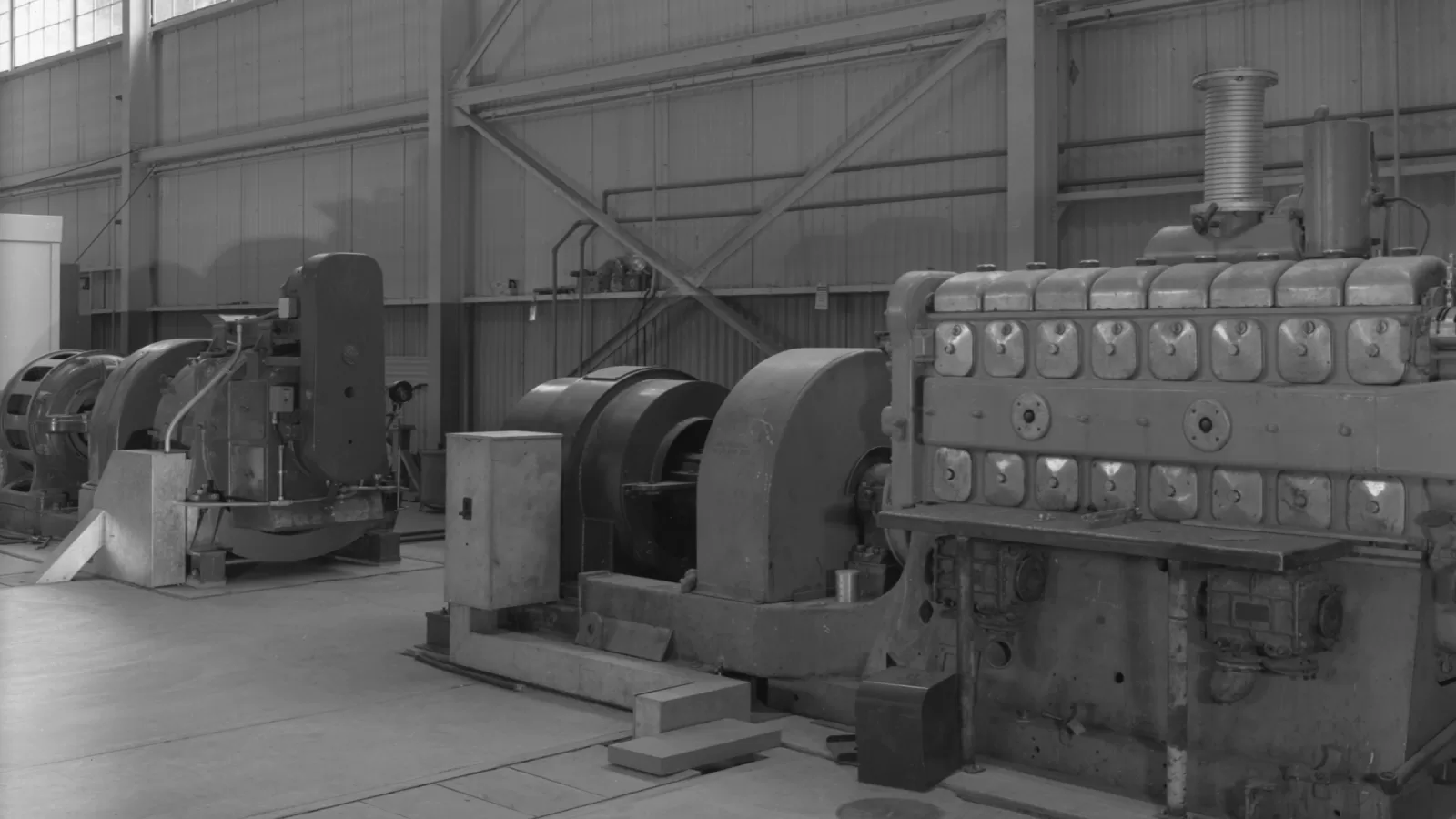
Photograph: a generating hall with a large diesel set in 1951 — machinery of the kind that ran stations in those years, not a Kuwaiti station. Lawrence Berkeley National Laboratory, public domain, via Wikimedia Commons.
Source: Ministry of Electricity, Water and Renewable Energy, historical overview page; and Al-Jarida.
Kuwait One, once a week.
The most useful stories we published this week, in your inbox.
No spam. Unsubscribe anytime.