Bahra 1 in the Subiya desert: a 7,000-year-old village that made its own pots and shell jewellery
A Kuwaiti-Polish mission digging since 2009 has found a bead workshop and a clay head carried from Mesopotamia
In the Subiya desert of northern Kuwait lies an archaeological site called Bahra 1. Under its sand are the remains of a village lived in around the middle of the sixth millennium BC, more than 7,000 years ago. It is one of the oldest and largest settlements known anywhere on the Arabian Peninsula.
A Kuwaiti-Polish team has been digging there since 2009, led by Kuwait’s National Council for Culture, Arts and Letters with the Polish Centre of Mediterranean Archaeology at the University of Warsaw, and with Kuwait University taking part.
A village between two worlds
Bahra 1 belongs to the age of the Ubaid culture, which grew up in Mesopotamia between roughly 6200 and 3800 BC. It is known for rectangular mudbrick houses, irrigated farming and painted pottery, and its reach ran from Anatolia to the Gulf. The Kuwaiti village was a meeting point between that culture and the Neolithic communities of Arabia.
Two kinds of pot
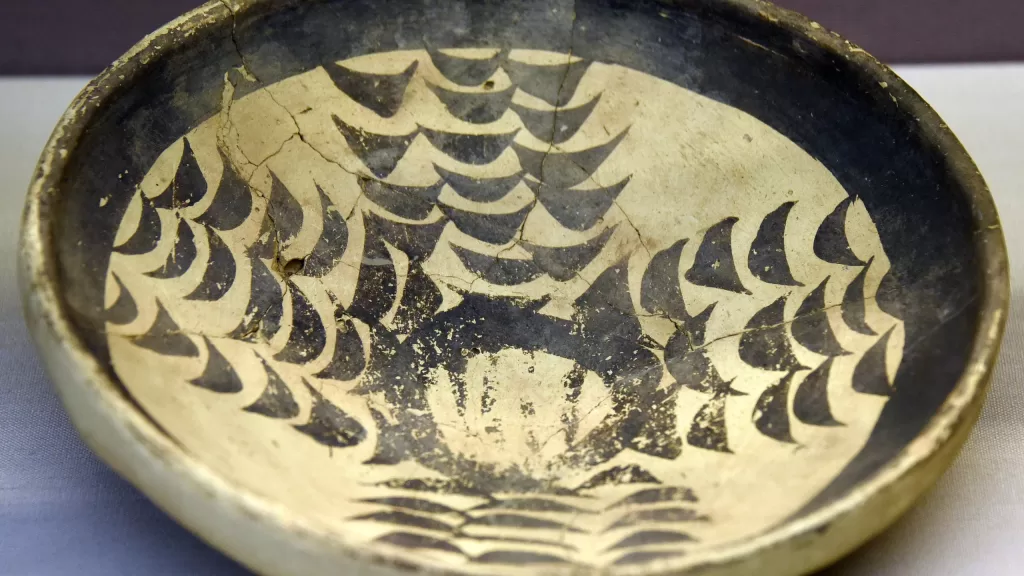
The excavators found two kinds of vessel. One is imported Ubaid ware, finely made and decorated in dark paint. The other is a thick-walled coarse red ware also found at other sites across Arabia. In 2024 the team found a clay vessel that had never been fired, proof that the red ware was made on the spot. On the team’s analysis, Bahra 1 is the oldest known place in the Gulf where that pottery was produced.
A shell jewellery workshop
The same season uncovered a courtyard or workshop in front of the houses where shells were worked into ornaments. It yielded many pieces of jewellery and pottery fragments more than 7,000 years old. The area lay outside the core of the village and was used for preparing food, processing shells and making beads.
A small clay head
The strangest find is the head of a small clay figurine: an unnaturally elongated skull, slanted eyes and a flat nose, the features of Ubaid figurines. Its body was never found. The team says it is the first of its kind in the Gulf, that it was not made locally but brought from Mesopotamia some 200 to 300 km away, and that its purpose is still unknown.
A painted bowl, a shell bead, a clay head: these are the oldest everyday objects anyone has left on Kuwaiti soil, thousands of years before pearl diving, long-distance sailing or the old souq.
Photo: an Ubaid-period pottery bowl found at Ur in Iraq, the same type of imported ware found at Bahra 1, not an object from the site itself. Photograph by Osama Shukir Muhammed Amin, CC BY-SA 4.0, via Wikimedia Commons.
Source: “Ubaid culture figurine: a unique 7,000-year-old discovery from Kuwait by Polish archeologists”, Research in Poland (Polish National Agency for Academic Exchange), 10 February 2025; and “Archaeological mission unearths 7,700-year-old shell crafting site in Kuwait”, Archaeology News, 23 November 2024, drawing on the University of Warsaw’s Polish Centre of Mediterranean Archaeology. Both read on 1 November 2026.
Kuwait One, once a week.
The most useful stories we published this week, in your inbox.
No spam. Unsubscribe anytime.