
On Arabian Gulf Street in Qibla stands a house built in 1936, and inside it today is a small museum, open from eight in the morning until one, then from four until eight in the evening.
It is one of the few places you can visit in an hour and leave having understood something you did not know.
The house before it was a museum
Yousef Al Marzouq built it in 1936 facing the sea, with four open courtyards and clear Indian influence: wooden doors brought from Karachi, and iron windows. Rashid Al Bannai, among the best-known builders in Kuwait, supervised the work.
And it holds one detail worth recording: it was the first house in Kuwait to use stone together with reinforced concrete.
In 1938, only two years later, Shireen Behbehani bought it, added a new floor, and put European-style fireplaces in the diwaniya rooms. A European fireplace in a Kuwaiti diwaniya in 1938 is an image that sums up that whole period.
In the 1970s the state acquired it through the Ministry of Information, and it later passed to the National Council for Culture, Arts and Letters. In 1980 it became Sadu House. It was restored in 2006.
What you see inside
The displays are arranged around a story called from the desert to the city: the tent, men’s bishts, decorative pieces, and an explanation of the weaving process itself and its standing among the Bedouin.
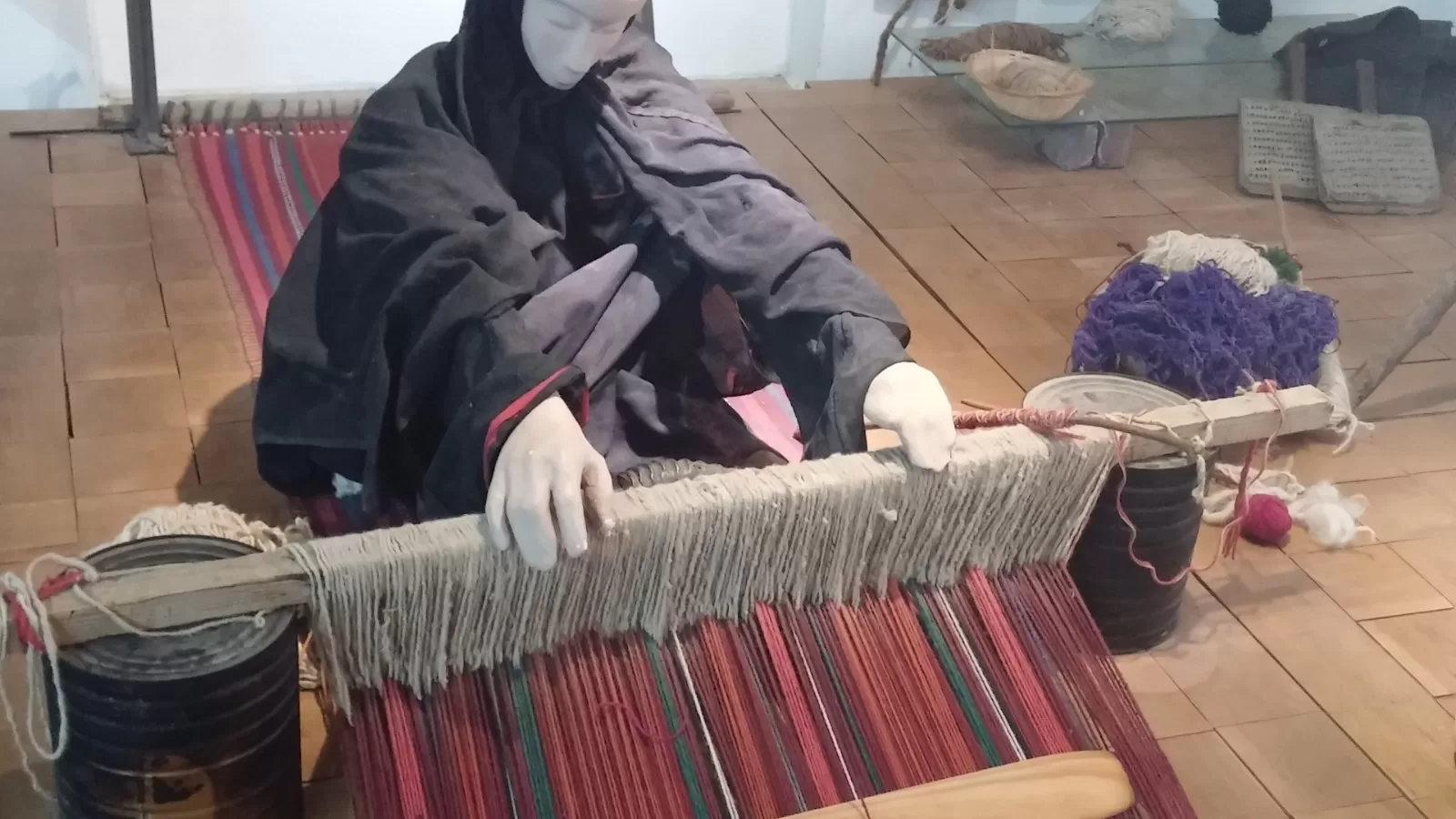
Weaving here is not decoration. It was the craft that produced the dwelling: the tent, the internal partitions, the bags and the camel saddles. The woman who wove was building the house.
There is also a shop selling weaving tools, stationery, bags, clothing and gifts.
And UNESCO
In 2025 the UNESCO intangible heritage committee inscribed traditional Al Sadu weaving on the representative list of the intangible cultural heritage of humanity, in a file shared between Kuwait and other countries in the region.
Practical information
- Where: Arabian Gulf Street, Qibla.
- Hours: 8am to 1pm, and 4pm to 8pm.
- In Ramadan: 10am to 1pm, and 9pm to midnight.
- Eid: closed the first two days, then normal hours.
- Telephone: 22432395.
Because the day splits into two shifts, an evening visit after four is the better one in summer, with a walk along the waterfront after sunset.
Photo: by Danny-w via Wikimedia Commons, licence CC BY-SA 3.0. An illustrative image of weaving; it does not show Sadu House.
Sources: Al Sadu Society — history of the house · Al Sadu Society — museum and opening times · UNESCO committee decision 20.COM.
Kuwait One, once a week.
The most useful stories we published this week, in your inbox.
No spam. Unsubscribe anytime.