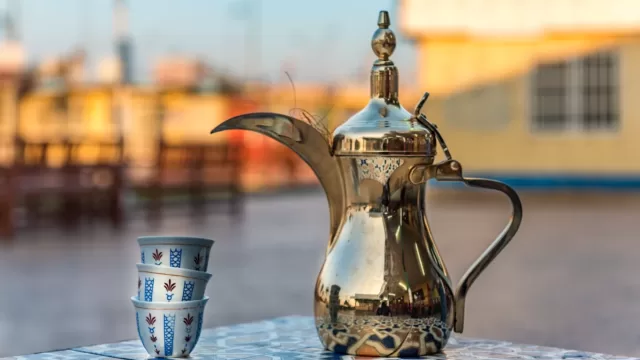

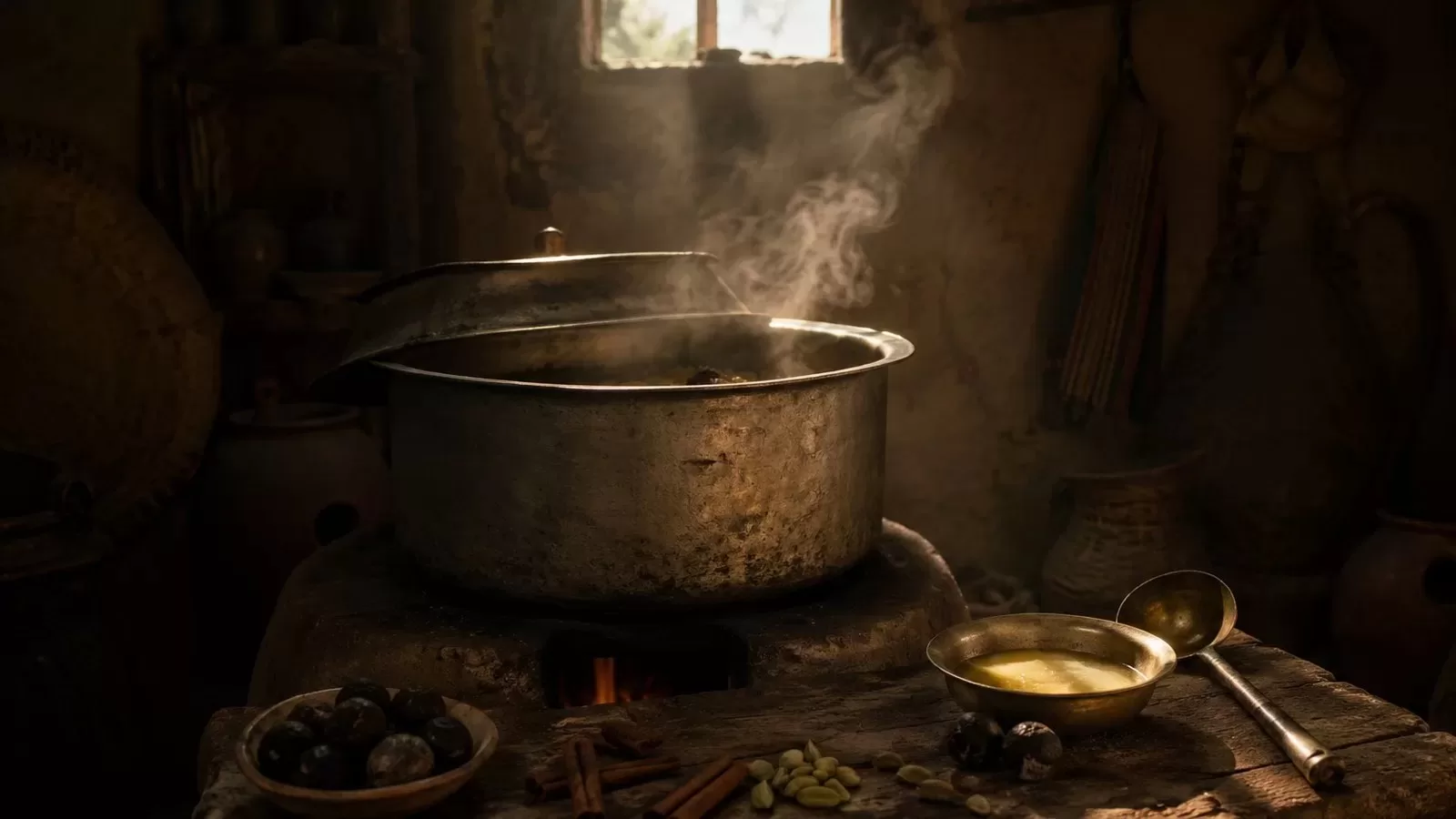
In the old kitchen, before the door opened and before anyone called for lunch, the smell arrived first. Cardamom boiling with meat, onion softening in ghee, and the faint sound of rice breathing under a heavy lid. Nobody asked what had been cooked. The whole house knew from the smell, from the hour, and from the weight of the pot being lifted off the fire.
The Kuwaiti kitchen was not a set of recipes so much as a whole household’s way of ordering its day: who lit the fire, who stirred, and who sat around the tray when it came down to the floor.
The story in short
A coast and trade cuisine before it was a desert one. The sources describe it as formed from an Arab, Persian and Indian mixture that arrived with ships, spices and rice. Its pillars are few: rice, wheat, meat and fish, ghee, and a spice blend of which every house has its own version. Its dishes are distributed by season rather than by day: a dish for Friday, a dish for Ramadan, and a sweet that comes out after dinner. And most of it is still cooked at home, with tools that have changed and a fire that is no longer wood.
The pot before the recipe
There were no written measurements. There was a hand that knew, a nose that judged, and one large pot that fed the house and whoever passed by. The old kitchen was built on simplicity rather than abundance: a countable set of ingredients, a wood fire that took time, and one cooked dish a day divided among everyone.
Those conditions are what shaped the form. A dish cooked for twenty people cannot be complicated, and cannot depend on precise timing. Which is why the most famous things in this cuisine are cooked in a single pot: the meat first, then the broth, then whatever absorbs the broth. One method, many names.
What the sea brought
Kuwait is a coastal city, and its ports received what its land did not grow. Rice was not grown here and spices did not grow here, and yet both became the pillars of the table. The sources describe the Kuwaiti kitchen as formed from an Arab, Persian and Indian blend, which travelled with voyaging and trade more than with conquest or migration.
Accounts differ on when each element settled into place, and when basmati became the first choice over anything else. What is not disputed is that the blend itself — cardamom, cinnamon, turmeric and black lime — carries the names of ports rather than the names of villages.
And because the sea was the nearest neighbour, it was also the nearest table. Zubaidi, hammour, safi and meed are names households knew the way they knew the names of the neighbourhoods, and mutabbaq samak — rice cooked in fish broth and turned over it — is considered by many as much the national dish as machboos is. The disagreement over which comes first is an old one and unsettled.
The rice that became the headline
If this cuisine has one face, it is machboos. Rice pressed over meat or chicken in the same pot, so it drinks the broth rather than boiling in water. That small step is the whole difference: the flavour is not added at the end, it is built from underneath.
Every house has its blend, and every blend has a secret said to lie in the frying: onion, tomato, garlic and black lime fried before anything else. The proportions differ from house to house, and the name of the dish itself differs from coast to coast around the Gulf, but the method is one. And it is the dish served when there is a reason: a guest, a Friday, or somebody home from a voyage.
The dough and the broth
And when it is not rice, it is dough. Margoog is thin sheets pulled out by hand and boiled in the broth until they drink it, and it is the dish on the table closest to the desert. Tashreeba is built on bread crumbled under the meat and broth, and appears in winter more than at any other time.
All three come from one idea: something that soaks up broth. The material changed — rice, dough, bread — and the logic stayed. That is why these dishes taste like one another despite looking different on the table.
What also joins them is that none of them needs daily shopping. Wheat, rice and flour store; meat is bought for the occasion; ghee keeps in the house for months. A cuisine built on what tolerates waiting, in a city whose people were waiting for ships to return.
The pot of the season
Not every dish is an everyday dish. Harees is one of those cooked only for a reason: Ramadan, an Eid, or a wedding. Wheat and meat beaten together for long hours until they become a single consistency, then dusted with sugar and cinnamon or poured over with ghee.
And the length of time is part of its meaning. A dish that needs a whole night is not cooked for one person, and is not cooked in a hurry. So in memory it attached itself to the gathering more than to the taste: a big pot, a full house, and bowls distributed to the neighbours before anyone sat down.
What is served after dinner
And the table does not end at the meat. Gers ogaily is a sweet that comes out with the tea and coffee once the plates are cleared, and is served at weddings, in majlises, and at Quran completions. Its taste is simple — flour, eggs, cardamom and saffron — but its place in the evening is what gives it value.
Accounts differ on the origin of the name and its link to the Ogaili caravans that moved between Najd, Iraq and the Levant. What is settled is that this sweet went on being made at home even after it became available ready-made, because the homemade one carries a taste nothing matches.
Who cooks today
The kitchen changed around it and it did not change much. There is a pressure cooker instead of a slow fire, popular restaurants serving harees and tashreeba all year, and apps delivering the dish to the door. And still, most of what is eaten from this list is cooked at home.
The new generation has not left the table; it has taken hold of it from another end. Young women remake Kuwaiti mezze with modern tools and inherited recipes, photograph what they cook, and trade adjustments the way grandmothers traded them at the door. The medium changed; the recipe still passes hand to hand.
Even the restaurants that put these dishes on their menus did not change the method much. They changed the size and the time only: a plate instead of a tray, a quarter of an hour instead of half a day. The taste people measure against is still the taste of home.
Why it survived
Because this cuisine was not built on scarcity or on high skill, but on repetition. A dish repeated every week preserves itself with no books and no schools. And because every dish in it is tied to an occasion, forgetting it would mean forgetting the occasion with it — and that has not happened.
Go back to the old kitchen one last time. The heavy lid is still lifting, the steam is still rising, and the smell still arrives before anyone calls. The house changed, the fire changed, and what remained is the moment when everyone knows lunch is ready without anyone saying a word.
Further reading: the Popular Heritage Exhibition, National Council for Culture, Arts and Letters · the Center for Research and Studies on Kuwait
Kuwait One, once a week.
The most useful stories we published this week, in your inbox.
No spam. Unsubscribe anytime.