
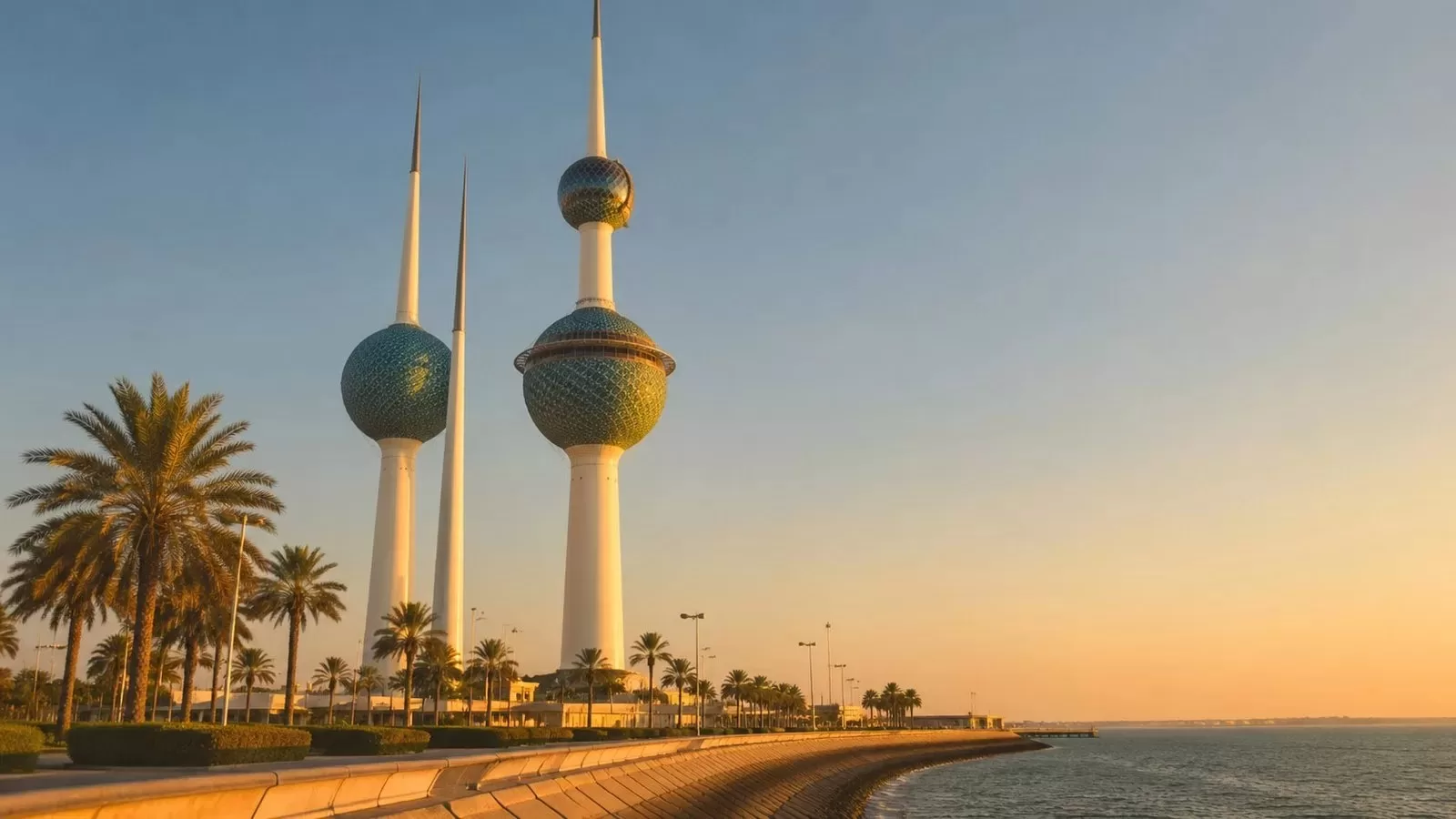
In any photograph taken of Kuwait City from the sea, there are three columns that never go missing. Two topped with blue and green spheres, and a third slender one with no sphere at all. Everyone who has driven along Gulf Road knows them; they go on stamps, on currency and on book covers, and tourists stand underneath them to take pictures.
And few remember that their first purpose was not the view. The Kuwait Towers are water tanks before they are a landmark.
Three towers, three jobs
The main tower stands 187 metres tall, the middle one 147, and the smallest 113. The main and middle towers each hold about a million gallons of water. The third, the slender one with no sphere, is not a tank at all: its job is lighting, carrying the floodlights that illuminate the other two.
In the upper sphere of the main tower there is a cafe and a restaurant on a revolving platform, which completes a full turn every half hour.
Why a water tank is designed like this
Here the context shows. In a country with no river and no lake, getting water was the hardest question, before electricity or housing. With the boom that followed the discovery of oil, the city had to build a network of enormous reservoirs, and the decision was that one of them would be something to look at rather than something to hide.
The towers were designed by the Lindstrom engineering office in Sweden and built by the Yugoslav company Energoprojekt, and were officially opened on 1 March 1979.
What happened in the 1990s
During the 1990 invasion the towers suffered severe damage, put by the sources at around seventy per cent. They reopened on 26 December 1992.
And that date carries a meaning beyond restoration: bringing the towers back into service in under two years was a message before it was an engineering project.
The face that stayed
Today the towers work in both functions at once: a reservoir below, a restaurant and viewing platform above. The visitor who goes up to see the city from above is standing, literally, on a million gallons of fresh water.
And that is the whole meaning. A city that used to send its ships to the Shatt al-Arab to fetch water put its reservoir on the waterfront and made it its face. Not to hide its need, but to declare it.
Go back to the photograph from the sea. The three columns are still standing, the sphere is still turning its half-hourly circuit, and the water is still below where it always was.
Further reading: the National Council for Culture, Arts and Letters · the Center for Research and Studies on Kuwait
Kuwait One, once a week.
The most useful stories we published this week, in your inbox.
No spam. Unsubscribe anytime.