
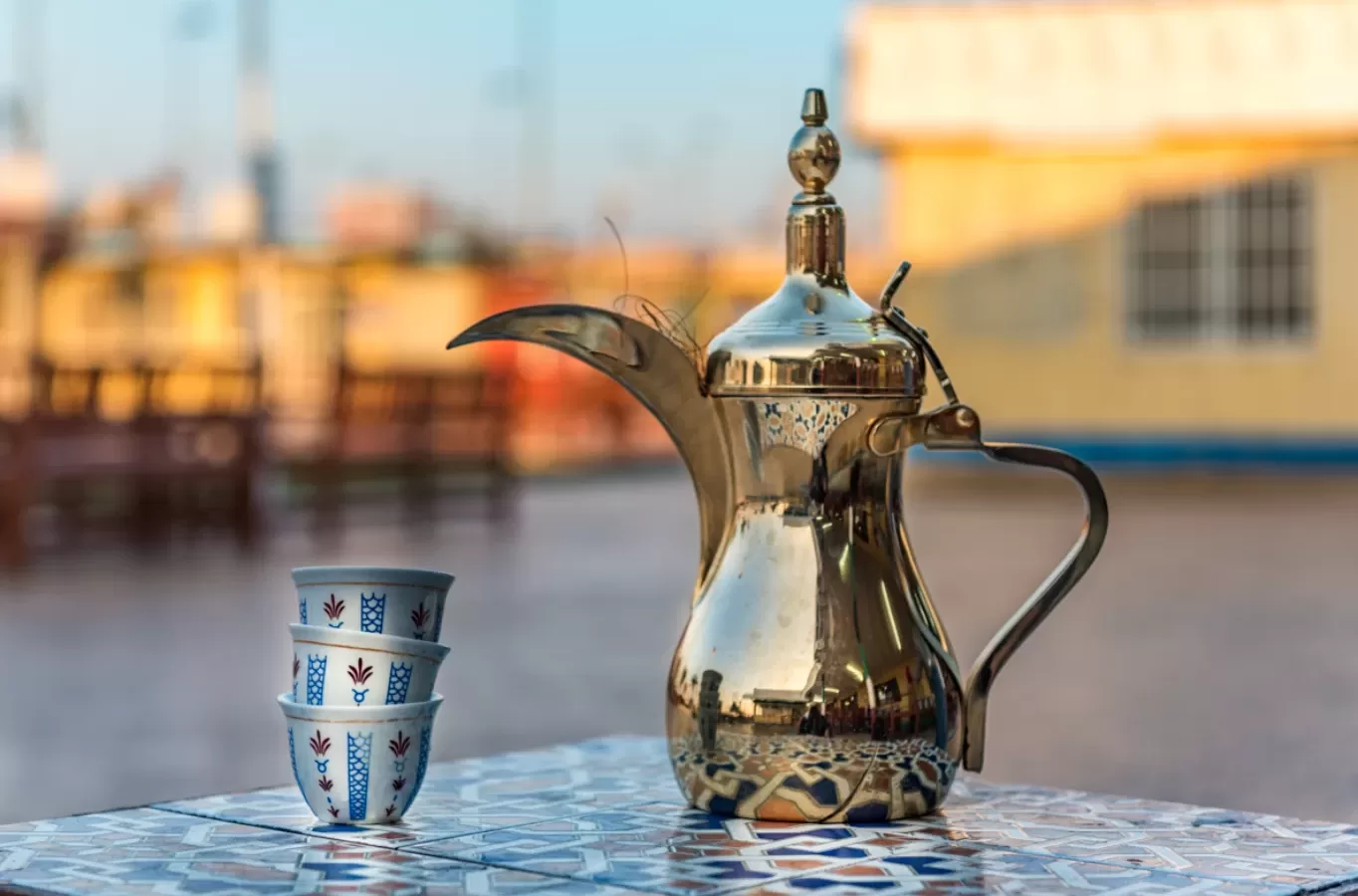
“The gahwa”, as Kuwaitis called the coffeehouse, was not only a place to drink. Merchants, sea captains and townspeople went to it, deals were struck in it, and visiting Gulf traders were received there. And nearly every trade had its own coffeehouse, known by it.
What a coffeehouse looked like
The Kuwaiti heritage researcher Mohammed Jamal says most of them were small shops or an arisha, a palm-frond shelter, open from seven in the morning to ten at night.
Each had a small kitchen with a burner for tea and coffee, wooden benches seating three or four, and extra chairs put outside. The owner usually served his customers himself, hiring “boys” when it got busy.
What was drunk in them
At first Arabic coffee only. Then tea arrived at the start of the twentieth century, and with it “sharbat” and the “gadu”, the shisha.
Then came namlet botila, a fizzy drink brought from Basra, until Mohammed Bushehri began manufacturing it in Kuwait in the 1920s.
Cooling it was a business of its own: it went into a copper basin or a wooden barrel filled with well water, and the bottles were covered with wet sacking to bring them colder. And at the end of the 1930s ice arrived, once the Alghanim ice machine began producing it.
The bashtakhta, then the radio
Coffeehouses competed by installing a bashtakhta, the phonograph, to hear songs. Then the radio came in for songs and news.
Some regulars passed the time with dominoes, draughts and “kout”, and some coffeehouses supplied them with playing cards and draughts pieces.
Where they were
They spread through the Furdha, the old Kuwait port, the merchants’ souk, the inner souk, Baraht Al-Sarareef, Souk Al-Haras and the Safat. And each had its own regulars: the sea captains, the pearl merchants, the sailors, the traders, the shareetiya wholesalers, or the donkey-drivers.
Bu Nashi: the ruler’s daily majlis
Gahwat Bu Nashi was the most famous and the oldest, west of the entrance to the merchants’ souk, opposite the great souk mosque. Sheikhs, merchants and the country’s leading men frequented it, and at their head the ruler, who came daily with his retinue to drink coffee, receive citizens, hear their complaints and settle the disputes between them.
The book From Here Kuwait Began by Khaled Al-Hatem records that it was founded by a man from Al-Ahsa called “Abu Nashi”, in the reign of Sheikh Abdullah bin Sabah, Kuwait’s second ruler, and that the majlis continued until the reign of Sheikh Ahmad Al-Jaber, the tenth ruler.
And in it took place the negotiations between Sheikh Salem Al-Mubarak and Ibn Rashid’s delegation after the Battle of Jahra in 1920.
Bu Abbas: a camel brought the water every morning
Gahwat Bu Abbas, named for its owner Ridha Ashkanani, stood on the seafront at Furdhat Al-Jolan: a very large shelter of bawari, woven reed matting, taking in captains, sailors, labourers and porters.
And it opened immediately after the dawn prayer. Its owner bought milk from a nearby house that kept cows, and brought water by camel from the wells of Shamiya every morning, serving breakfast to the regulars: bread, milk and tea, eaten by workers and sailors before heading to the port.
He is also recorded as having been charged by Sheikh Salem Al-Mubarak, ruler of Kuwait between 1917 and 1921, with collecting the ushur from the owners of the “ablam” boats arriving from Iran and Iraq. The ushur was a ten per cent duty levied on certain incoming goods since the reign of Mubarak Al-Sabah.
The rest, each with its customer
Gahwat Al-Tawawish in Souk Al-Badr: a yard under a palm-frond roof, the meeting place of the pearl merchants since the souk was built in Mubarak’s reign.
Gahwat Al-Dihn at the entrance to the oil souk opposite the Sangar gate in the second wall: the base of the “shareetiya”, who bought goods at source to sell on to shopkeepers.
Gahwat Abdulrahman, the captains’ coffeehouse, west of the inner souk entrance: Arabic coffee only, no tea and nothing else.
Ma Ridha in Qibla on the sea: for captains, sailors and the owners of the “tashashil” who carried stone from Ushairij for building house walls.
Nuwaider in the old Souk Al-Haras, Juwaider at the entrance to the tinsmiths’ souk, and Karam near Souk Al-Manakh with the finest teas.
Shaaban in Sarareef square: among the first to bring in a radio. And Abdulghaffar in Souk Al-Haras: it had a small namlet plant that supplied other coffeehouses.
The Brazilian Coffeehouse in the inner souk: it became known in the 1940s for serving Brazilian coffee when it began reaching the country, and drew merchants and the wealthy.
Gahwat bin Zanan in the inner souk: it was called “the young men’s headquarters”, because in the 1930s and 1940s it became something like a forum for merchants and young men during the Second World War.
Source: a Kuwait News Agency report on popular coffeehouses, citing the researcher Mohammed Jamal and the book by Khaled Al-Hatem.
Kuwait One, once a week.
The most useful stories we published this week, in your inbox.
No spam. Unsubscribe anytime.