
Before electric extractors, the wood smoke in a Kuwaiti kitchen left through a column built above the roof called the seesar. And it was not in every house.
What it is
The Kuwaiti heritage researcher Saleh Al-Mathan says the seesar was built by the “bannay”, the mason: uprights built in the kitchen rising to the ceiling, no more than a metre tall, around sixty centimetres.
It consists of four mandas, that is four columns, built of sea rock, ending in four openings through which the hot air leaves.
Its job is to make a defined path by which the hot air and the “sanoon”, the smoke, leave the kitchen for the open air.
The tarboosh on top of it
The mouth of the seesar is covered by a piece called the tarboosh: a small cover of tin, or of “basjeel”, wood. Its shape is either pyramidal or flat, and it is held down by a large stone placed on it.
And the purpose of that cover is not decorative: to stop rainwater coming down into the kitchen.
And those who could not build one
The seesar was not a requirement in every kitchen. Whether there was one depended on the householder’s means.
Its substitute in other houses was a small opening in the kitchen wall, or a square window called in Kuwaiti dialect the kutaiba.
And above the kitchen door was another opening with iron bars fixed inside it and a mesh panel over it, through which air came in and the smoke of the wood fire went out.
And do not confuse it with the badgir
Al-Mathan says people confuse the two, and they are entirely different.
The seesar takes hot air out. The badgir brings cool air in.
The badgir is a tower projecting from the roof of the house which the air strikes and is carried down into the rooms, tempering their heat in summer; Al-Mathan describes it as the equivalent of central air conditioning today.
Its name, as a number of researchers say, is an arabisation of the Persian badgir: “bad” and “gir”, meaning wind-catcher.
Its method is that baffles at the top of the roof have openings admitting the air, which passes downward and leaves through the rawshana at the edges of the room ceilings. There is a type of it in the “roof beard”, for anyone who wanted to sleep on the roof and have the cool air reach them.
Who drew them
The late Kuwaiti artist Ayoub Hussein painted the forms of the seesar and its positions in his works, and painted the badgir as well. These are architectural details many people overlook.
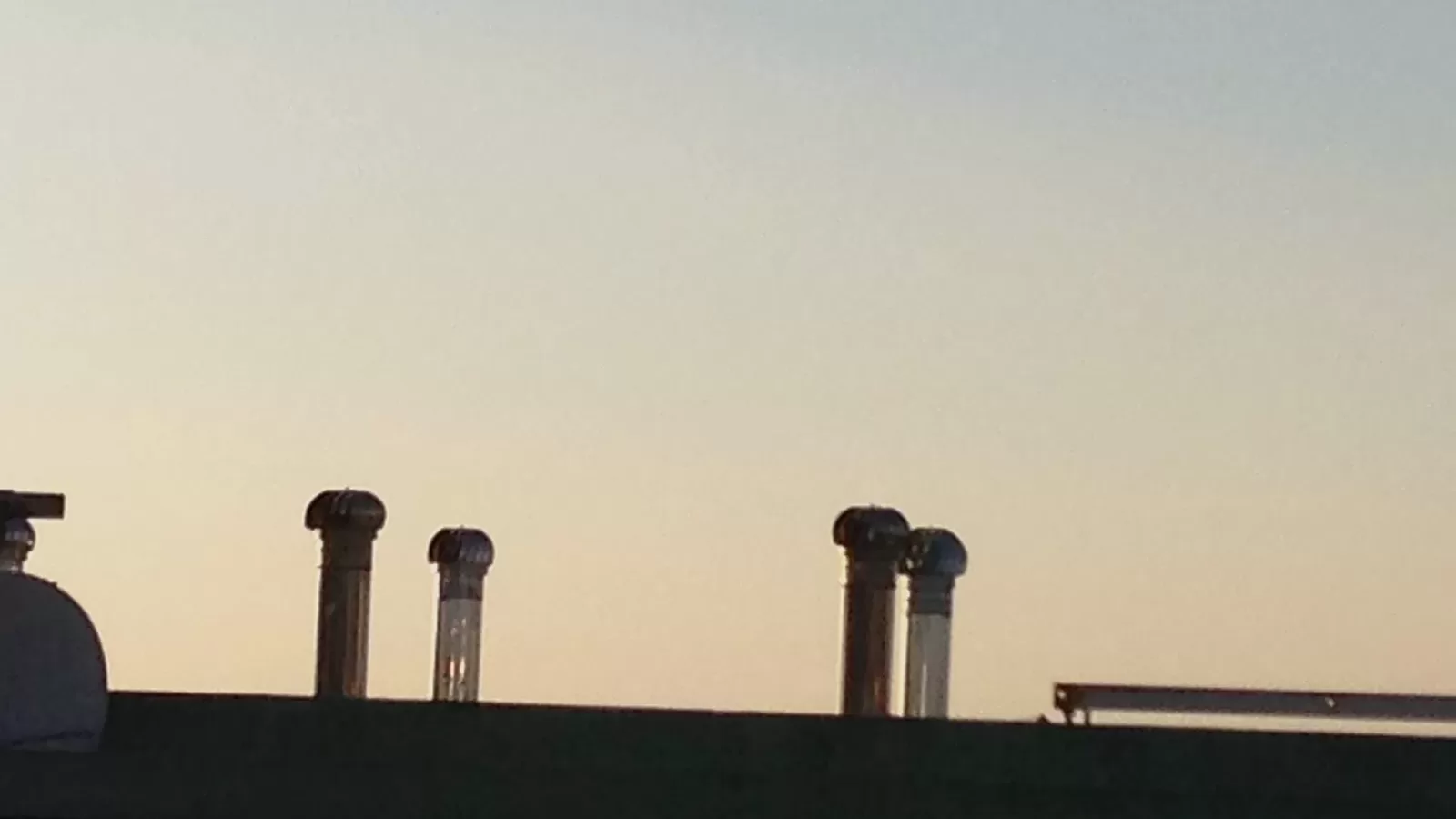
Photo: chimneys on a rooftop. By Nuorese 95, CC BY-SA 4.0 via Wikimedia Commons.
Source: a Kuwait News Agency interview with the researcher Saleh Al-Mathan.
Kuwait One, once a week.
The most useful stories we published this week, in your inbox.
No spam. Unsubscribe anytime.