
Twenty kilometres off the coast of Kuwait City, where the bay opens onto the Gulf, lies a flat island where today you hear nothing but wind and surf. From the deck of the boat, Failaka promises the visitor nothing: a low strip of sand, a few palms, and a surface that barely rises above the water.
Then you step onto it, and find that almost every step stands on four thousand years.
Failaka is the one place in Kuwait where every civilisation that passed through the Gulf left a mark you can touch. Traders, priests, soldiers and fishermen followed one another across it; the Greeks wrote on it the only administrative document of theirs surviving in the region; and Kuwaitis lived on it until one summer emptied it and they did not return. Failaka is not an island on Kuwait’s map so much as the first page of its book.
Four thousand years under the soil
Two thousand years before there was a city called Kuwait, Failaka was a station on the Dilmun sea route running from Bahrain to Mesopotamia. At the south-western end of the island, at the mounds archaeologists still know by abbreviated names, a complete town of the second millennium BC came to light: small houses whose rooms run to about three metres by three, walls of mud and stone, ovens, wells, and pottery workshops.
And with it came something more important than houses. At the mound known as F6 a large administrative building linked to food production was uncovered, along with two temples and a square stone palace. Out of the soil came Dilmun seals of various forms, beads, pearls and metal tools. The seals in particular are the island’s testimony: only someone signing a contract needs a seal, and only someone trading signs a contract. Failaka was a harbour that counted, weighed and dispatched.
The island the Greeks called Icarus
In the late fourth century BC explorers sent by Alexander of Macedon reached the Gulf. The sources say they gave the island the name Icarus for its resemblance in size and shape to a Greek island of the same name. Some trace the present name Failaka to the Greek word phylakion, meaning an outpost or forward post.
And at the start of the third century BC a nearly square fort was built on the island, its side about sixty metres, with a tower at each corner. Inside were two temples, one with Ionic columns whose stones were carefully carved and some brought from off the island. The fort saw five successive periods of occupation, ending in the first century BC.
And in that fort was found what makes Failaka an exception in the archaeology of the entire Gulf: a stone slab inscribed with a long text in Greek, considered the only complete administrative document found in the region. Not a charm and not a grave inscription, but instructions concerning the administration of the place and its people. A message from one official to another, surviving the state that wrote it.
A monastery in the middle of the island
Then the centre of gravity moved. In the middle of Failaka, at a site known as Al-Qusur, a Christian monastery stood in the seventh and eighth centuries AD. Excavations uncovered two successive churches, a communal refectory, and buildings given over to food production, among them date syrup. The pottery found there dates from the first half of the seventh century to the ninth.
Which means Failaka stayed inhabited and productive through the centuries in which the Gulf usually goes missing from the historical narrative, and that its people were farming, pressing and storing rather than merely passing through.
The village emptied in a night
Failaka’s layer closest to us is its harshest. Until the summer of 1990 the island was a thriving village of more than two thousand people, with schools, a market and a boat harbour, and a destination for Kuwaitis on holidays and sea trips.
With the Iraqi invasion the entire population was moved to the mainland, the beaches were mined, and the island’s buildings were used as targets for live-fire training. The mines were cleared after liberation, but the residents did not return. The houses left standing are still standing, with their punctured walls and their windows open onto nothing, and only a few dozen people live on the island today — staff, workers, and intermittent returnees.
That is the paradox that makes Failaka: the layer under the ground is preserved, studied and numbered, and the layer above it is left exactly as it was left.
What a visitor sees today
Since 1958 many archaeological missions have worked on Failaka, national and foreign, more than sixteen of them, from nine countries. The first was the Danish mission led by Geoffrey Bibby between 1958 and 1963, which opened the mounds at the south-western end, and work continues today in coordination with the National Council for Culture, Arts and Letters. The island is on UNESCO’s tentative list for World Heritage.
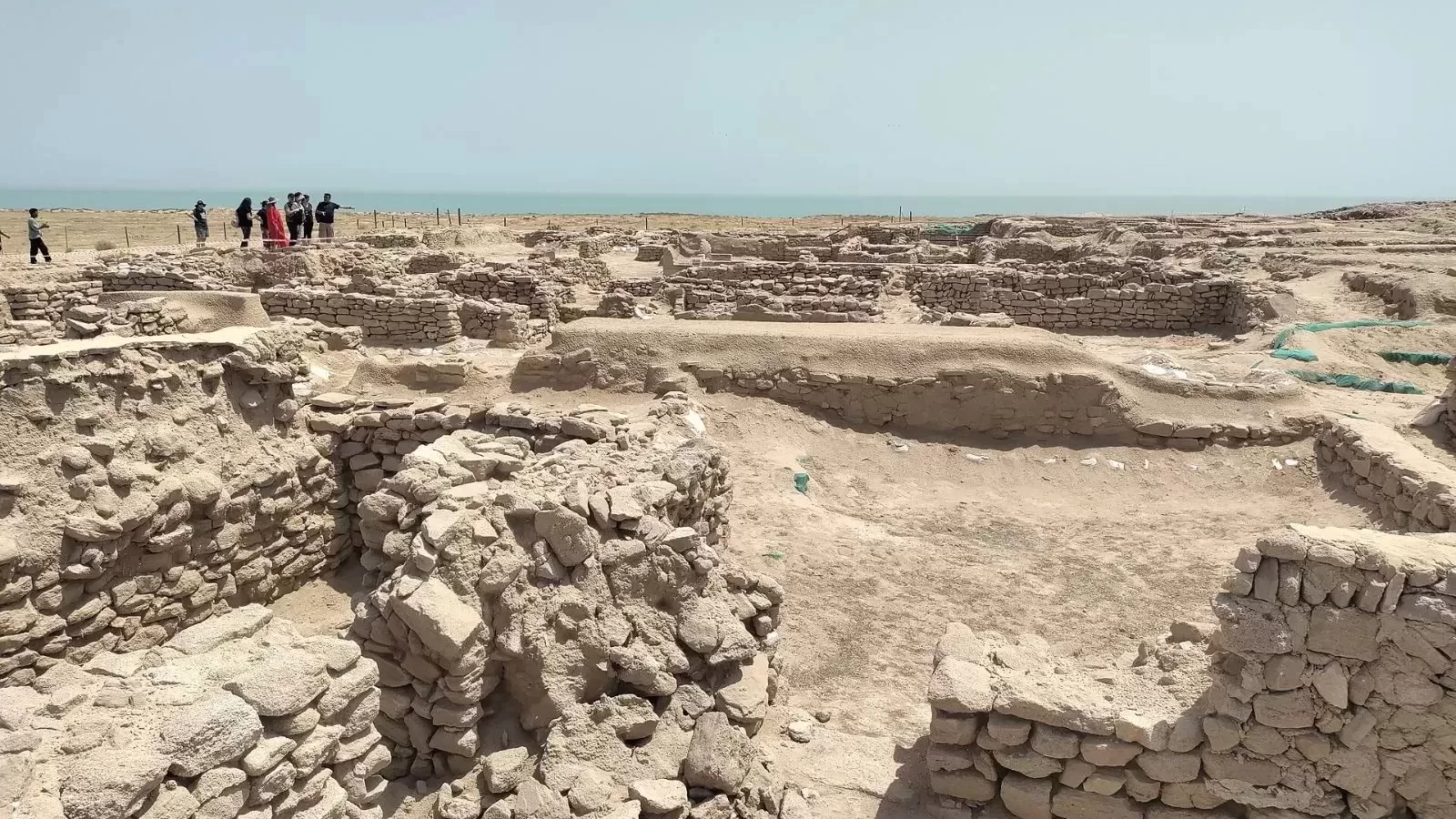
The visit begins from the Salmiya shore by boat and ferry, and ends in something that resembles no other destination in the country. There are not many signs, no cafes and no facades — instead there are knee-high walls running down to the sea, green nets protecting the excavation squares, and a low fence separating the visitor from a four-thousand-year-old town. Walking among them you understand with your body what books do not say: that the rooms were small, that the sea was very close, and that people built here because here was where the meaning was.
Go back to the opening scene. From the deck of the boat, Failaka promises the visitor nothing — a low strip of sand barely above the water. And under that strip sleep Dilmun, Greece, the monastery and the fishing village, one on top of another, waiting for someone to walk on them.
Photo: the archaeological site on Failaka, April 2025 — by Kishore R Sudarsan via Wikimedia Commons, CC BY-SA 4.0
Further reading: UNESCO tentative list: Failaka Island · UNESCO: Saad and Sayed area on Failaka · the National Council for Culture, Arts and Letters
Kuwait One, once a week.
The most useful stories we published this week, in your inbox.
No spam. Unsubscribe anytime.