
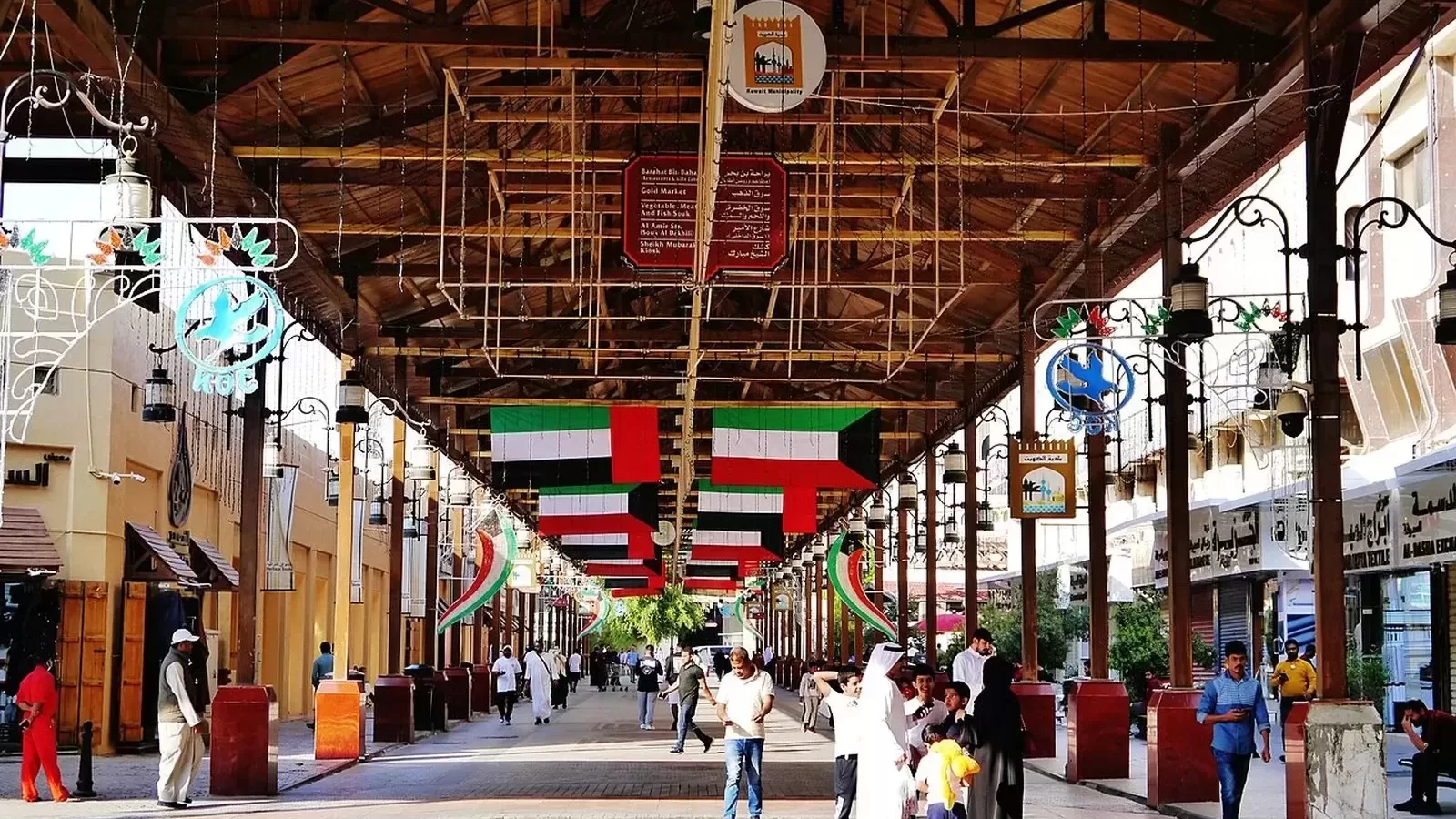
Walk through Mubarakiya souk and then lift your eyes from the goods to the signs. The names you read above the shops are not trading names invented in a marketing office; they are family names. And some have been in the same place since Kuwait was a city with a wall.
This is the first in a series on Kuwait’s merchant families: who they are, how they began, and what remains of their names today. We start with the one that appears most in daily life, the Alghanims.
An economy before oil
To understand how a merchant family comes into being in Kuwait, you have to remember what the economy was before oil: the sea and trade, and nothing more. Pearls brought up in a brutal summer season, ships carrying dates, timber and cloth between Basra, India and East Africa, and a souk in the heart of the city distributing what arrived.
In an economy like that, wealth is not made by whoever owns land, but by whoever owns a ship, or credit, or a relationship in a distant port. And that is where the merchant families came from: names that assembled capital, reputation and network, then passed them from father to son.
1932: the son who took over
The declared founding date of the Alghanim company is 1932, when Yusuf Ahmed Alghanim took over his father’s business. The date matters because it precedes oil: Kuwait did not export its first shipment for another fourteen years. Which means this trade was built on the market, not on rent.
The company itself describes its history as “over a century” of work, which means the family’s commercial activity is older than the company that carries its name. What exactly that activity was before 1932 is a matter on which accounts differ, and documented sources are not available in enough depth to be categorical.
What the name became
The company today trades as “Yusuf Ahmed Alghanim and Sons”, with Kutayba Yusuf Alghanim as chief executive. These are its published figures:
- More than fifteen thousand employees, from sixty-seven nationalities.
- Around thirty business units, representing more than five hundred international brands.
- A presence in three regions as the company defines itself: the Middle East, India and South East Asia.
- Five sectors: retail and distribution, food and beverage, automotive, industry, and services.
Among its most recent moves are launching the BYD car agency in Kuwait, and starting construction of manufacturing facilities in Saudi Arabia during 2024 and 2025.
The practical meaning of those figures is that a Kuwaiti deals with this name without noticing: in the electronics shop, at the car dealership, in a restaurant, and in an appliance in their kitchen.
What the story says
That the Kuwaiti merchant family did not arise with oil; it preceded it. Oil widened the market and lifted purchasing power, but the network, the reputation and the expertise in importing and distributing were there decades before. Which is why certain names held their position after everything around them changed.
And that is also what makes the series worth writing. The names of the merchant families are the thread tying the Kuwait that was to the Kuwait that is. You read the name on a sign today, and find it in a nakhoda’s ledger a hundred years ago.
In coming instalments we continue with other families, and with a trade measured by the ship before it was measured by the container.
Photo: Mubarakiya souk, Kuwait City — by Zairon via Wikimedia Commons, CC BY 4.0
Further reading: the official Alghanim group website · Forbes Middle East — top Arab family businesses
Kuwait One, once a week.
The most useful stories we published this week, in your inbox.
No spam. Unsubscribe anytime.