
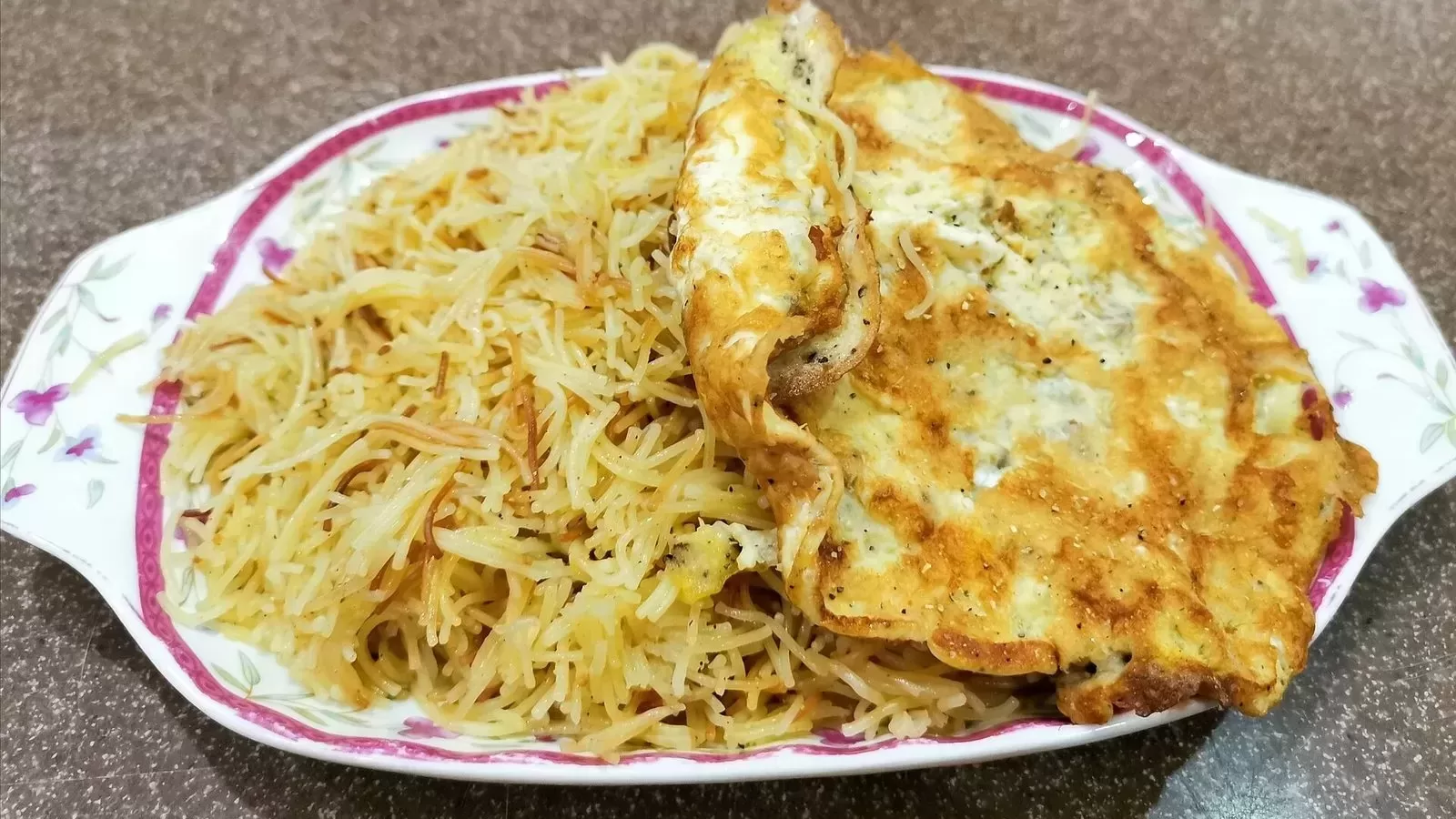
One plate holding together what most kitchens keep apart: vermicelli sweetened with sugar, cardamom and saffron, and on top of it a thin egg omelette with no sugar at all.
Sweet underneath and savoury above, in a single mouthful. This is balaleet, and it is why anyone who has tasted it knows it and does not forget it.
How it is made
The vermicelli is boiled and drained, then returned to the pan with ghee, sugar, cardamom and saffron, with rosewater, cinnamon or steeped saffron added according to the house. It is left until it drinks the syrup and turns glossy.
Then the omelette is made separately: beaten eggs spread in a wide pan until they set into a thin, cohesive sheet, laid over the vermicelli as a lid. It is not stirred in; it sits on top.
And the difference between good balaleet and the rest is not in the ingredients but in two points: that the vermicelli strands stay separate rather than becoming one mass, and that the omelette is thin rather than spongy.
When it is eaten
Balaleet is a morning dish before it is a dinner dish. It appears at Friday breakfast, on the Eid table early in the morning, and in Ramadan at suhoor, where sugar and starch together stretch how long you stay full.
And it is not Kuwaiti alone. It is known in Bahrain, Qatar, the Emirates and eastern Saudi Arabia under the same name or something close to it — which is what you would expect in a cuisine of the Gulf coasts, where recipes travelled with ships rather than with borders.
The vermicelli came by sea
The vermicelli itself is not native to this land. It arrived with the India trade, like the cardamom, saffron and cinnamon that season it. The sources describe the dish as forming in the Gulf ports out of the meeting between what arrived on ships and what was locally available in ghee, eggs and sugar.
Which makes balaleet a clean example of a rule that recurs in the Kuwaiti kitchen: imported ingredients, local method.
Why it survived
Because it is cheap and quick and made from things in every kitchen. And because putting sweet and savoury in one plate remains something that surprises anyone trying it for the first time, even if they have eaten it their whole life at their grandmother’s house.
Photo: a plate of balaleet — by Droodkin via Wikimedia Commons, CC BY-SA 4.0
Kuwait One, once a week.
The most useful stories we published this week, in your inbox.
No spam. Unsubscribe anytime.