

When a Kuwaiti ship left port bound for India or Zanzibar, it did not sail on custom alone. It carried a written law aboard, in numbered articles, setting out who commanded, who stood at the helm, how the money was divided on return, and what happened to a man who ran off in a distant port.
It was called the Travel Law, it was issued in 1940, and it has sixty-one articles.
Who issued it and why
The law was issued by the ruler of Kuwait, Sheikh Ahmad Al-Jaber Al-Sabah, on the submission of the head of the Shura council, and its preamble carries a phrase that sums up its purpose: “in accordance with our wish to reform the country and its people”.
It did not come alone. It was issued alongside the Diving Law in the same year. The first regulated the pearl diving season, the second the long trading voyage. Both were made for one practical purpose: to settle the disputes that arose between sailors and captains, which until then had been resolved by custom and by whoever had the louder voice.
The ship and the nakhoda
The opening articles start from the obvious and write it down explicitly. Article one: the ship must be seaworthy and fully crewed for the voyage. Its fitness to sail and the number of its men are a requirement, not a judgement call.
Article two sets three conditions on the nakhoda: that he be in possession of his senses, know the sea routes, and be of good conduct. Note that the third condition is moral rather than technical, and deliberately so: the nakhoda holds people’s money and people’s lives for months, far from any authority.
Article three obliges the shipowner to appoint an experienced man to assist the nakhoda and stand in for him when necessary, with exemption only if no such assistant exists at all.
The helmsman: the man who holds the bearing
The law gives a whole article to the man at the helm. Article eight requires the helmsman to be sound of sight, versed in matters of the sea, knowledgeable of the bearing, capable of holding the ship’s rudder and the line of the course, and alert to a sudden wind.
And if the ship is at anchor, he must perform his duty during the period he is responsible for, and once another takes the helm he must join his colleagues in the remaining work. Anyone in breach is deemed incapable of performing his duty.
The money: shares, not wages
Here the essence of the system appears. A sailor on a Kuwaiti ship was not a hired hand on a wage but a partner in the voyage’s takings.
Article nine sets out the order: once the ship’s total takings are known, the cost of food and the port expenses come out first. Then the remainder is divided.
And the nakhoda has powers within that division: whoever falls short in his work or breaches the rules has a deduction from his entitlement in proportion to his shortfall, and what is deducted is added to the shares of the rest of the crew. And whoever outperforms his fellows in work may be rewarded by the nakhoda, the reward coming from the freight itself.
The runaway in a distant port
The harshest articles are the ones dealing with absence, and they are more precise than you would expect.
The law distinguishes two stages of the voyage. A man who went missing on the outward leg, in the ports of India, Yemen or Zanzibar, forfeited his entire share of the takings and was required to return the money he had taken for that voyage.
A man who went missing on the return, from Muscat to one of the Gulf ports, kept his share of the takings — the share is called the qallata — but paid the mazwariya, the wage of the man who took his place. And its calculation is exact: the crew’s share of the takings is divided over the number of voyage days, and the resulting daily figure is the mazwariya for each day of absence.
And if the ship put in at a port for an unspecified period, the crew were required, once the nakhoda went ashore, not to leave the landing boat and to be present until he returned. A man who failed to be there and forced the nakhoda to sail on could be left behind, with the nakhoda bearing no responsibility for his expenses or the cost of rejoining his ship. Whoever did not rejoin was deemed a runaway.
Why this law is worth reading today
Because sixty-four years before modern employment contracts appeared in the region, Kuwait had a written text defining the job, requiring competence, tying pay to output, and setting a penalty measured in days rather than in mood.
And it is also an exact economic portrait: a society whose entire wealth was in the sea, which therefore made a law for the sea.
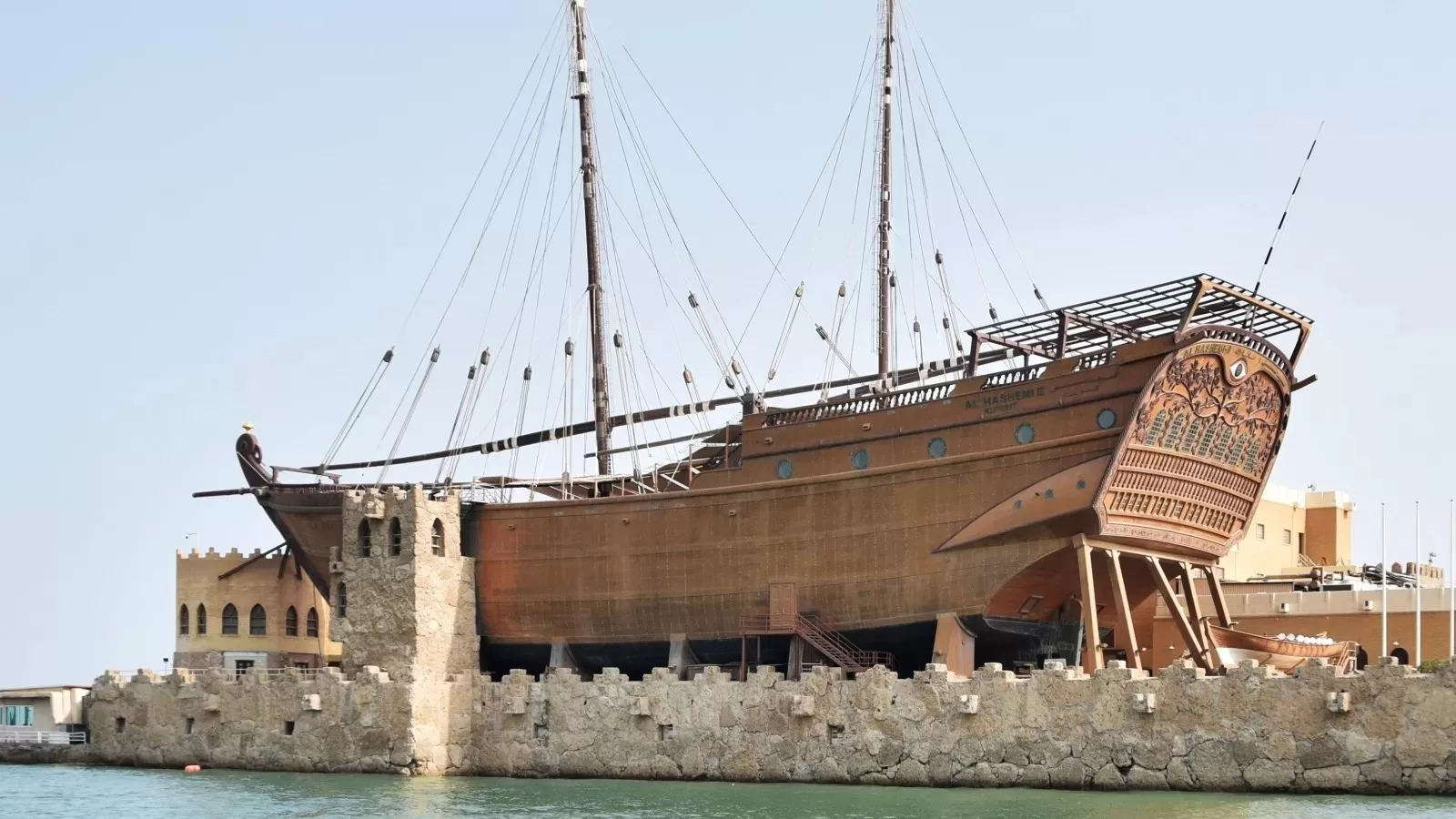
Photo: Al-Hashemi II, the largest wooden ship ever built, Kuwait — by Mosbatho via Wikimedia Commons, CC BY 4.0
Further reading: the text of the Travel Law as given in The History of Shipbuilding in Kuwait and its Various Activities by Dr Najat Abdulqader Al-Jassem Al-Qinai and Dr Badr Al-Din Abbas Al-Khusousi, relayed via the Kuwait History Forum
Kuwait One, once a week.
The most useful stories we published this week, in your inbox.
No spam. Unsubscribe anytime.