

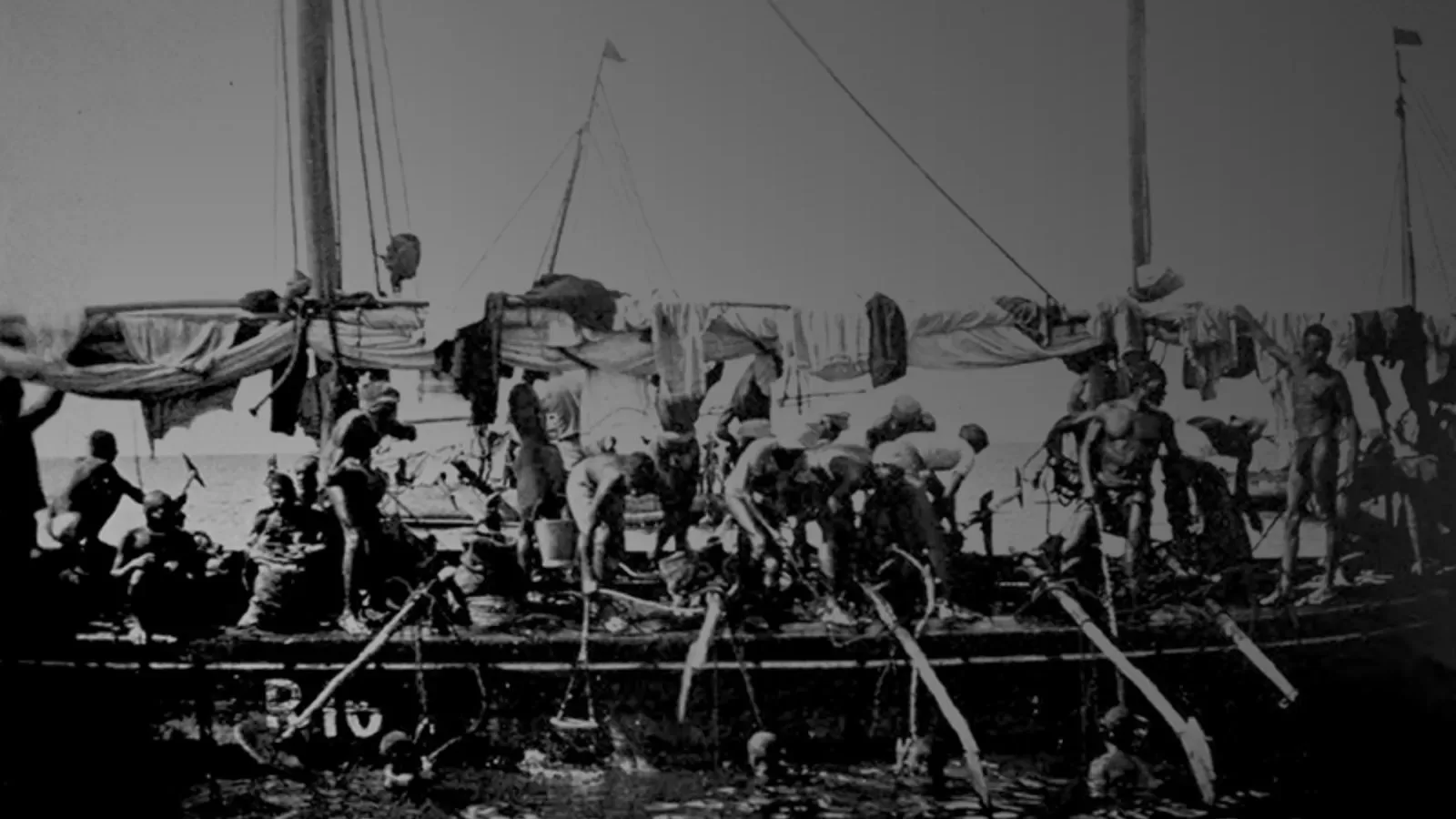
Before oil, the ruler’s income in Kuwait came from the sea, and its largest item was a tax called the qallata, or “the sheikhs’ qallata”. It was taken from every ship at the end of the great diving season, and its amount was one diver’s share of that ship’s take. Which means it was not a fixed sum: a ship that came back with many pearls paid a lot, and one that came back empty paid almost nothing.
Kuwait was not alone
J.G. Lorimer records in the Gazetteer of the Persian Gulf, geographical section, that the sheikhs of the coast levied taxes on divers, and that each sheikh had a system unlike the others, with no single law binding them. The first such tax on the Arab side was imposed by the ruler of Bahrain in 1801 under the name “nawb”, amounting to one diver’s share per ship. Years later a second tax called the “tiraz” was added, also one diver’s share, its purpose being to appoint paid guards in the towns and villages through the summer, because the men were at sea. The nawb was collected in autumn and the tiraz in spring.
How the season was divided
The great dive ran four months, split into two tarshas of two months each: “the first tarsha” and “the following tarsha”. Within each tarsha was a smaller division, every fifteen days called a “qura’a”. Four qura’as to a tarsha, eight to the whole season. And because the tax was reckoned from the take, it was not paid until all of that had finished.
The ledger
Sheikh Mubarak Al-Sabah appointed Jassem bin Mohammed Boodai to collect the qallata, and he entered it in schedules kept in a dedicated ledger presented to the ruler at the end of the season. Each entry is a single line: the name of the merchant or captain, then the amount in rupees, then the number of vessels, then the Hijri date. The published schedules cover 1330 to 1334 AH, that is 1912 to 1916 according to whoever published them.
And the clearest thing in the ledger is the gap between one line and another in the same week. In Ramadan 1330 alone: Ahmad Al-Duwaihi, two hundred rupees for one vessel; Mohammed bin Mudaij, three hundred and fourteen rupees for one vessel; Abdulhadi bin Fahad Al-Mailam, two hundred and seventy for two vessels; Jassem bin Hussein, six hundred and twenty-four for one vessel. And on roughly the same day: Saleh bin Shaheen Al-Foudari, seventy; Abdulwahab Al-Yusuf, fifteen; Salem Al-Ouwaishir, eleven; and Hussein bin Ali Al-Abdoun, three rupees for one vessel.
The ledger has its own term for a man who took nothing: “maqas shai”, “he cut nothing”. It also has “from the hand of so-and-so” for a sum delivered through someone else, and “on behalf of so-and-so” when a big merchant or captain paid for another captain.
Reckoning the rupee
A rupee is sixteen annas, and an anna four paisa. A “lakh” is a hundred thousand rupees, and five lakhs half a million. So when you read three rupees against a whole vessel in the schedules, you are reading a ship that came back with nothing worth naming.
Who collected it: two accounts
The source that published the schedules says Jassem bin Mohammed Boodai collected them in Sheikh Mubarak’s reign, then Jassem bin Idrees took over under Sheikh Jaber bin Mubarak, then Saud bin Awn under Sheikh Ahmad Al-Jaber. A second account, published by Al-Seyassah in April 2026, says Jassem bin Idrees was the one charged with collecting it from 1896 under Mubarak himself, and stayed on it for some forty-four years before Saud bin Awn succeeded him. The two accounts agree on Saud bin Awn and differ on the beginning, and the ledger itself is what settles that, not what is relayed from it.
Abolished, then back at half
In 1938 the Legislative Council abolished the diving tax and exempted divers from it. After the council was dissolved, Sheikh Abdullah Al-Salem, then crown prince, brought it back, but halved it because the men of the trade could no longer pay it, and in its new form it was called the “iswaba”. It continued into the 1950s, when Kuwaitis stopped working in diving at all.
And that is the whole story in a sentence: a tax taken out of the share of a man who went to the seabed, abolished by the Legislative Council, brought back at half, then ended because the trade itself ended.
Sources: the Gazetteer of the Persian Gulf by J.G. Lorimer, geographical section, for the regional background · the qallata ledger schedules belonging to Sheikh Mubarak Al-Sabah in the hand of Jassem bin Mohammed Boodai, as published on the Kuwait History Forum · and Al-Seyassah, 15 April 2026, article by Tareq Idrees.
Kuwait One, once a week.
The most useful stories we published this week, in your inbox.
No spam. Unsubscribe anytime.