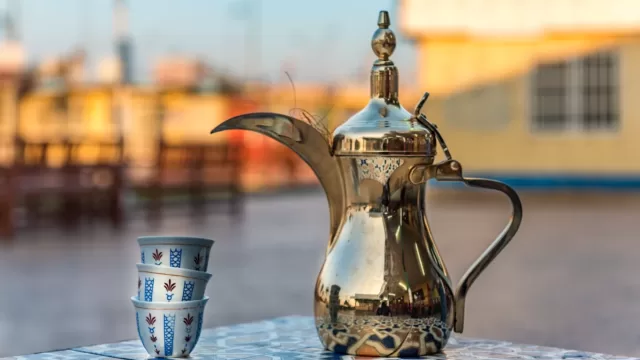

In the old Kuwaiti kitchen a grandmother asked for the “qallas” and was handed the glass, stirred the tea with the “qafsha”, and sent lunch to the neighbours in the “sufurtas”. Three words heard daily in the house, and not one of them Arabic in origin.
The researcher Dr Saud Mohammed Al-Osfour published in Al-Qabas a series titled “A Heritage Window: the Kuwaiti kitchen of old”, in which he counted dozens of the pieces that were in people’s homes and paused over their names. The picture that emerges from the list is clearer than any explanation: the Kuwaiti household bought its tools from abroad, and bought the names with them.
The stove that carried a foreign name
The “chulat brimz” is the kerosene cooker, and it was the central element in the kitchen before gas. Al-Osfour takes “brimz” to be English in origin, and notes that wood and charcoal preceded it, with the fire set under the pot on the “marka”, three legs of hard iron.
And with the stove came its tools: the “dafour” that throws a large flame for lighting charcoal, the “minfakh” of leather and wood for feeding the fire, the “beeb al-chaz” for keeping kerosene, and a needle for clearing the burner hole when grease deposits blocked it.
The spoon that changed its name twice
The “khashuqa” is an arabised Turkish word, and Al-Osfour notes it becomes Persian too if the kaf is swapped for a qaf. With it goes the “qafsha”, which he takes to be Persian, and which is the only one still alive today in “qafshat al-chai”, the tea spoon. The khashuqa is barely mentioned now except by what remains of the first generation.
And Al-Osfour records an important observation about the fork: it entered the Kuwaiti kitchen late, along with modern tableware. Which means eating by hand remained the norm for a long time after the stove had gone over to kerosene.
The sufurtas, the bastooq and the yuniya
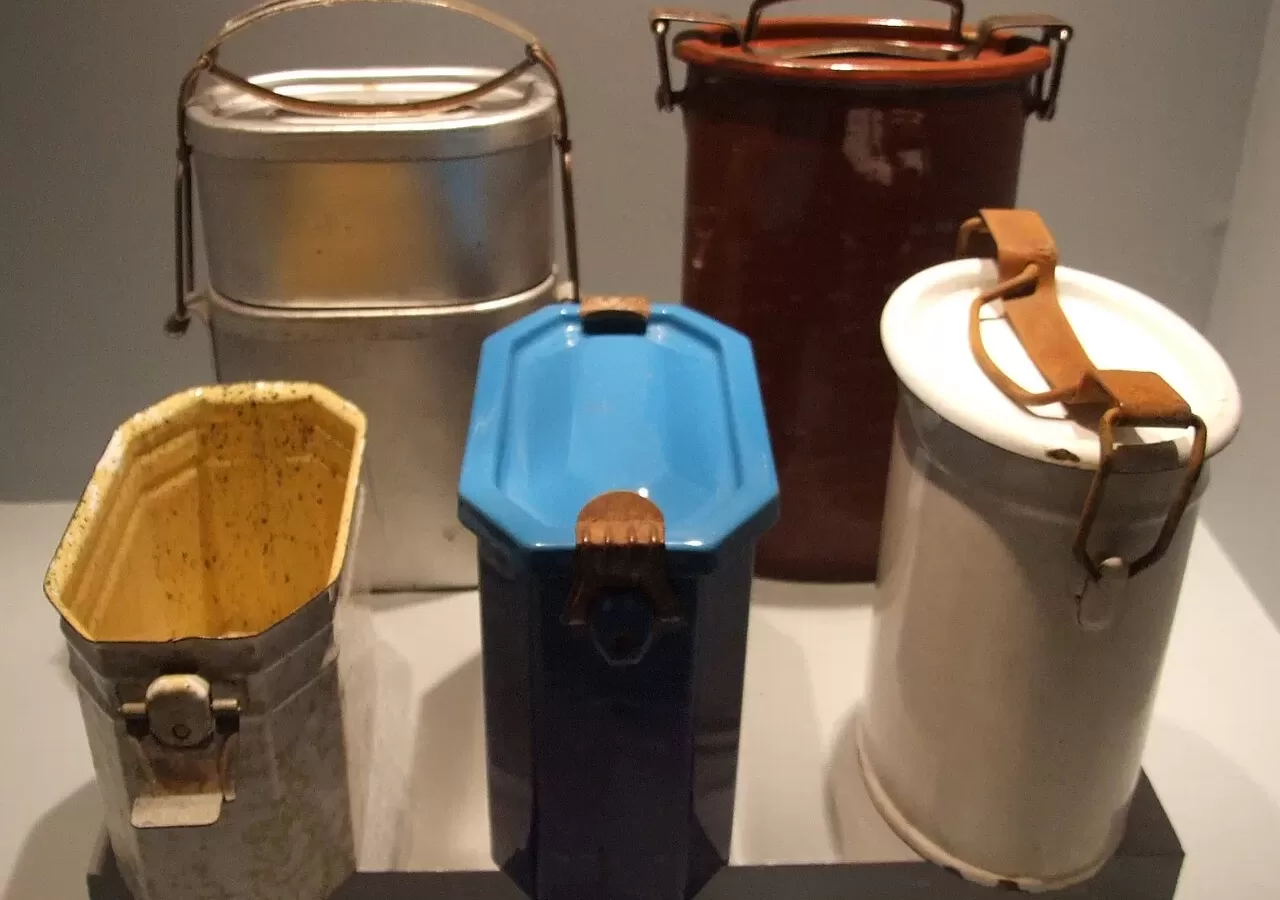
“Sufurtas” is a Turkish word meaning travel vessel, and it is the stacked multi-tier container, one dish per tier. The woman of the house used it to send food to neighbours and on outings, and building workers carried it because a whole meal fits into a single vessel.
The “bastooq” Al-Osfour takes to be Indian in origin, a vessel of ceramic or metal for keeping liquids, sometimes reserved for pickles, for fat, or for laban on desert and sea trips. The “doolaka” is a jug for water and juice, an arabised word from Persian or Turkish, and Iraqis call it by the same name.
And the “yuniya” — also said koniya and qoniya — is the sackcloth ghirara in which rice, sugar and salt were kept. One name in three pronunciations, the mark of a word that entered the ear before it entered writing.
Bread was not baked at home
The “tawa” is a cast-iron griddle for making bread, and it also serves for grilling fish. But Al-Osfour records a detail worth pausing on: not every Kuwaiti household used it for that purpose, because the Iranian baker existed.
Meaning that in many homes bread was bought rather than baked, and that the baking trade rested on an incomer. This is one of those cases where a tool’s name says less than its absence from use does.
Why all this happened
Al-Osfour opens the series with a sentence that explains the rest: the old Kuwaiti kitchen was influenced by the Iraqi, Persian and Gulf kitchens — Bahraini especially — and by the Indian fundamentally, then by later Levantine and Turkish influences. Natural flavourings such as saffron, rosewater and Indian and Chinese spices were present in it.
This is no linguistic coincidence. The list Al-Osfour assembled reads like a trade map: Turkish, Persian, Indian and English — the same directions he names in the kitchen’s influences. The word travels with the object, then stays in the house after the object itself has gone.
The proof is that “qafsha” is still said, while “khashuqa”, “bastooq” and “yuniya” have become words known only to those who lived that period.
Source: Dr Saud Mohammed Al-Osfour, the series “A Heritage Window: the Kuwaiti kitchen of old”, Al-Qabas, parts 1, 2, 4 and 5, November and December 2019.
Photo: stacked metal tiffin carriers with handles. By Claus Ableiter, CC BY-SA 3.0 via Wikimedia Commons.
Kuwait One, once a week.
The most useful stories we published this week, in your inbox.
No spam. Unsubscribe anytime.