
Kuwait City grew up in the early seventeenth century with no engineered plan: the houses came before the road, and the road was whatever was left between the houses. And because the roads were not drawn but formed, every shape of them acquired a name describing it more precisely than the word “street” does.
Three kinds of sikka
- Sikka sadd: a narrow passage leading to no other road, ending at a house door. So “the end of the sikka” is a literal expression rather than a figurative one.
- Sikka dhayyiqa: the narrow lane, leading through to other places.
- Sikka ouda, meaning the great lane: it branches off the neighbourhood and reaches a second neighbourhood.
A sikka was named after the majority of its residents, such as Sikkat Anza and Sikkat Al-Sibaan. The sikaika is the diminutive of sikka, a metre to a metre and a half wide and under fifty metres long, running between two main lanes or serving as the entrance to two or three houses.
The darb and the tarouq
The darb is an unpaved road, but so much walking on it by feet, animals and carts levels it out without obstacles. The turqa or tarouq is a small dirt track for pedestrians alone, which animals do not use, and usually in outlying places.
The ayer and the baraha
The ayer is the corner of a house and the last house in the neighbourhood, and it was where the woman selling bajella or vegetables would sit. The baraha is an empty space ringed by the houses that look onto it, usually carrying the name of the first person to settle near it or of the large family owning most of its houses.
The musaqqaf: a bridge between two houses
Bahrainis and the people of Al-Ahsa call it the sabat: a roofed passage joining two houses, usually of one family or of relatives, over which the two households — women especially — crossed, while people passed underneath. Most of the musaqqafs were in the Sharq district.
From the same word came the roofed souk, an interior market such as Souk Al-Hareem, Souk bin Duaij, Souk Al-Gharabally and Souk Wajif, whose roof was covered with palm fronds or reed mats to soften the sun.
The thulaima
A small breach in the wall, opened by erosion from wind, rain and damp, or knocked through by boys breaking the edge of a wall to cross it or to catch birds.
Then came the asphalt
The first paving was in 1945: Dasman Street from Dasman Palace to Safat Square, called “the tar street”. Ibrahim Al-Banna supervised it, and brought the “tari” — the black tar — from Qaruh island. The method was for the workers to break stone and spread it on the road, then lay the tar after melting it over a fire, then coarse sand from the sea.
And in 1947 a street was cut running from Safat Square to the seashore, sixty feet wide, making it the largest commercial street in Kuwait at the time.
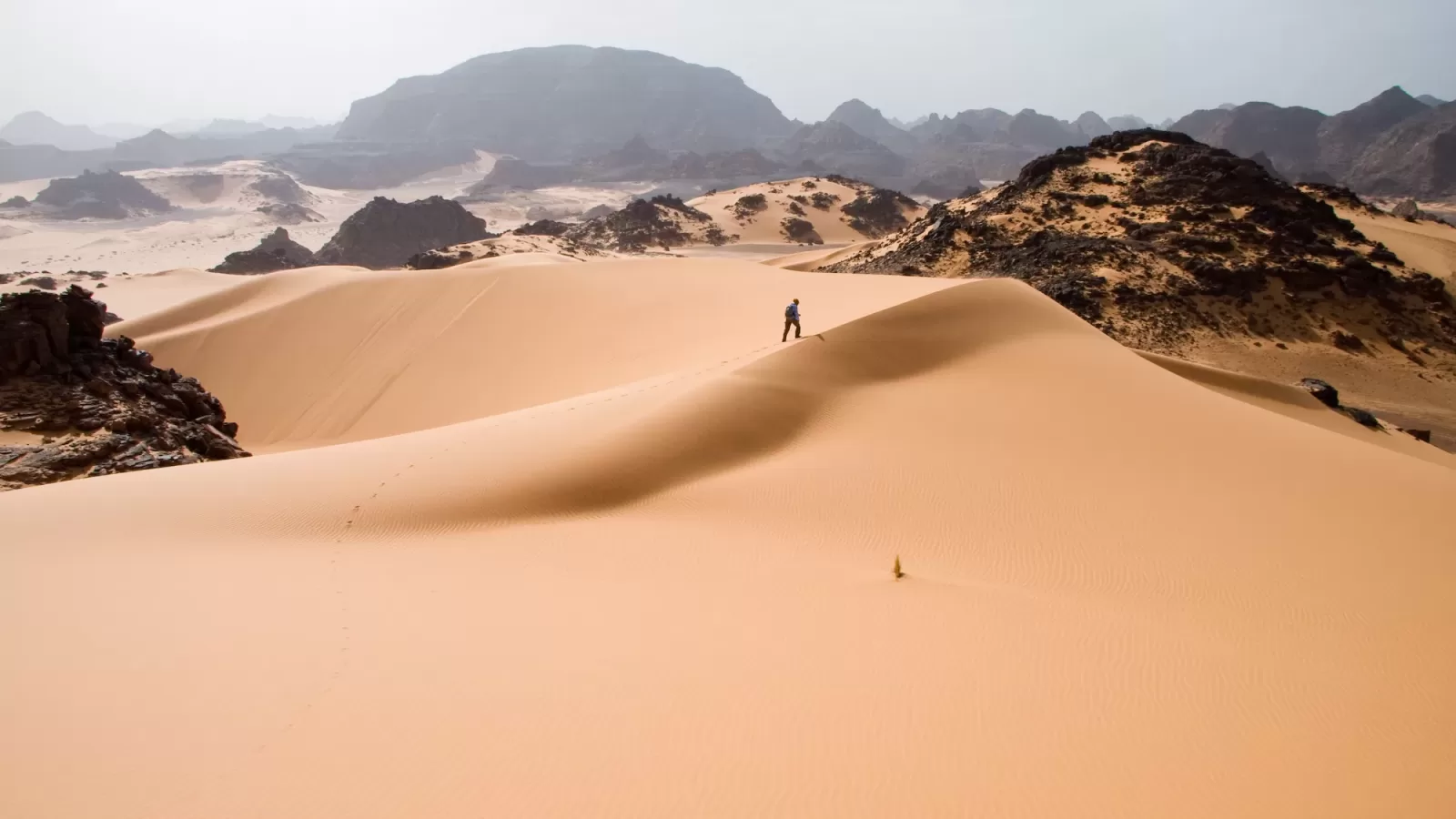
Photo: a sand dune with no paved road. By Luca Galuzzi, CC BY-SA 2.5 via Wikimedia Commons.
Source: the Kuwait News Agency, KUNA, report on Kuwait’s old roads, with statements from the Kuwaiti heritage researcher Saleh Al-Mathan and the researcher Al-Qattan.
Kuwait One, once a week.
The most useful stories we published this week, in your inbox.
No spam. Unsubscribe anytime.