Everyone knows the name sadu today, and most people who know it have seen it hung on a wall or spread across a majlis. How it was actually made, with what tools and what colours, is what the weavers’ own testimony preserves.
The tool
The shisa, a gazelle horn, is used to part the threads as the weaving goes. The loom is stretched on the ground, and was stretched in the Shamiya near the wells when the tents moved in summer.
The colour
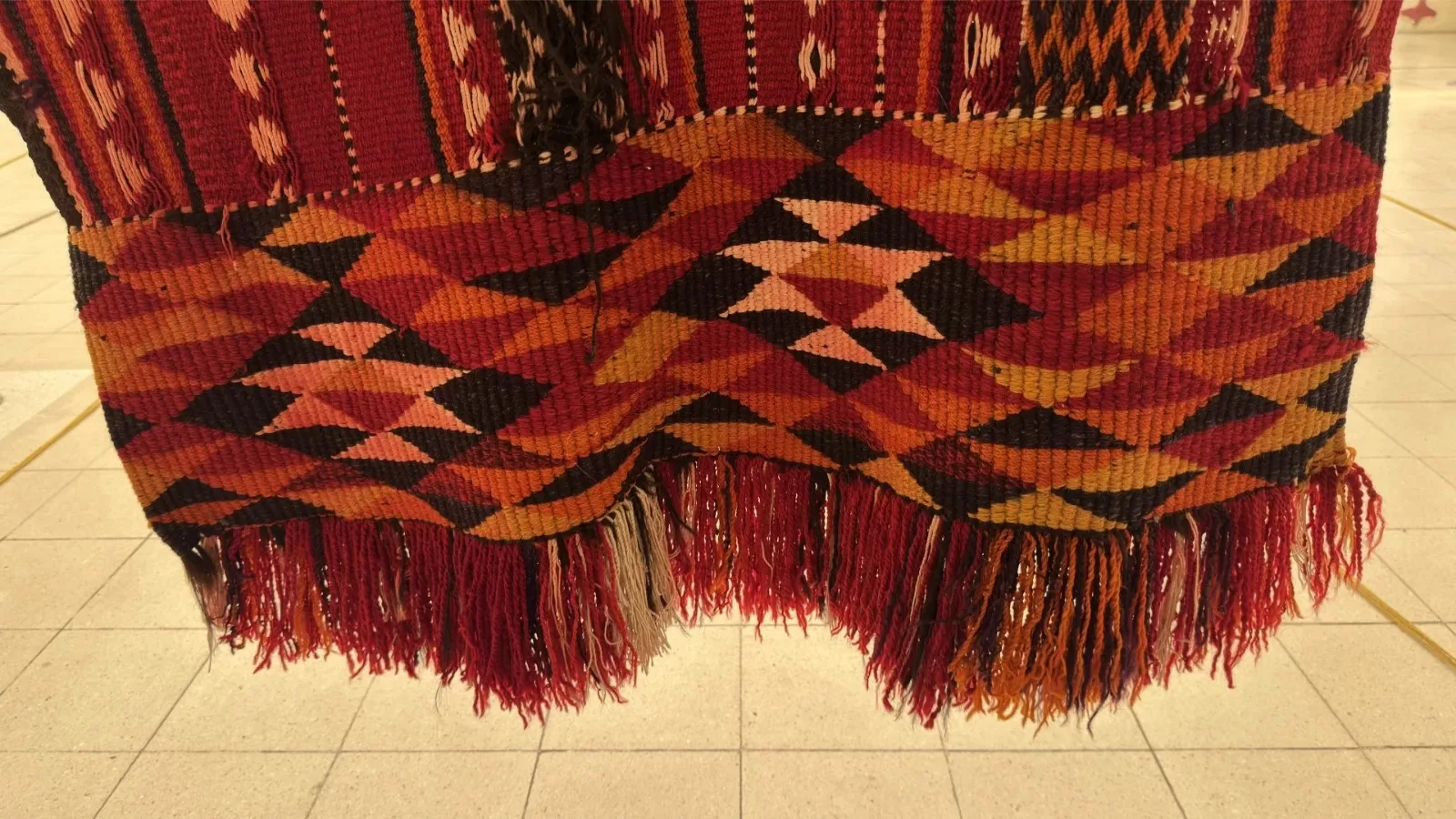
The dyes were plants, soaked before use: safflower, pomegranate rind and madder for red, with henna, black lime and alum to fix the colour. Powder dyes were brought in from India for red, orange and green.
The name follows the tribe
The weaves carry their belonging in their names: mutairiya, shammariya, dhafiriya. And each piece has a function: the qatia divides the inside of the tent, the rawaq is a side panel against the wind, the mazawid are bags for clothes, the zil is a rug of heavy wool, and beside them the flat basat.
A woman who excels at weaving is called dhafra.
From a house to a cooperative
The house that became Sadu House was built in 1936. The state bought it in the 1970s, and in 1991 the Sadu Cooperative Crafts Society was registered at the Ministry of Social Affairs, with the weavers holding the shares and taking the profit from sales.
There is a date disagreement here and we pass it on as it stands: the newspaper account says the house was named Sadu House in 1978, and the society’s own site says 1980. We do not choose.
And today
The society sells the tools of the craft itself: a meranti-wood loom at 125 dinars, and a sadu weaving comb at 6.
The international file
Sadu was inscribed on UNESCO’s Representative List of the Intangible Cultural Heritage of Humanity on a joint Kuwaiti-Saudi file, at the fifteenth session held remotely with some hundred and forty states present. It was Kuwait’s second file, after the date palm in 2019.
Among those attending for Kuwait: the secretary-general of the National Council for Culture, Arts and Letters, Kamel Al-Abduljaleel; the permanent delegate to UNESCO, Dr Adam Al-Mulla; and the representative for the intangible heritage convention, Sheikha Farah Ali Al-Sabah.
A note on the sources
The detail on tools, dyes and names comes from an interview with the weaver Mutra Al-Muslim and the society’s chair Nawal Ibrahim Al-Atiya in Al-Jarida. That is oral testimony, reported as theirs rather than asserted. We could not read the text of the UNESCO decision itself: the convention’s site refuses this machine and the National Council’s site returns a block.
Photo: a Kuwaiti sadu weaving. By Di7ane, CC BY-SA 4.0 via Wikimedia Commons.
Sources: Al-Jarida, 18 December 2020, on the UNESCO inscription, and 3 September 2009, the Nawal Al-Atiya interview; Turathona magazine, issue four, Rabi al-Akhir 1417 / September 1996; and the Sadu Society site.
Kuwait One, once a week.
The most useful stories we published this week, in your inbox.
No spam. Unsubscribe anytime.