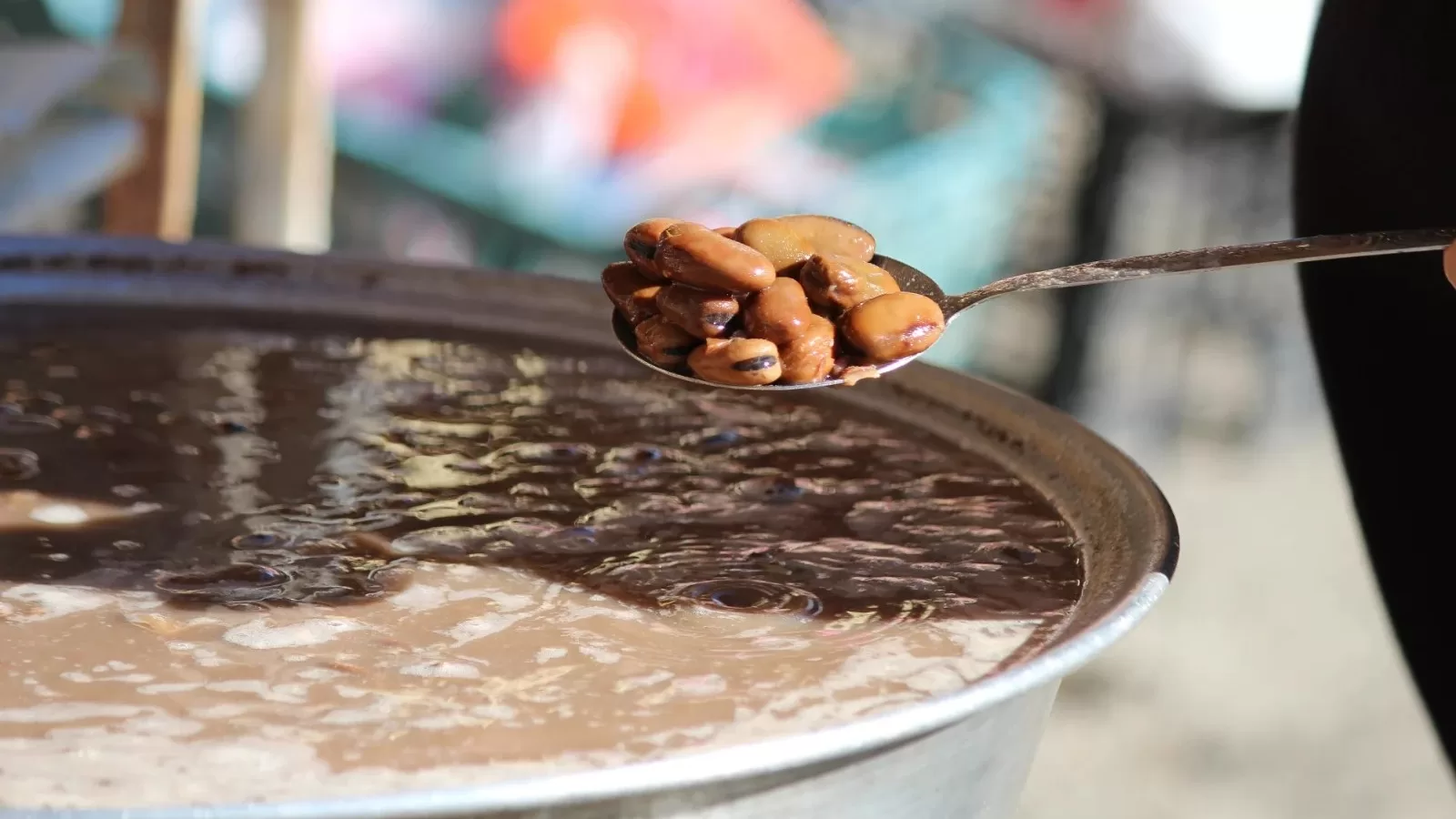
A whole trade rested on two things: nakhi, which is chickpeas, and bajella, which is fava beans. It was not a daytime trade but a night one. The cooking began in the evening and ran until dawn, when the seller came out with his pot.
Where the grain came from
In sacks, on the trading ships from Basra and Abadan. Then it was boiled at home in large copper pots, in salted water with red pepper and shinan, a herb that speeds the cooking.
How it was sold
By the ladle. Scooped into small bowls, or into a vessel the customer brought from home. The price was one baiza, a quarter of an anna, per measure.
The pot was kept hot under burlap, and the seller sat on more of the same with the day’s takings underneath him. Beside him stood bowls of salt and pepper and a basin for rinsing the dishes.
When it was eaten
At breakfast and dinner, in Ramadan at maghrib and suhoor, and in the diwaniyas. It was the food of the hour that needed no kitchen: bought hot, eaten standing or carried away.
What is left of it
A corner beside a co-op, or a popular café. The reasons Al-Rai gives in its report: changed eating habits, fewer people in the trade, and rising food prices and rents.
The grain now comes through food traders from Mexico, India and Morocco, with the Mexican and Moroccan grades described as the cleanest and largest. It sells all year, and buying concentrates in Ahmadi, Dasma, Daiya, Yarmouk, Khaldiya, Qortuba, Shamiya and Shuwaikh residential.
A note on the sources
There is no official record of a street trade. What we have is two Kuwaiti dailies: Al-Nahar on 19 April 2015, and Al-Rai on 1 March 2017 by Rehab Al-Shammari. The account in the second is from a restaurateur the paper does not name, so we report it as theirs.
We found no archival price list confirming the baiza, no named seller in either source, and no count of how many are left in the trade today.
Photo: a pot of cooked fava beans and a ladle. CC BY-SA 4.0 via Wikimedia Commons. The picture shows such a pot generally, not a Kuwaiti seller’s.
Sources: Al-Nahar Kuwait, 19 April 2015; and Al-Rai, 1 March 2017, prepared by Rehab Al-Shammari.
Kuwait One, once a week.
The most useful stories we published this week, in your inbox.
No spam. Unsubscribe anytime.