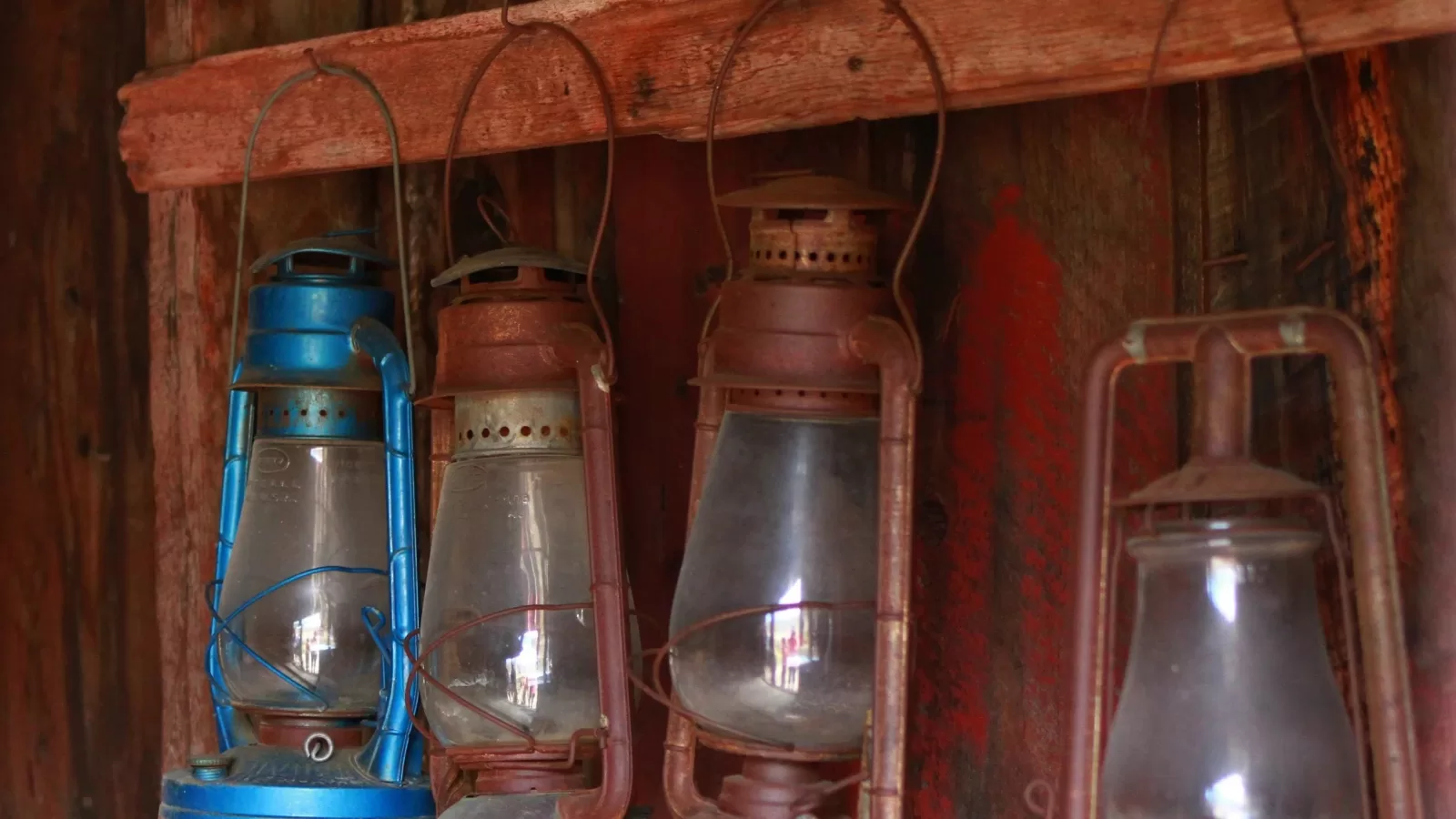
Before current reached the shops and the houses, a Kuwaiti lit the night with sesame oil — al-hal — and later with kerosene. The lamp was never one object: al-sarai, al-fanar, al-kandiri, al-bulbul, al-lala and al-lamba each had a shape, a name and a place in the house.
The kerosene came from India from the middle of the nineteenth century, in four-gallon tins the town called al-quti, the Russian ones packed four to a wooden crate. Importing ran through Gray Mackenzie on British India Line steamers, and in 1911 Britain leased Bandar Al-Shuwaikh, part of it for fuel storage. A second account puts the first official import at 1902, through the agent Ali bin Sheikh Ahmad Al-Omar.
It was dear, so it was almost never burned for cooking: it was bought by the bottle and used for light alone.
Electricity reached the palace before it reached the market. An archive piece in Al-Qabas documents a contract signed on 14 October 1912 with an Indian engineer, N. Bayankar, worth about 12,000 Indian rupees, for a generator sized for 400 lamps; the palace was lit on the night of 28 April 1913. Another account says Sheikh Mubarak bought a generator in 1906 for the wedding of Sheikh Hamad Al-Mubarak. The two do not agree, and we have left them both standing.
What mattered to ordinary people came in 1933, when Kuwaiti merchants founded the National Electricity Company. From 1934 it ran two diesel sets of 30 kilowatts each at 400 volts direct current: one worked by day until ten at night, the other carried the night.
Current reached shops and houses on 1 April 1934. Sixty subscribers in the first year, then about 400; consumption was lighting and nothing else. A few households ran electric fans, and one small air conditioner was fitted in a room of Sheikh Ahmad Al-Jaber’s palace.
A unit cost six annas. The company’s office was a shop belonging to Abdullah Al-Mulla Saleh in the merchants’ souq, and he went round the shops and diwaniyas urging people to use less — and checking that nobody was drawing current off the street pole without a subscription.
The municipality contracted the company from 1933 to light some souqs and streets with fifty lamps of thirty candlepower each, at 2.5 rupees per lamp per month.
Subscribers reached about 700 by 1940, the year the Murgab station opened with two 200-kilowatt sets. Direct current was abandoned altogether in 1950.
Photograph: old kerosene lanterns hanging from a wooden beam; not from Kuwait. By Lisafern, CC0 via Wikimedia Commons.
Source: Al-Qabas, “The Story of Electricity in Kuwait” by Yaqoub Yousef Al-Ibrahim · Al-Rai, citing Mohammad Abdulhadi Al-Jamal, “Old Crafts, Trades and Commercial Activity in Kuwait”.
Kuwait One, once a week.
The most useful stories we published this week, in your inbox.
No spam. Unsubscribe anytime.