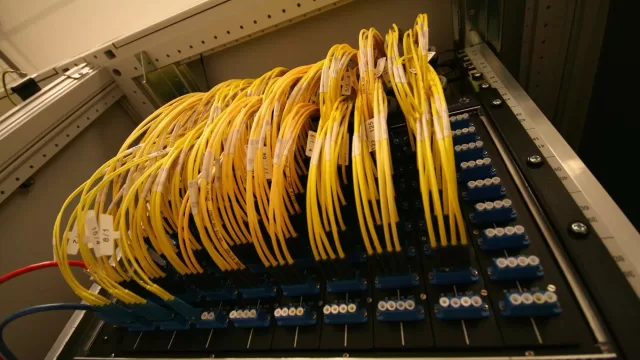
Nothing you load on your phone in Kuwait travels by satellite. It travels down a glass thread wrapped in steel, lying on the floor of the Gulf and the Red Sea. TeleGeography’s submarine cable map — the reference telecoms operators use themselves — records six systems touching the Kuwaiti coast.
The oldest is Fiber Optic Gulf (FOG): 1,300 km, in service since June 1998, jointly owned by Kuwait’s Ministry of Communications, Bahrain’s Batelco, Ooredoo and e&. It is a neighbourhood link — Kuwait to Bahrain, Qatar and Dubai — not a road to the world.
Kuwait–Iran followed: 380 km, live since June 2005, run by the Ministry of Communications with Iran’s Telecommunication Infrastructure Company.
The cable that actually took Kuwait out of the region is FALCON: 10,300 km, in service since September 2006, owned by FLAG. It comes ashore at Al Safat and runs through nineteen landing points — Mumbai, Colombo, Malé, Al Seeb, Manama, Doha, Al Khobar, Al Faw, Port Sudan and Suez. Which is to say: Kuwait’s road to Europe runs through the Suez Canal.
In February 2012 came GBICS/MENA, run by Gulf Bridge International: 5,270 km across nine landing points that form a ring inside the Gulf — Al Hidd, Al Khobar, Al Faw, Kuwait City, Bushehr, Al Seeb, Al Daayen, Fujairah and Mumbai. The ring is not engineering vanity. Cut the seabed on one side and the traffic walks round the other.
In 2024 Kuwait was touched by the largest system ever laid: 2Africa, 45,000 km and fifty landing points wrapped around the African continent, owned by a consortium including Meta, Orange, Vodafone, Telecom Egypt and center3.
The sixth has not arrived. Fibre in Gulf (FIG), 1,931 km, owned by Ooredoo, has a stated ready-for-service date of December 2027.
Why this matters to you. When you read that a cable has been cut in the Red Sea, you are reading about your own browsing speed. The long haul to Europe and America passes through one narrow corridor at Suez, and the two Kuwaiti cables that use it are FALCON and 2Africa. What keeps the service standing on such a night is the Gulf ring: GBI and FOG carry your traffic to a nearer data centre until the corridor reopens.
It also explains why games and video calls degrade before ordinary pages do. A page tolerates a few tens of milliseconds. A call does not.
Source: TeleGeography Submarine Cable Map — https://www.submarinecablemap.com/country/kuwait
Kuwait One, once a week.
The most useful stories we published this week, in your inbox.
No spam. Unsubscribe anytime.