Long before Kuwait had an office to collect duty, its rulers took a modest share of what came in by land: no more than three per cent of a cargo’s value, and as little as one per cent under Abdullah Al-Sabah, who ruled from 1763 to 1813. The traveller Stocqueler put it at two per cent in 1831.
Assessed by eye
There were no price lists. A bale of plain brown cloth was charged one French silver riyal, and a bale held thirty lengths of thirty yards each. Everything else was settled at a small agreed sum per sack.
The ruler had another income that carried no name. Merchants handed him money when he needed it, and sea captains brought gifts home from a voyage. Ahmad Abu Hakima estimated that merchants, together with the Bedouin paying at the town gate, contributed some twenty thousand French riyals a year — a figure drawn from Colonel Pelly’s reports as British Resident in the Gulf between 1863 and 1865.
The wadi levy, priced by the sack and the head
The researcher Mohammad Abdulhadi Jamal records a levy called al-wadi, imposed in the time of Sheikhs Muhammad and Jarrah on goods entering or leaving the town, and paid by whichever party was not from Kuwait. The tariff followed the goods:
- Two rupees for a camel.
- One rupee for other livestock.
- One rupee for a sack of rice.
- Four annas for a sack of wheat, and the same for barley.
- Four annas for a qalla, the round palm-leaf basket that held thirty-eight kilograms of dates.
- Two baizas for an ounce of sugar.
An anna was a sixteenth of a rupee; a baiza a quarter of an anna, so a sixty-fourth. The baiza stayed in circulation until 1957.
May 1899
When Sheikh Mubarak Al-Sabah came to power and his spending grew, he set up an organised customs department in May 1899 and fixed a five per cent duty on everything reaching Kuwait by sea or overland. The rate later climbed to ten per cent on some categories.
Souad Al-Sabah describes it as the first Kuwaiti department of state, and the only one until 1921. It stood in front of the Naif gate in the old town wall, with the customs door on the inner side facing the town. The sea desk worked from half past six or seven in the morning until noon, then from two until sunset.
Jamal adds that this was the first time duty was charged on goods arriving by sea; until then only overland cargo paid. It also caught goods from Ottoman ports, which had been entirely exempt early in Mubarak’s reign, and goods leaving Kuwait by either route. The department itself was housed in a small shed on the shore beside the old landing place.
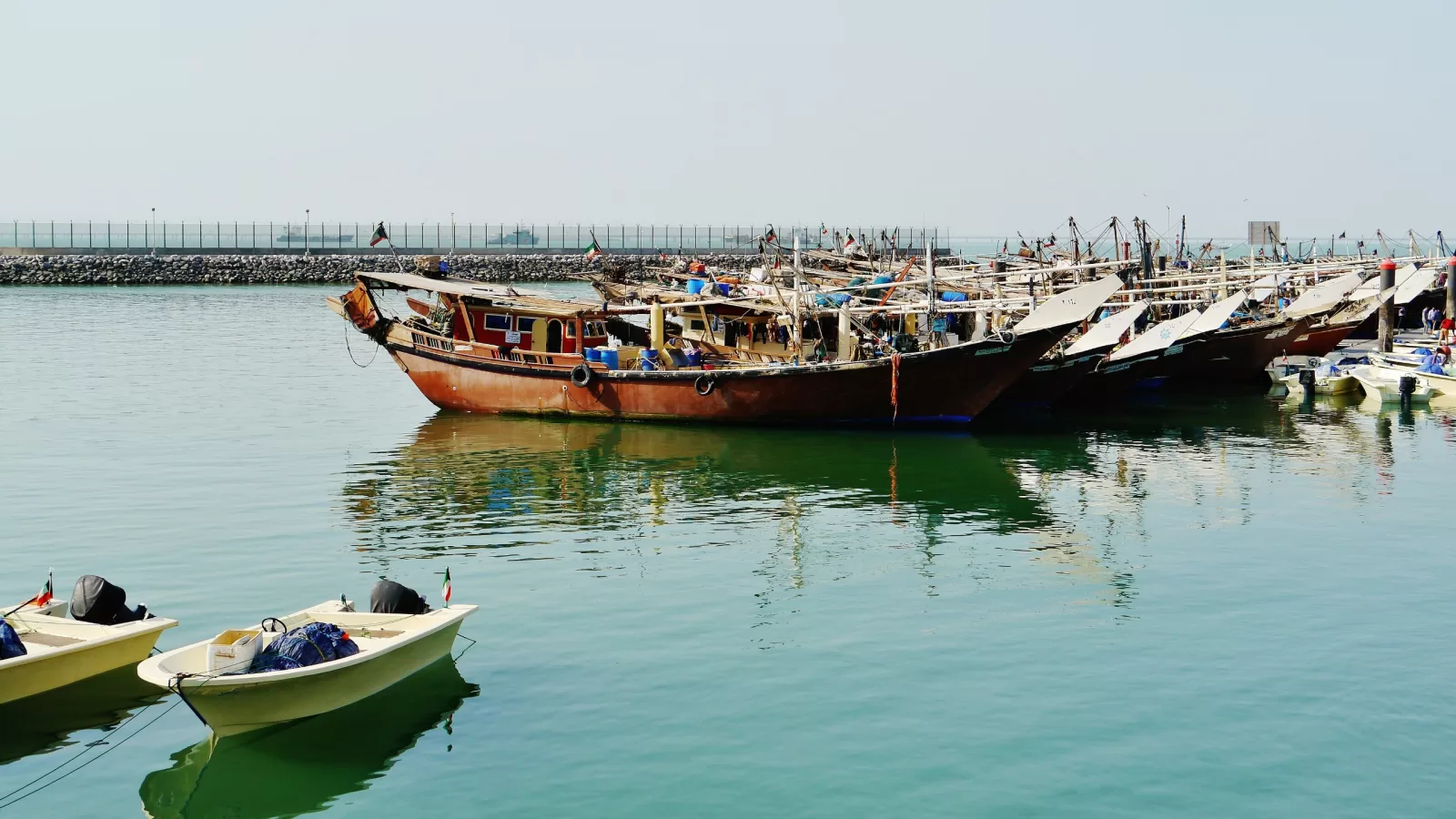
Photograph: the dhow harbour in Kuwait City today, not the old landing place. Photo: Zairon, CC BY 4.0 via Wikimedia Commons.
Source: Omar Al-Dosari’s research on the founding of Kuwaiti customs, with studies by Mohammad Abdulhadi Jamal, Ahmad Abu Hakima, Ahmad Al-Muzaini and Souad Al-Sabah, published as a newspaper series in Al-Qabas and reproduced on the Kuwait History forum.
Kuwait One, once a week.
The most useful stories we published this week, in your inbox.
No spam. Unsubscribe anytime.