The Tareq Rajab Museum is a private family collection, not a state institution. Tareq and Jehan Rajab founded it in 1980, and it now occupies two buildings in the same block of Jabriya. One ticket admits you to both.
Where, when, how much
Tareq Rajab Museum: Block 12, Street 5, Building 22, Jabriya. Tareq Rajab Museum of Islamic Calligraphy: Block 12, Street 1, Building 2, Jabriya. A short walk apart.
Hours as the museum publishes them: Saturday to Thursday, 09:00 to 13:00 and again 16:30 to 20:30. Friday, mornings only, 09:00 to 13:00.
Admission is KD3 for adults, KD1.5 for anyone under 18, and free for children under 6, with the same ticket valid at both museums. There is no booking page and no online ticket on the museum’s site — you turn up and pay at the door.
In the main museum
The Hattin diorama, built by Tareq Nader Rajab in 2023 on a reconstruction of the terrain at the Horns of Hattin, using 3,500 hand-painted miniatures. The large bronze door of Sultan Barquq. The Gold Room, holding pre-Islamic and Islamic jewellery including pieces from the Himalayan region.
The arms and armour collection runs to more than 150 Islamic firearms, from Morocco to India. There is a cast bronze incense burner shaped as a Buddhist stupa, Afghanistan, twelfth century; a North Indian ivory sarinda from the turn of the nineteenth century, shown alongside oud, qanun and nay; Orientalist paintings by David Roberts, Carl Haag and Frederick Goodall; and Coptic weavings of the fifth century beside eighth-century pieces from the Tiraz court workshops.
In the calligraphy wing
Opened to the public in 2007. At its centre stand four burqa — curtains from the door of the Kaaba — with a curtain from inside the Prophet’s chamber in Medina and coverings from the Kiswa and the Door of Repentance. Named calligraphers on the walls include Yaqut al-Musta’simi, Sheikh Hamdullah al-Amasi, Hafiz Osman and Abdullah Sayrafi. A separate Chinese Room holds Chinese Islamic calligraphy on manuscripts and ceramics, mostly Qing period onwards.
Worth knowing first
No temporary exhibition is running. The museum’s exhibitions page says several are in planning and will be announced there and on its Instagram, so this is a permanent-collection visit.
The site publishes no telephone number, no photography policy, no accessibility information and no holiday calendar, so if you need a specific date confirmed, contact the museum directly.
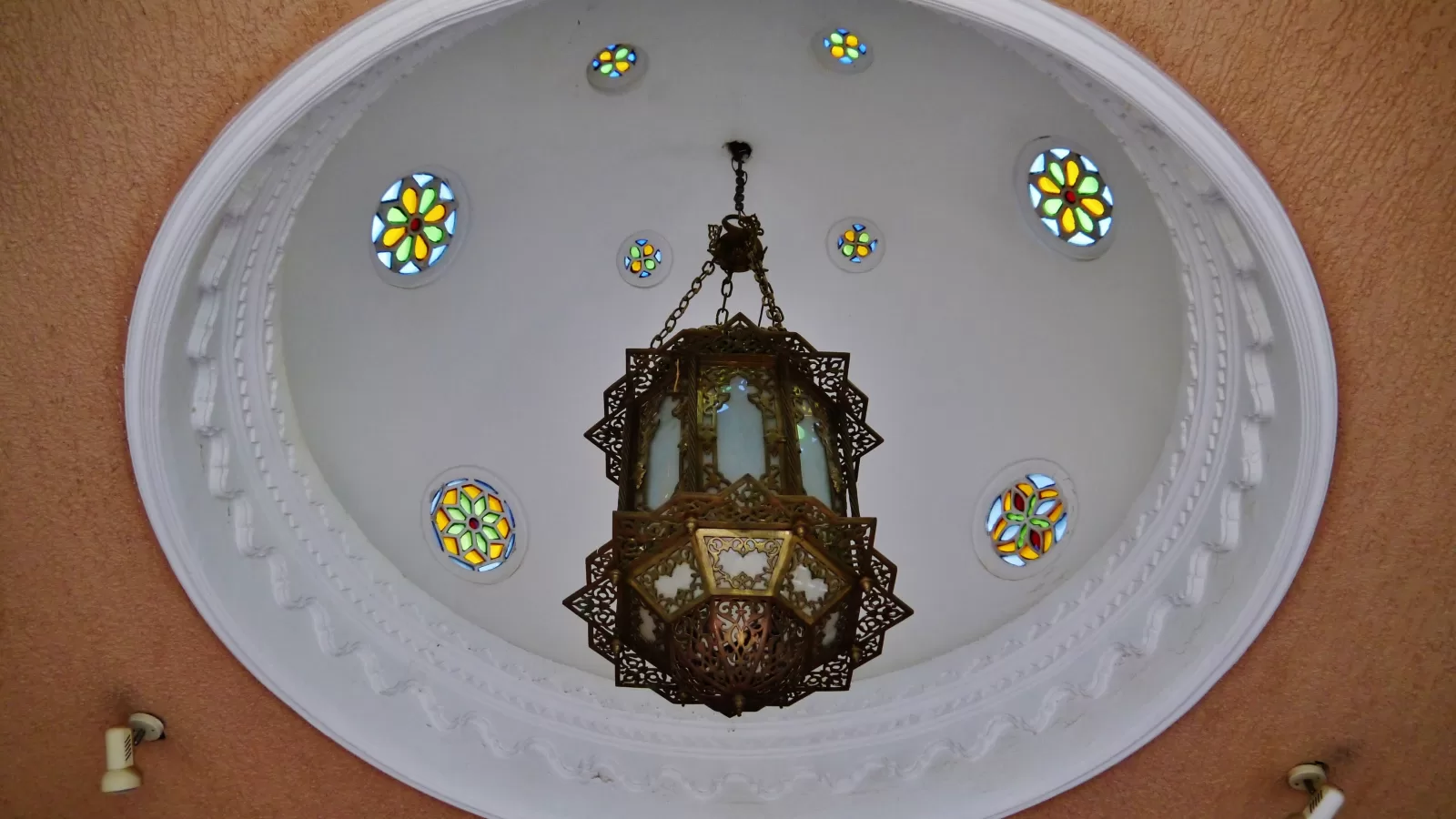
Photograph: a plaster dome and hanging lantern inside the calligraphy museum in Jabriya. Photo by Zairon, licence CC BY 4.0 via Wikimedia Commons.
Source: the museum’s own site, trmkt.org — home page, both museum pages and the exhibitions page, read on 24 September 2026.
Kuwait One, once a week.
The most useful stories we published this week, in your inbox.
No spam. Unsubscribe anytime.