Late in 1922, two men met at Hafiz Wahba’s house in Kuwait town: the writers Sultan Al-Kulaib and Abdulhamid Al-Sane. What they wanted was a club — somewhere thinking people could argue. Clubs in Kuwait at that moment attracted suspicion, so the idea was quietly recast as something no one could object to. A library.
A charity’s shelves, moved into a merchant’s diwaniya
It did not start from nothing. The Arab Benevolent Society had opened Kuwait’s first reading collection in 1913 as one of its activities; when the society wound up, its books were carried to the diwaniya of Ali bin Amer on Anza lane, in the old town’s central quarter. There, in rented rooms, the collection became a library in its own right in 1923.
At its head was Sheikh Yusuf bin Isa Al-Qinai as president, Sultan bin Ibrahim Al-Kulaib as director, and Abdullah Al-Omran as its first librarian. That is the account of the historian Saif Marzouq Al-Shamlan, and it is the one Kuwait’s news agency and the cultural monthly Al-Arabi follow. A competing version, from the librarian Aziza Al-Bassam, dates the meeting to 1922 and the opening to 1924.
Gifts, not subscriptions
Everything it had was given. Abdulaziz Al-Rashid, writing his history of Kuwait in the same decade, records that the town’s benefactors donated to the library and that many valuable books were gathered in its courtyard from them. The ruler passed on the newspapers and magazines that arrived in his name. In 1935 Shaha Al-Hamad Al-Saqr gave a shop she owned in the merchants’ qaisariya to house it.
No source records a membership fee or a monthly subscription. The money side of this institution remains thinly documented — a gap the reviewer of the one scholarly monograph on it, by Ayed Ateeq Al-Juraid, pointed out plainly.
What people read there
It subscribed to the Egyptian papers Al-Balagh, Al-Ahram and Al-Muqattam, to the Syrian Al-Qabas and others. Al-Hilal and Al-Manar circulated among its readers, and those two were the flashpoint: conservative shaykhs objected to the reading of newspapers and magazines at all.
One reader left a description. The writer Khaled Al-Badr, interviewed in 1984, said his family sent him to Basra to study in 1921; he came home in the summers and went to the library at about thirteen, meeting there Sheikh Yusuf Al-Qinai, Khaled Ahmad Al-Mashari, Mohammad Ahmad Al-Ghanim, Saleh Al-Fallah and Mohammad Al-Barrak — the last of whom was there more than anyone.
Visitors noticed it too. The Lebanese traveller Ameen Rihani wrote that Kuwait’s revival rested on two pillars: this library and the schools.
Two hundred books left of fifteen hundred
The premises never settled. The collection moved to a shop on Al-Amir street in the Mubarakiya quarter, then into the Ahmadiya school, where the books sat for a long time and a great many were damaged or lost. When a group of notables set out in 1935 to revive it and counted what survived, they found no more than two hundred volumes, most of them falling apart, out of more than fifteen hundred.
A new board was formed in 1936 — Al-Qinai presiding, Abdullah Al-Omran overseeing operations, Abdulhamid Al-Sane supervising the work — the stock was rebuilt to around fifteen hundred, and a building went up on Al-Amir street.
The year it stopped being private
In 1937 the government folded the library into the education department under Sheikh Abdullah Al-Jabir Al-Sabah, renaming it the Public Knowledge Library and supplying it with Arabic periodicals. The names then changed roughly every decade: Main Knowledge Library until 1962, Main Public Library until 1966, Central Library until 1985, State Central Library until 1994, when amiri decree 52 created the National Library of Kuwait.
What began as a safe substitute for a forbidden club ended as the institution that holds the country’s printed memory. And the number that best sums up its first decade is not how many books it opened with, which nobody wrote down, but how few were left the day someone decided to save it.
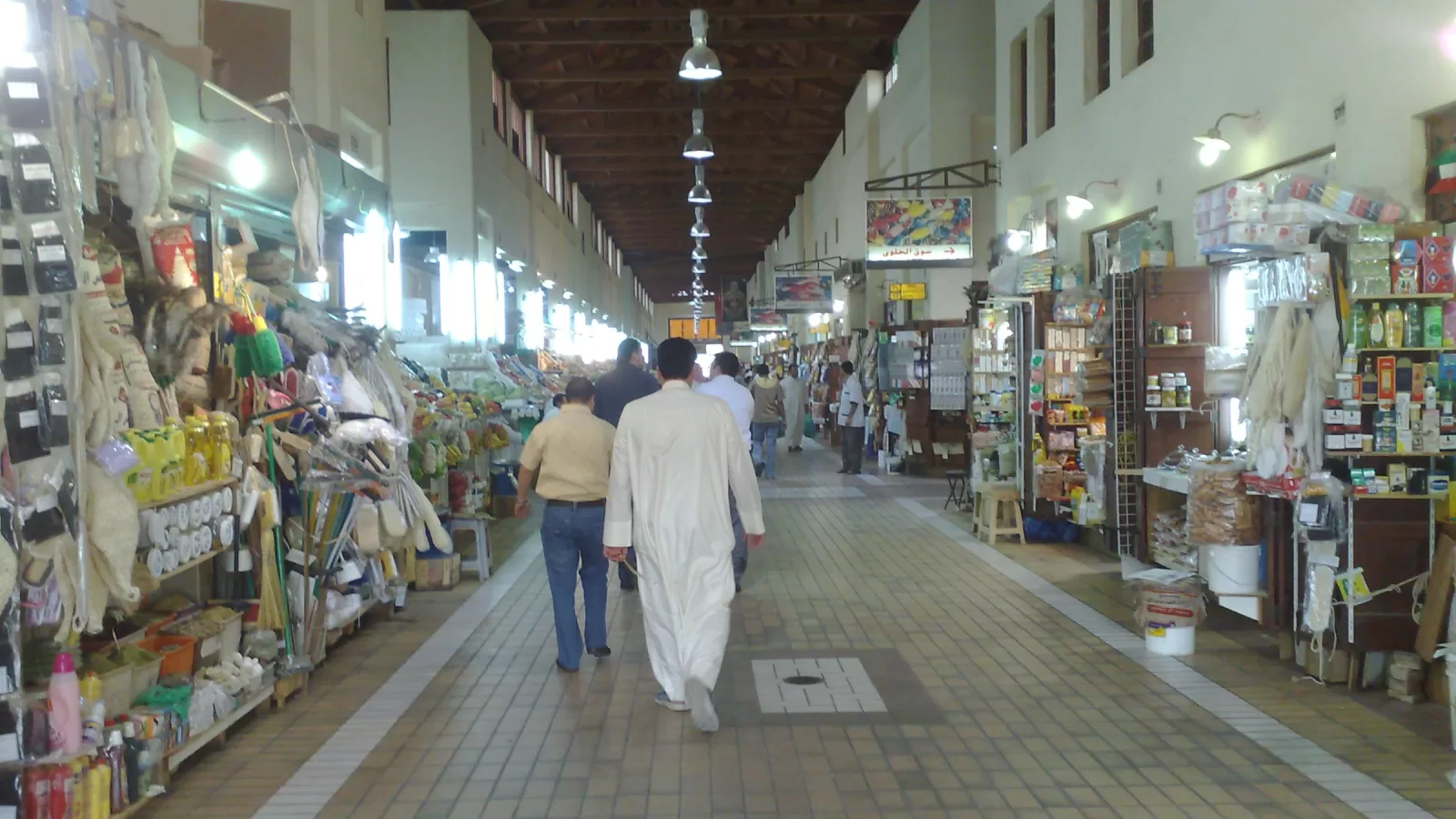
Photograph: an alley in the Mubarakiya souq, the quarter where the library kept a shop on Al-Amir street. Public domain, via Wikimedia Commons.
Sources: Ayed Ateeq Al-Juraid, «The Kuwaiti Ahliya Library 1923-1937», as reviewed in Al-Jarida; Al-Arabi magazine, published by the National Council for Culture, Arts and Letters; Kuwait News Agency.
Kuwait One, once a week.
The most useful stories we published this week, in your inbox.
No spam. Unsubscribe anytime.