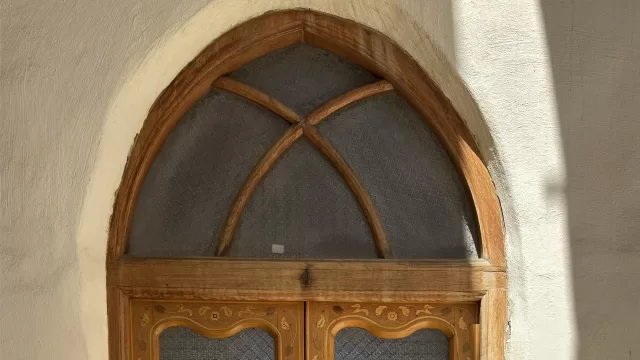

Before Ahmadi was a town, it was tents. As the Kuwait News Agency tells it, Kuwait Oil Company’s workforce grew after the discovery of the Burgan field, and permanent houses had to replace the canvas. That was the start of the town, named after Sheikh Ahmad Al-Jaber Al-Sabah, the tenth ruler, in whose reign the field was found.
Why this ridge
According to the file Kuwait’s National Council for Culture, Arts and Letters submitted to UNESCO, the Kuwait Oil Company founded the township in 1946 on the Dhahar Al-Adan ridge beside the Greater Burgan field. The site was chosen for its height, not its view: from up there, oil could flow by gravity through pipelines down to the export terminals on the Adan coast. KUNA puts the town about 400 feet above sea level, a few miles from the Gulf.
From Nissen hut to veranda
The first phases were temporary and prefabricated, Nissen huts among them. The master plan came from Wilson, Mason and Partners under James Mollison Wilson, who drew on the company town at Abadan and on Garden City thinking: houses spread among trees rather than packed into blocks.
The houses were built for the heat, with verandas, shading devices, cavity walls and planted plots, and they were graded by the occupant’s rank in the company. Those cavity walls also changed the job of ajar brick: once used for decoration and floors, it became a load-bearing material.
A whole town owned by a company
KOC owned, designed and ran the place. Its networks covered drinking water, sewage and wastewater treatment, stormwater, gas, electricity, roads and irrigation, plus district cooling fed by a central chilled-water plant. Mosques and other places of worship for company staff were part of the plan.
After independence and the Kuwaitisation of jobs, Ahmadi turned from a largely expatriate company town into a mostly Kuwaiti residential district.
On UNESCO’s list
On 21 January 2026 the council submitted Ahmadi Company Town to UNESCO’s World Heritage tentative list as a cultural landscape, making it the sixth Kuwaiti site on that list.
Photo: lawn and trees in a park in Ahmadi, taken in 2022. By Kishore R Sudarsan, CC BY-SA 4.0, via Wikimedia Commons.
Source: “Ahmadi Company Town” on the UNESCO World Heritage Centre tentative list (whc.unesco.org/en/tentativelists/6944), submitted by the National Council for Culture, Arts and Letters on 21 January 2026, and the Kuwait News Agency’s account of Ahmadi’s origins as published by Kuwait Times on 17 December 2015. Both read on 13 October 2026.
Kuwait One, once a week.
The most useful stories we published this week, in your inbox.
No spam. Unsubscribe anytime.