Kuwait Towers: a 9,000-cubic-metre water tank that became the national symbol
Ordered from a Swedish firm in 1965, shaped by Danish architect Malene Bjørn, and honoured with an Aga Khan Award in 1980.
Kuwait Towers were built to hold water. In 1965 the Ministry of Electricity and Water commissioned the Swedish engineering and architecture firm VBB to build a modern system for storing and distributing fresh water, with Sune Lindström as chief architect. Until then, water reached homes by tanker truck, even after two seawater distillation plants went up between 1950 and 1953.
The scheme added 33 towers with a combined capacity of more than 100,000 cubic metres, most of them the mushroom-shaped towers spread in clusters around the country. The north of the city, near the shore, needed 9,000 cubic metres of storage — and because that site sits on a promontory jutting into Kuwait Bay, its design got special treatment. In 1967 VBB brought in Bjørn & Bjørn Design, led by the Danish architect Malene Bjørn. The nomination file says Sheikh Jaber Al-Ahmad asked for a distinctive design that would change the bay’s skyline.
Three towers, three jobs
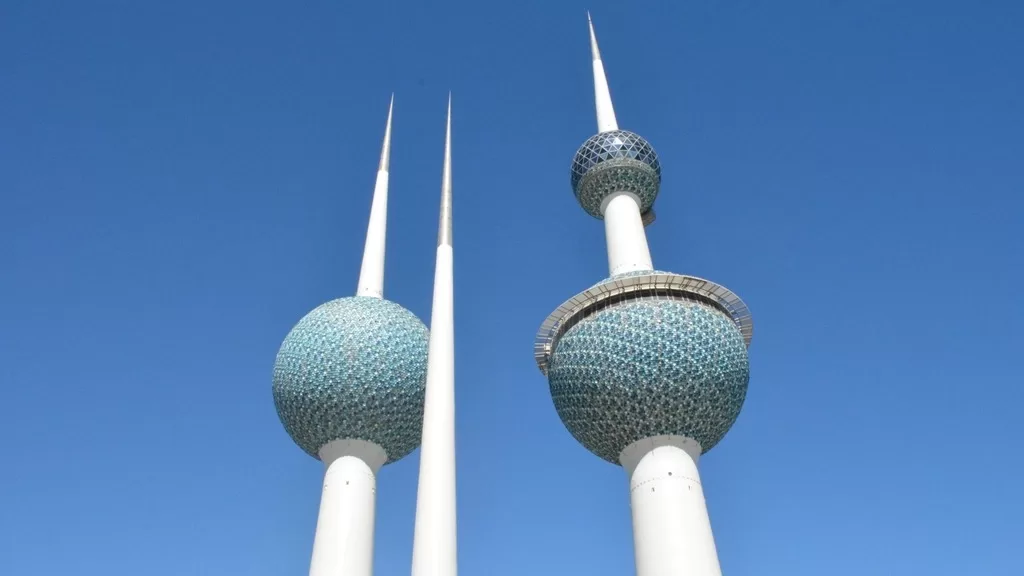
The tallest is a hollow concrete shaft about 185 metres high — at the time the tallest structure in the Middle East. It carries two spheres. The lower half of the larger one is a reservoir of just over 4,500 cubic metres; the upper half holds a restaurant, a banquet hall and an indoor garden. The smaller sphere, about 120 metres up, has a viewing platform that turns through 360 degrees.
The second tower carries a single sphere used only for water and is closed to visitors. The third, 100 metres tall, is a plain white needle with floodlights that light up the other two.
41,000 enamelled discs
The concrete is white, and the spheres are clad in 41,000 enamelled steel discs in blues, greens and greys, a nod to the mosaic domes of mosques. The tips are sheathed in stainless steel welded to the reinforcement all the way to the ground, so they double as lightning conductors. Because the soil near the sea was poor, the builders used both reinforced and prestressed concrete; the viewing sphere is triangular glass panes held in an aluminium space frame.
An award, then a nomination
The Aga Khan Award record gives 1976 as the completion year, while the file prepared by Kuwait’s National Council for Culture, Arts and Letters puts the opening on 26 February 1977. In 1980 the towers won the Aga Khan Award for Architecture in its first cycle; the jury called them a “bold attempt” to bring together modern technology, aesthetics, function and public facilities.
On 12 June 2014 the National Council submitted Abraj Al-Kuwait to UNESCO’s World Heritage Tentative List, noting that the towers still do the job they were built for: storing water.
Photo: the spheres of Kuwait Towers against a clear sky. Public domain (CC0), via rawpixel.
Source: UNESCO World Heritage Centre, Tentative List: Abraj Al-Kuwait (submitted by the National Council for Culture, Arts and Letters, 2014); Archnet: Water Towers, Kuwait City, Aga Khan Award for Architecture 1980.
Kuwait One, once a week.
The most useful stories we published this week, in your inbox.
No spam. Unsubscribe anytime.