The naqa’a: harbours of hand-cut sea rock, laid without cement, that sheltered Kuwait’s ships
Walls four metres high on a three-metre base, an entrance turned away from the north wind, and more than forty pools along the shore named after their owners.
Before modern ports, the shore of Kuwait City was lined from east to west with stone-walled pools called naqa’a (plural niqa’). In his book on Kuwait’s old maritime life, the historian Dr Yacoub Yousef Al-Hijji describes each one as a coastal basin enclosed by a wall of sea rock, built to protect ships from the waves the northerly wind whipped up across Kuwait Bay, and to repair them between voyages.
How the walls were built
Sailors broke the rock by hand from nearby reefs and ferried it in boats kept for the job, then stacked it, stone on stone, with no cement. On the large basins the wall rose four metres on a three-metre base, with gaps left at the bottom so seawater could flow in and out.
Builders followed rules every sailor knew. The wall was curved, as close to a half-circle as possible, so waves broke along it instead of striking it head-on. Each basin needed a way in and a way out, so the tide could flush out mud and fine sand. And the entrance did not face north; where it had to, it was shaped to stop waves rushing straight in. Rashid Al-Rabah was one of the master builders of the craft.
The parts of a naqa’a
- Al-Qaf: the seaward rock wall, pronounced with a hard “g”.
- Al-Fatiq: the side gap in the wall between one basin and the next.
- Wayyat al-naqa’a: the mouth ships sailed in through.
- Al-Hibs: a smaller, broad rock wall with steps down to the sea, where women washed clothes and boys swam and fished.
Who owned them
A leading seafaring merchant usually paid to build a basin, and it took his name. Others joined him to moor their ships there, and each paid towards upkeep according to how many ships he kept in it. The smaller pearling boats were not left in the water; they were hauled up the beach at the end of the season.
The researcher Mohammed Abdulhadi Jamal counts more than forty basins in his book on Kuwait’s old markets, among them the Shuyoukh, Shamlan, Marafie, Al-Nisf, Boursli and Dasman basins in Sharq, and the Ghunaim, Marzouq, Khalid, Badr, Abduljalil and Al-Sayer basins in Jibla. Shamlan’s was the largest in the eastern quarter, with ships moored row behind row, the smaller ones nearest the shore. In Jibla, the Abduljalil basin sheltered the family’s baghla ships, some of which carried horses to India.
Once pearling ended in the 1950s and the shoreline was rebuilt, the basins passed into memory.
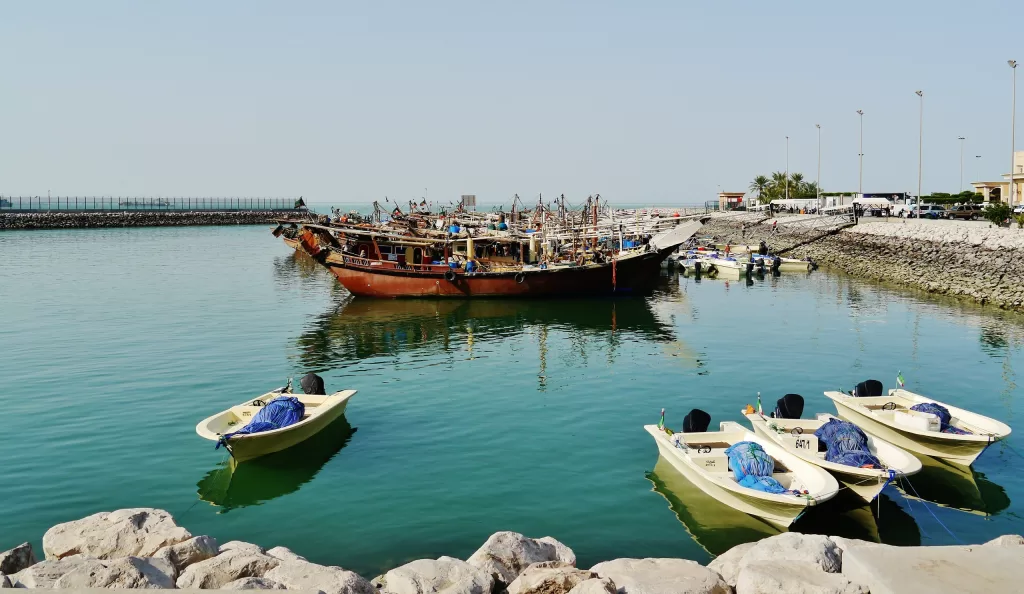
Photo: wooden dhows moored behind a rock breakwater at today’s dhow harbour in Kuwait City, not an old naqa’a. By Zairon, CC BY 4.0, via Wikimedia Commons.
Source: Dr Yacoub Yousef Al-Hijji, Old Maritime Activities in Kuwait, via Al-Anba’s “Bahri” page, 21 March 2012; and Mohammed Abdulhadi Jamal, Old Markets of Kuwait (2004), and Saif Marzouq Al-Shamlan, History of Kuwait and the Arabian Gulf, via the thread “Old naqa’a of Kuwait City” on the Kuwait History forum.
Kuwait One, once a week.
The most useful stories we published this week, in your inbox.
No spam. Unsubscribe anytime.