6 GHz Wi-Fi in Kuwait: only the lower part of the band, and indoors only
CITRA's rules open 500 MHz at 200 mW. Saudi Arabia went for more than twice that.
Wi-Fi 6E and Wi-Fi 7 routers add a third band, 6 GHz, to the familiar 2.4 and 5 GHz. It is wider and far less crowded. How much of it you are allowed to use, though, depends on where you live, and Kuwait has opened part of it, with conditions.
What the regulation allows
The technical schedule in the Wi-Fi Service Regulation published by CITRA, Kuwait’s telecoms regulator, sets out the 6 GHz band like this:
- Frequencies: 5925 to 6425 MHz, a 500 MHz slice.
- Power: 200 mW radiated.
- Where: inside buildings only.
- Standard: the European EN 303 687.
The Wi-Fi Alliance’s tracker of 6 GHz rules lists Kuwait alongside the UAE, Qatar, Bahrain and Oman on the same lower portion. Saudi Arabia adopted the whole band, 5925 to 7125 MHz, which is 1200 MHz.
What it means in practice
- Your new router can use 6 GHz at home. If both the router and your device support Wi-Fi 6E or 7, the band is yours indoors.
- No outdoor access points on it. The rule keeps 6 GHz inside buildings, so it is not for covering the yard or garden.
- Fewer wide channels. 500 MHz holds fewer of the very wide channels than countries that opened the full band. That matters more in a crowded apartment block than in a standalone house.
- Equipment needs approval. Devices on these frequencies must be type-approved for Kuwait, and anyone wanting to use an unapproved device has to apply for certification. Modifying a device’s specifications without CITRA’s written consent is banned, as is marketing power amplifiers for this kind of equipment.
And 2.4 and 5 GHz
The same schedule allows 2.4 GHz from 2400 to 2483.5 MHz at 100 mW, with channels 1 to 13. The 5 GHz band is split into segments between 5150 and 5825 MHz, reaching 500 mW in the upper segments, where dynamic frequency selection and transmit power control are mandatory. Wi-Fi on these two bands is a secondary use: if it causes harmful interference to another service, the equipment has to be switched off.
For the router settings themselves, from the network name to channel width, see one name for your home network.
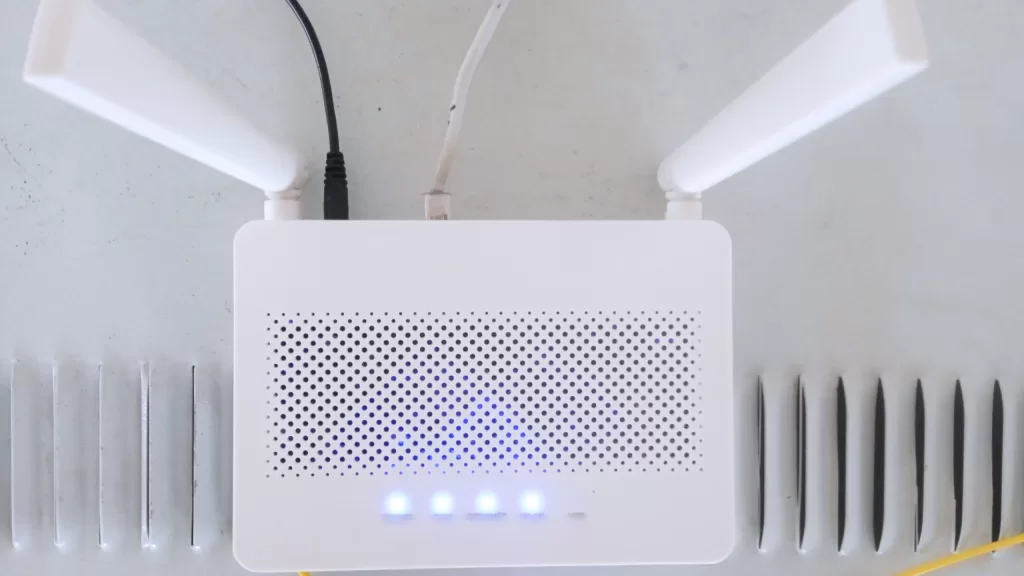
Photo: A home wireless router with two antennas. By Solijon Solayev, CC BY-SA 4.0 via Wikimedia Commons.
Source: CITRA, Wi-Fi Service Regulation, Article 2 and the technical schedule in Article 4 (citra.gov.kw); Wi-Fi Alliance, “Regulations Enabling 6 GHz Wi-Fi”. Both read 10 November 2026.
Kuwait One, once a week.
The most useful stories we published this week, in your inbox.
No spam. Unsubscribe anytime.