The Fahaheel wall: a village raised 1,400 rupees in one café sitting and built its own defences in a month
After the Battle of Jahra, Kuwait’s ruler asked the southern settlement to guard the frontier. Its people answered with mud, palm trunks and sea rock.
Most people know about Kuwait City’s third wall. Far fewer know that Fahaheel, the pearl-diving and farming village on the southern coast, once had a wall of its own, built by its residents in 1921 and paid for by a collection taken in a single café sitting.
Guarding the southern flank
After the Battle of Jahra in 1920, the threat of renewed Ikhwan raids was still what everyone talked about. Fahaheel was the last sizeable village to the south, surrounded by date palms and sidr trees, and its grazing land had already been raided. Sheikh Salem Al-Mubarak, then ruler, asked Jassem Al-Abdullah Al-Dabbous, the village’s emir, to hold Kuwait’s southern frontier. The Al-Dabbous family had moved down from Sharq in 1901, when Sheikh Mubarak appointed Jassem to govern Fahaheel.
Timber from the state, wages from the café
Jassem sent his son Sultan to the city on horseback. The answer came from Sheikh Ahmad Al-Jaber, then crown prince: the government would supply the two gates, the mangrove poles, the beams, the reed matting and all the timber, but it had no cash to spare after the battles of Hamdh and Jahra.
That left the builders’ wages. Mishari Al-Roudhan took Sultan to the Abu Nashi coffee house in Souq Bahaitah, where merchants and craftsmen gathered, and put the request to the room: 1,400 rupees. A tray went round, the men gave more than was asked, and Sultan was told to count it in front of them.
Four metres of mud and sea rock
Work began in Ramadan and finished about a month later, in May 1921, with families across the village pitching in and four master builders setting the angles and heights. The result was roughly square, about 500 metres around, made of mud, palm trunks and rock from the shore. It stood four metres high, about a cubit and a half thick at the base and a cubit at the top.
There were two entrances: one on the east, facing the sea, for fishing and pearling trips, and one on the west towards the desert and the road to Kuwait City. Four corner towers, called ghoul, had firing slits at the top. The wall never enclosed every house in the village.
Jassem set one condition: anyone who did not contribute could not live inside the wall, though they were welcome to shelter there if a raid came.
Taken down without a fight
Once the Ikhwan threat ended in the 1930s, the wall had no job left. Oil brought refineries and the new town of Ahmadi next door, Fahaheel spread outwards, and the wall was pulled down bit by bit in the mid-1950s until nothing remained. Older residents still place its towers by today’s landmarks: one by the old fish market, another near the Al-Dabbous mosque inside the souq, a third by the Ajyal market.
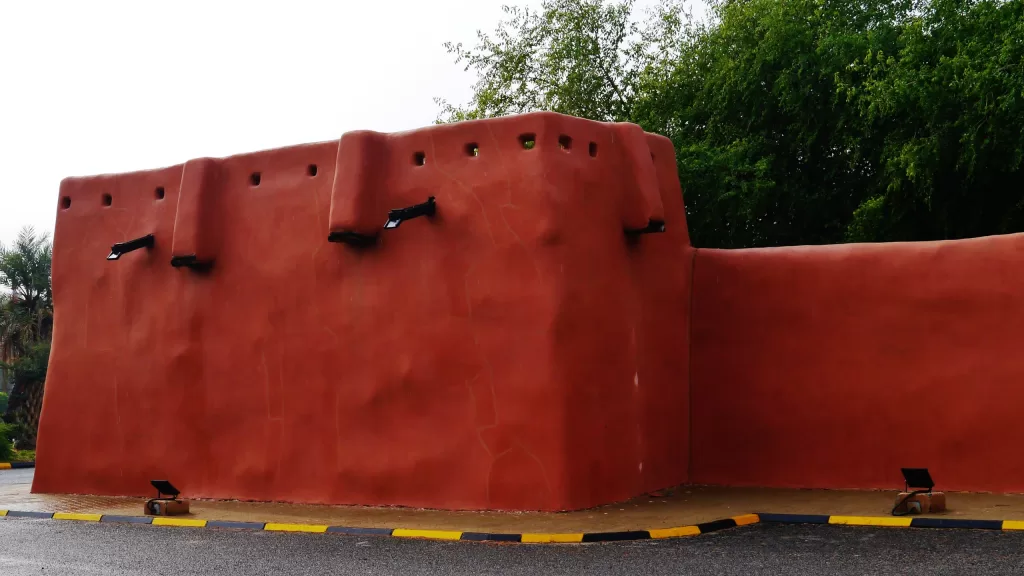
Photo: A corner tower of the Red Fort wall in Jahra, built of mud like the Fahaheel wall, not the Fahaheel wall itself, of which nothing survives. Zairon, CC BY 4.0, via Wikimedia Commons.
Sources: Adel Hassan Al-Saadoun, “The Fahaheel Wall”, Al-Qabas, 11 May 2007, based on interviews with Salman Abdullah Jassem Al-Dabbous and other family members, as republished on the Kuwait History forum; heritage researcher Hussain Al-Qattan speaking to KUNA, as reported by Al-Wasat, 8 March 2018.
Kuwait One, once a week.
The most useful stories we published this week, in your inbox.
No spam. Unsubscribe anytime.