The Al-Loughani Family: A Rupee for Every Poor Neighbour, and a Poet Who Kept Quiet
Two waves from the southern Gulf, a pearl dealer on the Bombay steamers, and a diwan saved in 1999
The Al-Loughani family reached Kuwait in two waves during the nineteenth century, according to the historian Farhan Al-Farhan. The first group arrived early in the century and settled in the Qibla quarter; the second came around mid-century and settled in Sharq. Both came up from the southern Gulf, from around Qatar and Bahrain. The name is also written Al-Lougani, and the family traces its line to the Tamim tribe.
A pearl dealer on the Bombay run
Saad bin Abdulaziz Al-Loughani, born around 1860, belonged to the second wave. Al-Farhan describes him as a well-known trader and tawash, a pearl dealer, who spent most of the year in Bombay and Karachi and travelled on the British steamers that called at Gulf ports and Basra. He took his sons Abdullah and Abdulaziz to India with him, where they were schooled and picked up several Indian languages.
Al-Qabas, quoting his contemporary Thunayan Al-Omairi, records that every year when Saad paid his zakat, the poor of the Sharq quarter would line up outside his house and each would be handed one rupee. He suffered heavy trading losses late in life and died on 31 January 1945, aged 85, an entry noted in the diaries of Ahmad Al-Bishr Al-Rumi, later published by Dr Yacoub Al-Ghunaim.
The poet who kept quiet
His son Abdullah, born around 1895, learned to read at a Quran school under Sheikh Yousef bin Issa Al-Qinai. He loved poetry from childhood but hid it from his parents, and went on hiding it even after he married, sharing verses only with the friends who came to his majlis at home: Fahad Abdulmohsen Al-Fahad, Ahmad Al-Bishr Al-Rumi, Abdullah bin Ghassab and Zaid Al-Harb among them.
His best-known poem is an elegy for Sheikh Ali Al-Salem Al-Sabah, killed at the battle of Al-Riqai in 1928, and singers including Saada Al-Breiki, Awda Al-Muhanna and Awwad Salem set his words to music. He died at Al-Amiri Hospital on 16 September 1967. His work was nearly lost until Bassem Al-Loughani, his brother’s grandson, gathered it into a diwan published in 1999.
First class at Al-Mubarakiya
His brother Abdulaziz, born in 1901, was among the first intake of Al-Mubarakiya School when it opened in 1911, Al-Farhan writes, citing a history of education by Adel Al-Abdulghani. A lover of music, he collected rare recordings of Kuwait’s early singers and gave them to Kuwait Radio in the 1960s.
Abdullah’s son Issa taught generations of Kuwaiti pupils from the 1940s to the 1960s, and the Ministry of Education named a primary school in Sabah Al-Salem after him. The family had its sea names too: Saif Marzouq Al-Shamlan’s history of pearl diving lists Nakhoda Abdullah bin Mijren Al-Loughani among the best-known diving captains of the Qibla quarter, and the oarsman Yousef bin Ali Al-Loughani, whose strength earned him double the usual share.
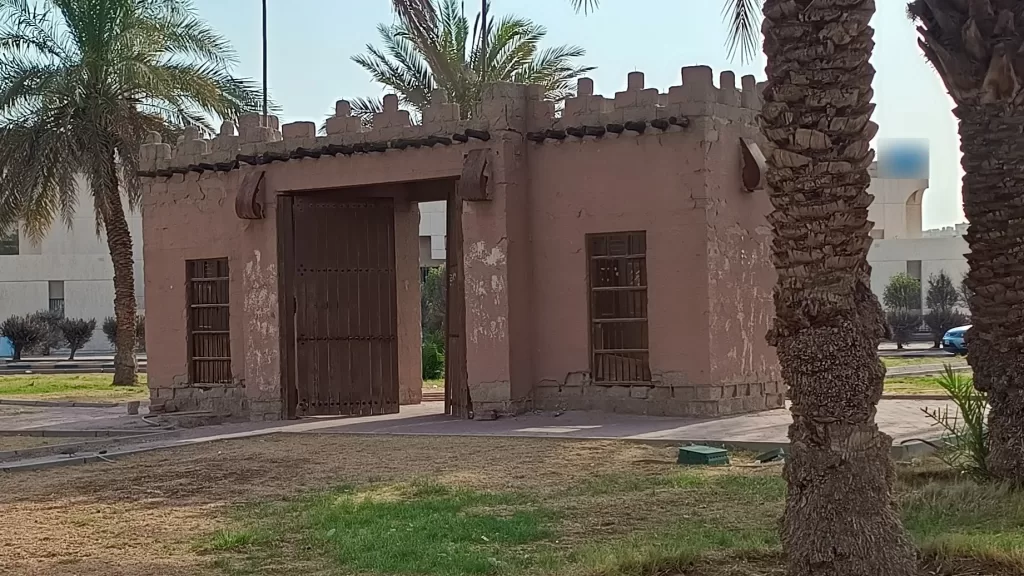
Photo: A mud-brick gateway of an old house among palms in Khaitan, Kuwait. Not the family’s house. Basil Babu velamattathil, CC BY-SA 4.0, via Wikimedia Commons.
Source: Farhan Al-Farhan, “Al-Loughani in the eastern Arabian Peninsula”, Al-Qabas, 6 June 2002 (reposted on the Kuwait History forum); “A biography of a poet oblivion nearly took”, Al-Qabas, 16 September 2005.
Kuwait One, once a week.
The most useful stories we published this week, in your inbox.
No spam. Unsubscribe anytime.