10 November 1936: twenty schoolboys waited at Mutla for four teachers from Palestine
Ghanem Al-Ghanem was one of them. He remembered what changed at Al-Mubarakiya next: a new curriculum, and Kuwait’s first scout troop.
In the autumn of 1936, Al-Mubarakiya School was waiting for four teachers from Palestine. Soon after the Education Council was set up, it wrote on 5 September 1936 to the Mufti of Jerusalem, Haj Amin al-Husseini, asking him to nominate four teachers for the school, with Kuwait’s education budget covering their pay and costs, Al-Qabas reported, citing Saleh Shehab’s history of schooling in Kuwait. The four who arrived, according to an eyewitness and the Kuwait History forum, were Ahmad Shehab Al-Din, Mohammad Al-Maghribi, Khamis Najm and Jaber Hassan Hadid; the nominee list in Al-Qabas has Dhu al-Kifl Abdullatif in place of Hadid.
Twenty boys at Mutla
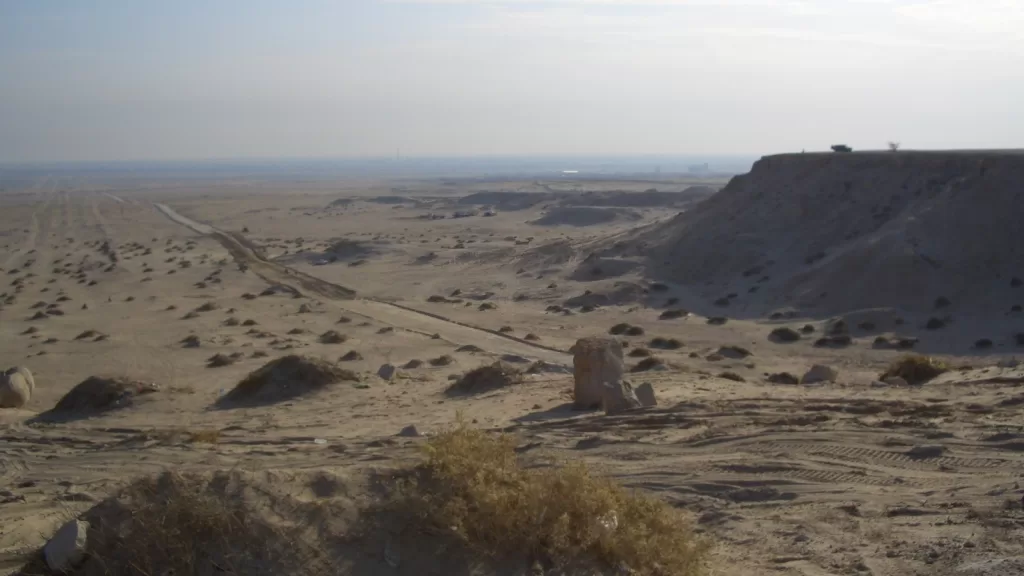
Ghanem Yousef Al-Ghanem, then a pupil at Al-Mubarakiya, told Al-Anba in 2010 that the teacher Khaled Al-Nasrallah was asked to pick twenty boys for the welcome. They rode with officials in four open cars out through the Jahra Gate to Mutla on an unpaved track, arriving two hours later at sunset, and sat by a water jar and a single room asking every passing car about the teachers. One driver said he had seen a car carrying men in red tarbooshes. About three hours after the night prayer, two cars arrived with the four teachers, and the party reached town at midnight.
A night of watchmen
The teachers were put up in a hotel and didn’t sleep. In the morning they complained about madmen shouting all night; the official explained that what they had heard was the nawateer, the market watchmen, calling to one another. Houses were then rented for them near the school. Some got about by bicycle, and Jaber Hadid bought a donkey.
A new curriculum, and a scout troop
Ahmad Shehab Al-Din was made head of Al-Mubarakiya as soon as he arrived, Al-Qabas reported. The curriculum switched from the Iraqi to the Palestinian one; pupils protested, and the guards broke them up with canes, Al-Ghanem recalled. In the same school year, 1936–1937, Al-Maghribi founded the Mubarakiya scout troop, Kuwait’s first. He asked each boy for two and a half rupees and chose thirty of eighty. Al-Ghanem said his mother sold a wooden chest for forty rupees so he wouldn’t feel poor.
A march through the merchants’ market
The troop marched with drum and bugle from Freej Al-Fahad, opposite the school, to Safat Square, merchants stepping out of their shops to watch and some onlookers throwing pebbles because the scouts showed their legs. Then came Kuwait’s first scout camp, near Shamiya, for a whole month in spring, with water carried in skins from the Shamiya wells. Sheikh Abdullah Al-Jaber visited after the afternoon prayer and brought sheep.
After them
More missions followed: a second in 1938, then the first Palestinian women teachers in 1939 for girls’ schooling, according to the Kuwait History forum.
Photo: Mutla, north of Kuwait City, where the boys waited in 1936. By Mishari Alarfaj, CC BY-SA 1.0, via Wikimedia Commons.
Source: Ghanem Yousef Al-Ghanem interviewed by Al-Anba, 2 October 2010; “The history of football in Kuwait” in Al-Qabas; and “The first Palestinian teachers in Kuwait” on the Kuwait History forum.
Kuwait One, once a week.
The most useful stories we published this week, in your inbox.
No spam. Unsubscribe anytime.