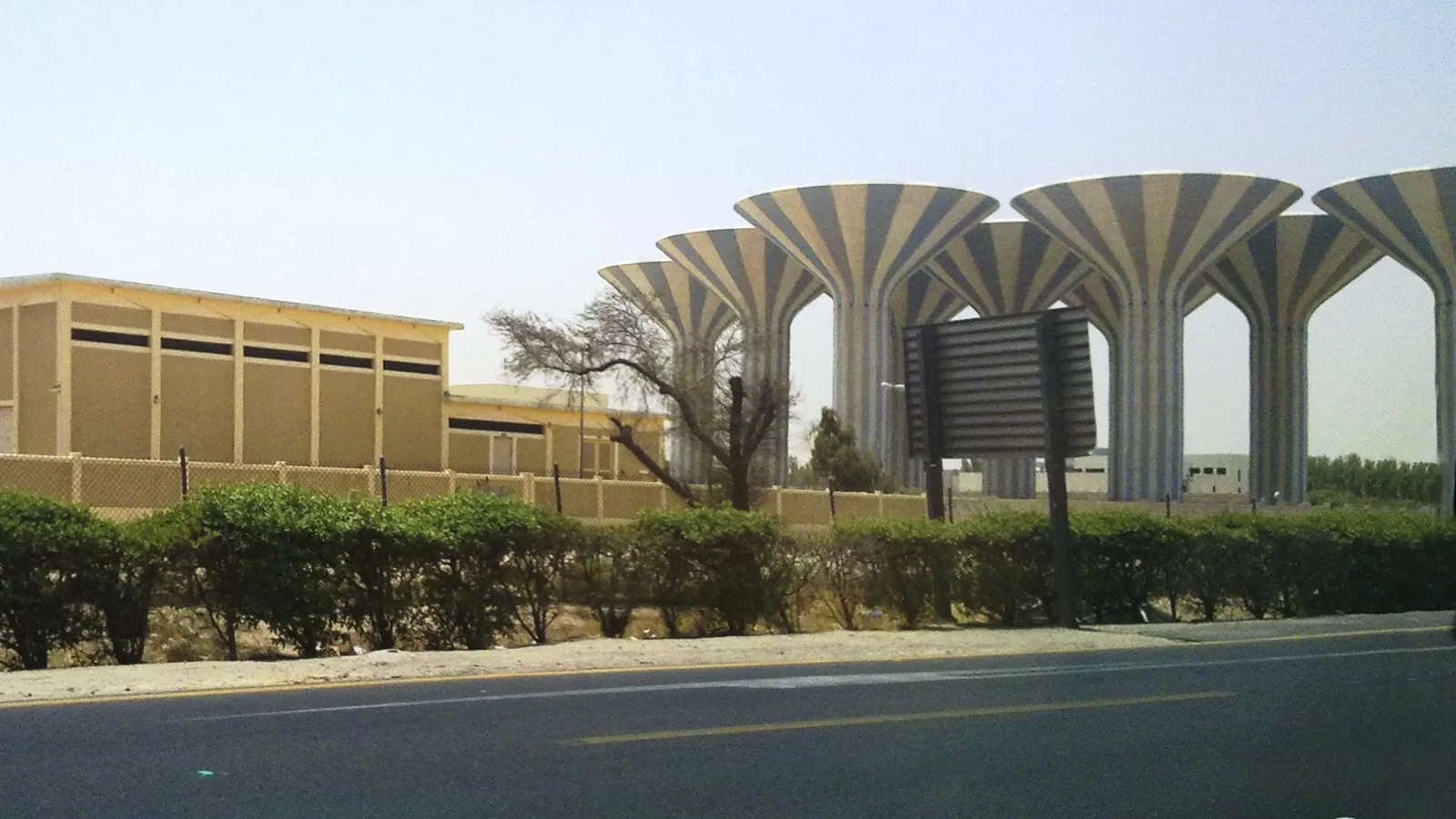
Visitors photograph the three towers on the bay. Residents live with the other ones: thirty-three concrete stems topped with fluted cups, standing in five groups along the motorways and between the districts, holding up Kuwait’s water since 1976.
Who drew them
The client was the Ministry of Electricity and Water. The design came from the Swedish practice VBB — Sune and Joe Lindstrom, Stig Egnell — working with Bjorn and Bjorn Design and Malene Bjorn.
The shape is the engineering
The flared head that gave the towers their nickname is not decoration. A raised reservoir puts the network under pressure by height alone, so water reaches a tap because of where it is stored rather than because a pump is pushing it there at that moment. Lift the tank, and the whole district gets a steady supply without a machine running at every corner.
The numbers
Storage across the scheme comes to more than 100,000 cubic metres. The northern group, set on a headland over Kuwait Bay, holds 9,000 of those on its own, and was given particular care in the design because of how visible it is. Each of the five groups differs from the others in how many towers it has, how tall they stand and how they are patterned — which is why each one reads as a marker for its own district.
The award
The towers took the Aga Khan Award for Architecture in the 1978 to 1980 cycle, the prize’s first. A municipal water tank had entered the architectural record as a piece of public infrastructure that became a national silhouette.
Photograph: a group of the water towers seen from the roadside. Photo by irvin calicut, CC BY-SA 3.0 via Wikimedia Commons.
Source: Aga Khan Award for Architecture, “Water Towers” project file, Aga Khan Development Network.
Kuwait One, once a week.
The most useful stories we published this week, in your inbox.
No spam. Unsubscribe anytime.