
When the temperature drops and the cold gets into Kuwaiti houses, people look for warmth in everything — clothes, gatherings, and food. And tashreeba is one of the fixtures of the Kuwaiti winter table: not simply a dish that fills you, but one tied in the memory to childhood, to a grandmother, and to sitting round the tray.
What tashreeba is
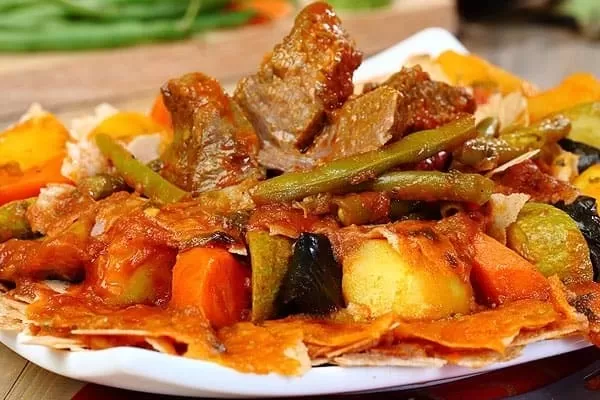
Tashreeba is a traditional Kuwaiti dish made from regag or Iranian bread, torn up and soaked in meat or chicken broth and cooked with vegetables. The ingredients shift a little between households, but the governing rule is a rich broth and bread that drinks it until it dissolves into the flavour.
Where it comes from
Researchers on Gulf cooking trace tashreeba back to older Arab cooking, where soaking bread was common in times of scarcity. Kuwaitis developed it into something else: a winter dish, and one served at small occasions and through Ramadan. Grandmothers made a point of preparing it for the household after the sunset prayer, when everyone gathered in the diwaniya or around the tray.
Ingredients and method
Tashreeba is usually made with lamb or chicken; fresh tomato and tomato paste; onion and garlic; assorted vegetables such as courgette, potato and sometimes carrot; and a traditional Kuwaiti spice mix — turmeric, cardamom, dried lime, black pepper and cinnamon. It is served with fresh regag or Iranian bread.
The meat or chicken is cooked with the onion and spices until done, then the vegetables and water go in and it is left to boil down into a rich broth. At serving, the bread is torn and drowned in that hot broth, so the pieces take up the flavour.
Then and now
Tashreeba may look like a plain dish beside the variety of a modern kitchen, but it carries considerable weight. It is the dish of mothers and grandmothers, and of a Kuwaiti winter. And with the new generation’s interest in traditional cooking there are attempts to present it differently — in earthenware, with hand-made bread, or on the menus of contemporary Kuwaiti restaurants trying to bring the inherited food back in a modern register.
A social dish
In the past tashreeba was among the dishes served at small invitations, at winter occasions, and in mosques after the Friday prayer. Some families made a habit of cooking it and distributing it to the neighbours during Ramadan.
Today some cafes and younger restaurants in Kuwait have added it to their lists, on the wave of heritage revival, served neatly with modern additions such as crisped onion or a spoonful of laban on the side.
Further reading: the National Council for Culture, Arts and Letters · the Center for Research and Studies on Kuwait
Kuwait One, once a week.
The most useful stories we published this week, in your inbox.
No spam. Unsubscribe anytime.