The Daraa and the Bukhnaq: How Kuwaiti Women Dressed
A long loose gown cut by hand from cloth chosen in the souk or in India, and a girl's headscarf edged with fine gold thread. What each one signalled, and when it was worn.
In a time when no label decided what was elegant and no magazine set the season, Kuwaiti women knew exactly what to wear, when and why. Clothes were a language: each piece had a story, each colour a meaning. Two of them stayed in the memory more than the rest — the daraa and the bukhnaq.
The daraa
The daraa was not simply house clothing; it was the clearest statement of how a woman presented herself. Long, loose and flowing, usually made from light cotton or silk, in bright colours and distinctive patterns. It was not bought ready-made but cut by hand, its cloth chosen carefully from the local markets or from India, where Kuwaiti merchants had long-standing trading ties.
Its forms varied with the occasion:
- The house daraa: light and practical, worn at home. Colourful, easy to move in, simply embroidered.
- The occasion daraa: more elaborate, sometimes embroidered with gold or silver thread, worn at weddings or when receiving guests.
- The Eid daraa: prepared specially in the days before Eid. Its colour was a personal choice and its patterns carried the mood of the day, and girls wore it visiting houses through the Eid days.
Women exchanged the names of skilled tailors the way they exchanged recipes, and a daraa was judged on its cut and the balance of its colours rather than on its price.
The bukhnaq
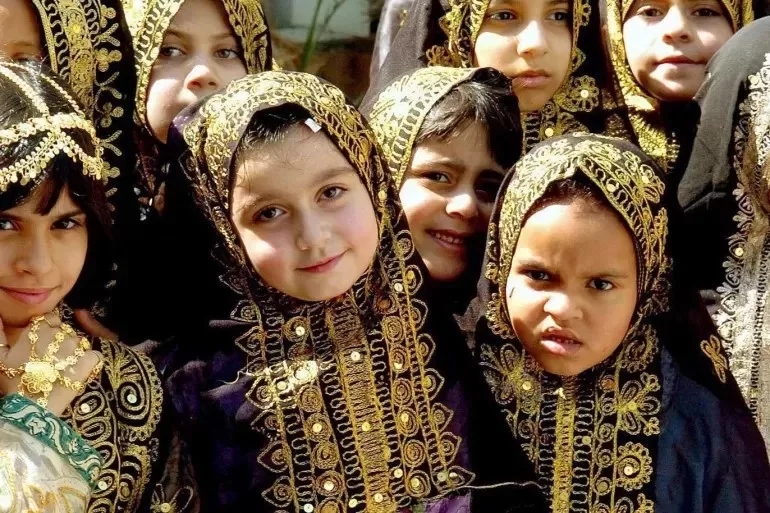
The bukhnaq is the young girl’s headscarf. Girls wore it as they began learning to cover, and it became part of how they appeared at school, at home and at occasions. It was usually made of chiffon or light cotton, with simple embroidery around its edges.
It was not imposed but was a gentle stage. Mothers sewed it by hand, sometimes in pure white and sometimes in a brownish black, edged with fine gold or silver thread known as telli.
In the morning, girls walked to the kuttab or the school with the bukhnaq over their heads — an image the memory holds.
Colours and patterns
The colours followed the season. In summer, light blues, mint green and bright yellow. In winter, women turned to burgundy, deep violet and warm khaki. Wearing bold colour was uncontroversial; confidence came from the wearer rather than from a trend.
The patterns were drawn from the surroundings: palm leaves, small flowers, and motifs borrowed from the old Kuwaiti shanasheel screens and doors.
Each girl had a small drawer holding her folded gowns, her pressed bukhnaq, her hair clips and her own perfume — often made by her mother from oud oil or rose.
Elegance without volume
The detail carried it: the gown matched to a silver bangle, the way the hem was folded when sitting down, the smile that finished the look. It was quiet rather than loud, and drew on an appreciation of plain things.
At weddings a woman wore a special daraa, completed with a black abaya worked in silk thread, and a boshiya in an elegant colour covering the face in half-transparency.
From the past into modern wardrobes
Today you will not see daraas in the street, but they live on in houses, in grandmothers’ wardrobes, in gift boxes given in Ramadan, and in markets that reproduce them with contemporary touches. The bukhnaq has become part of the memory, appearing at heritage occasions and in schools that mark a “heritage day”.
Further reading: the National Council for Culture, Arts and Letters · the Center for Research and Studies on Kuwait
Kuwait One, once a week.
The most useful stories we published this week, in your inbox.
No spam. Unsubscribe anytime.