Street Games Kuwaiti Children Played
Hila, darbaha, maqsa, anbar and the Eid swing. What each one needed, and the rules the players made up themselves.
In the streets of old Kuwait, between the narrow quarters and the sandy yards, children’s games ran until sunset. There was no grass pitch and nothing electronic: the ground was the pitch, a stick was the equipment, and pebbles were the decoration.
Kuwaiti children’s games were physical and collective, built on simple skills and inherited songs, and nearly always played outdoors — after school hours, or in the late afternoon and evening when the heat dropped.
Hila (hopscotch)
One of the best-known girls’ games. Adjoining squares were drawn on the ground with charcoal or something sharp, and the girl hopped through them on one foot after throwing a small stone called the dabba. It took balance and precision, and girls competed at it hard, cheered on by their friends.
Darbaha
A game among the boys, using a metal wheel or a small iron hoop driven along with a long stick. Controlling the wheel took balance and steering, and boys took pride in how fast they could run it through the lanes of the quarter.
Maqsa
Played with two sticks, one short and one long. The short stick is struck with the long one to send it into the air, and the player tries to hit it again while it is up. Maqsa was a test of strength and speed, and was usually played in the wider yards away from the houses to avoid broken windows.
Anbar
A team game played with metal tins or stones stacked into a pyramid, at which a ball or a rolled-up cloth is thrown. The object is to knock all the pieces down and then rebuild the stack without being caught by the other team. Plenty of running, and a mix of accuracy and fitness.
The Eid swing
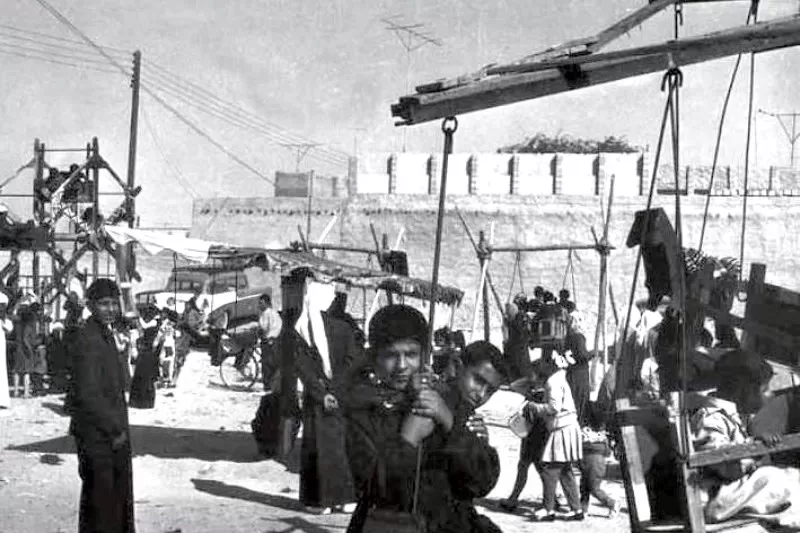
On Eid mornings, with the yards full of children, the gulaiba stood among the other Eid amusements: a ring of wooden seats tied to a frame, rising and falling as it turned, and creaking as it went.
Children sat on the swinging seats and held on. A man pushed it by hand and the ride began, turning slowly at first and then faster, until the shouting rose. It was less a piece of equipment than a fixture of the day.
Rules made by the players
These games were played with no supervision and no organisation, but the children set their own rules, and learned from them about cooperation, taking turns, and giving way to others. Each game had its season, and each quarter had the children known for being good at hila or maqsa or the rest.
Further reading: the National Council for Culture, Arts and Letters · the Center for Research and Studies on Kuwait
Kuwait One, once a week.
The most useful stories we published this week, in your inbox.
No spam. Unsubscribe anytime.