The Saffar and the Haddad: Two Trades That Equipped a Household
Coffee pots and cooking vessels beaten and engraved in copper; doors, locks, farm tools and window grilles in iron. Where they worked, and what ended them.
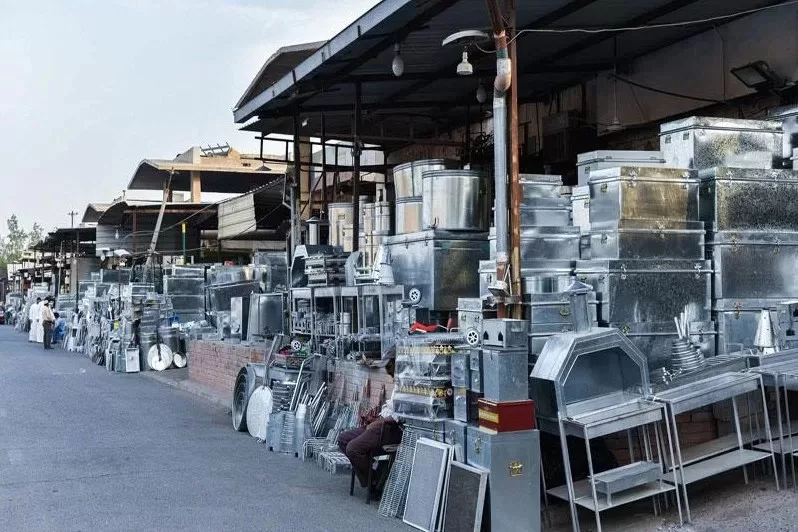
Before machinery took over daily life, the sound of a hammer on an anvil and the ring of polished copper filled the lanes of Kuwait’s markets. The haddad — the blacksmith — and the saffar — the coppersmith — were not simply manual workers but skilled craftsmen, and their work underpinned Kuwaiti life before oil.
The saffar
The saffar was the craftsman who made, polished and repaired copper vessels. The Kuwaiti kitchen depended almost entirely on them: from the dallah in which coffee was boiled, to the large pots in which feasts were cooked, to the vessels for water and storage.
His work did not stop at shaping. He also engraved and decorated, using fine tools to cut geometric or botanical patterns into a vessel, giving it a visual quality alongside its function.
The haddad
The blacksmith was the cornerstone of any building or manufacturing work, and his output ranged across iron doors, windows, locks, farm tools and blades. He was regarded with considerable respect, for his strength and skill and because his work was what secured every house and shop.
The workshops the blacksmiths used were known in Kuwait as the dukkan, usually small, and full of the noise of work and the heat of the fire. Notably, some of these workshops were passed from one generation to the next, so a family name stayed attached to the trade itself.
Where they worked
Both trades were practised at particular points in the old Kuwaiti souk, such as Souk Al-Saffareen in the middle of the town, which was busy into the middle of the twentieth century. Customers went to them directly, either to buy what they needed or to have what they owned repaired.
The distinctive sound of metal being struck served as an indirect announcement to customers that the saffar or the haddad had started his day.
The decline
With mass-manufactured goods, plastic and stainless steel, these trades began to lose ground. The cheaper option became available and the faster one attractive, and the need for hand-made pieces shrank. One by one the coppersmiths’ and blacksmiths’ shops closed, replaced by shops, restaurants and modern retail.
What survives
The trades kept their place in the Kuwaiti memory. Many households hold on to old copper vessels as decoration or as a reminder, display them in a majlis, or pass them to children as part of a family’s inheritance.
Official bodies and heritage associations have begun reviving these crafts at heritage exhibitions and popular festivals, as an attempt to hold on to what is left of the skill.
Further reading: the National Council for Culture, Arts and Letters · the Center for Research and Studies on Kuwait
Kuwait One, once a week.
The most useful stories we published this week, in your inbox.
No spam. Unsubscribe anytime.