Before the Engine: Six Ways Fish Reached a Kuwaiti Table
The hadhra traps whatever came in on the tide, and the oval gargoor is built from palm ribs and wire imported from India.
Before engines and modern gear, there were exactly six ways between the sea and the Kuwaiti table. Each had its name, its tools, its season and the fish it suited — and each has a local word with no equivalent in standard Arabic.
1. Al garageer
Pronounced locally jarajeer: the fish traps. Most are oval, made from palm ribs or reeds and from wire imported chiefly from India. They run between half a metre and two metres, and the funnel-shaped entrance is called the fak, tapering inside so the fish cannot get back out; the catch comes out through a temporary opening at the other end. The bait is called yeem: cuttlefish, or haf, or oum — the sardine — or shellfish and some weed depending on what is wanted. They are set on the bottom in shallow water, among the reefs and rocks. Older traps with darkened wire are said to catch more than new ones.
2. Al ghuzool
The nets, called yashoumiya, of cotton and linen thread imported from India and Africa. The floats are pieces of palm frond base brought from Basra, and the weights on the bottom rope are stones called masawi. Two kinds:
- Two or three fingers of mesh: for small fish — meed, bayah, jirjifan — called taroof or sharkh, used in shallow water so the net stands like a wall from surface to bottom.
- Four fingers of mesh: for medium and large — zubaidi, kanaad, rabeeb, gubab — called leekh, fished by the method known as hayal. Mostly used in the north of Kuwait and in the qaid season for zubaidi and sabour, made of four to six sections, and fished on moonlit nights.
3. Al khait and al mayadeer
The line. The main line is made locally from cotton, branching into three or four lines, each ending in a midar and a weight called the balad, baited with shrimp or cuttlefish. An effective method for hamour and shaari, with special mayadeer for nagroor and shaam.
4. Al koofa, for shrimp
Made from palm stems, with names for each part: the dafou, the janah, the shanash, the keesa. Its mesh is smaller than an ordinary net and its thread thicker, and it has a dedicated man to raise and lower it on the bottom. It is set as a vertical wall resting on the seabed, then its ends are drawn round in a half circle with the fishermen pressing the bottom rope down with their feet so the shrimp cannot escape, the circle tightening until it is lifted. Khor Al Sabiya was the best-known ground for it.
5. Al masakir and al hudhoor
The maskar is a barrier of limestone or sea rock laid in a half circle about fifty centimetres high between the high and low water marks, sometimes running for kilometres along the shore. Fish come in with the tide, are trapped as it falls, and are picked up by hand.
The hadhra is a barrier of reed tied with special rope. It has a wall running from the shore out to sea called the yad, the arm, which leads fish into a circular trap called the hoosh; they enter on the flood and do not leave, and are collected at the thabr from the deep pocket at its end that stays submerged. What it takes most is meed, sils, yamam, cuttlefish and jirjifan.
6. Al gumbar
A night method: the fisherman carries the kabir, a pointed iron spear, with a sword and a lamp. He takes wahar, gubgub, shaam and bayah by night. The one danger named for it: the electric ray.
And the boats that carried all of it
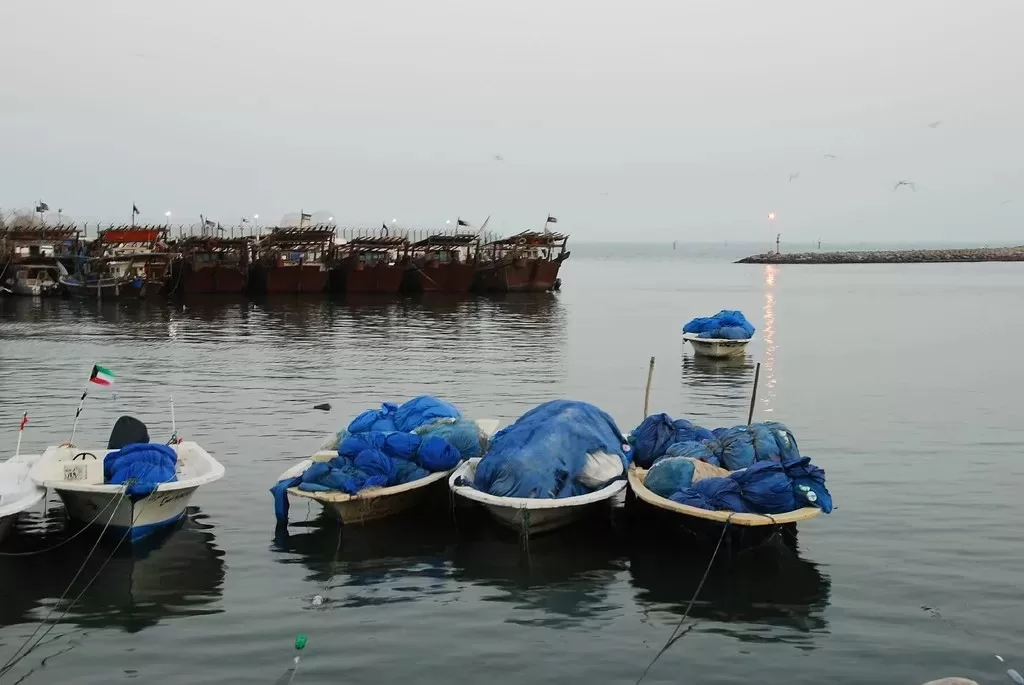
The shuwai, the houri, the jalboot and the warjiya — heading for Failaka, Warba, Khor Bubiyan, Miskan, Kadhima, Sabiya, Had Al Hammar, Ras Al Zour and Julaia.
Photo: fishing boats moored at the shore. By radiant guy, CC BY-SA 2.0 via Flickr.
Source: the researcher Nawaf Al Osfour speaking to Al Qabas, 17 July 2012, as part of his photographic record of Kuwait’s sea trades, via the version of the piece on the Kuwait History forum.
Kuwait One, once a week.
The most useful stories we published this week, in your inbox.
No spam. Unsubscribe anytime.