

In 1921 a second formal school opened in Kuwait. It did not open because the first was full, but because a disagreement had broken out inside it over something simpler than a reader today would expect: what a school is entitled to teach.
The disagreement that opened a door
Sheikh Yusuf bin Issa Al-Qinai taught at the Mubarakiya school. And when he wanted to bring English, science and geography into it, he met opposition. So he agreed with Sheikh Abdulaziz Al-Rasheed to establish another school, the “Ahmadiya”. That is the account given by Al-Arabi magazine, published by the National Council for Culture, Arts and Letters, in its biography of Al-Qinai.
A witness from inside the event
The advantage here is that one of the founders wrote about the school only five years later. Abdulaziz Al-Rasheed published The History of Kuwait in 1926, and it holds details you will not find in later accounts:
- The name is not a coincidence. It was named after Sheikh Ahmad Al-Jaber, and Al-Rasheed says he had the leading hand in its founding and the large share in its financial support.
- Its location. It stood in the Qibla quarter, and at the far end of that same quarter was the American hospital.
- Its social function. Al-Rasheed describes it as the window through which every stranger arriving in Kuwait looked in. Which is to say it was not only a school but the country’s face to its visitors.
- Its administration. It had a board, and at one point its headmaster was also headmaster of the Mubarakiya, and the same man headed the national library.
- Its funding. Al-Rasheed records that one of the merchants of the Al-Zayed family attended one of the school’s celebrations, was impressed by the order and success he saw, and donated two hundred rupees on the spot.
And geography? It was taught
Here is the testimony that closes the circle. Al-Rasheed records that Fahad bin Salem Al-Sabah received at the Ahmadiya the principles of jurisprudence, doctrine, grammar, morphology, geography and other subjects.
The subject objected to at the first school was being taught at the second. That alone explains why two schools were necessary.
A correction to an oft-repeated account
The first educational mission to leave Kuwait, in 1924, is usually told like this: seven students travelled to the A’zamiya College in Baghdad.
Al-Rasheed tells it more precisely. Fahad bin Salem was one of the mission, but he alone stayed at the Rahmaniya school in Basra, while his companions carried on to Baghdad and entered the A’zamiya College. The mission, then, did not all end up in one place.
And three years after the Ahmadiya opened, in 1924, an attempt was made to merge the two schools. It did not succeed. That last account comes from the Kuwait History Forum rather than from Al-Rasheed’s book.
Sources
The original and the most important: Abdulaziz Al-Rasheed, The History of Kuwait, 1926. And the biography of Sheikh Yusuf bin Issa Al-Qinai in Al-Arabi magazine. And the chronology of education on the Kuwait History Forum.
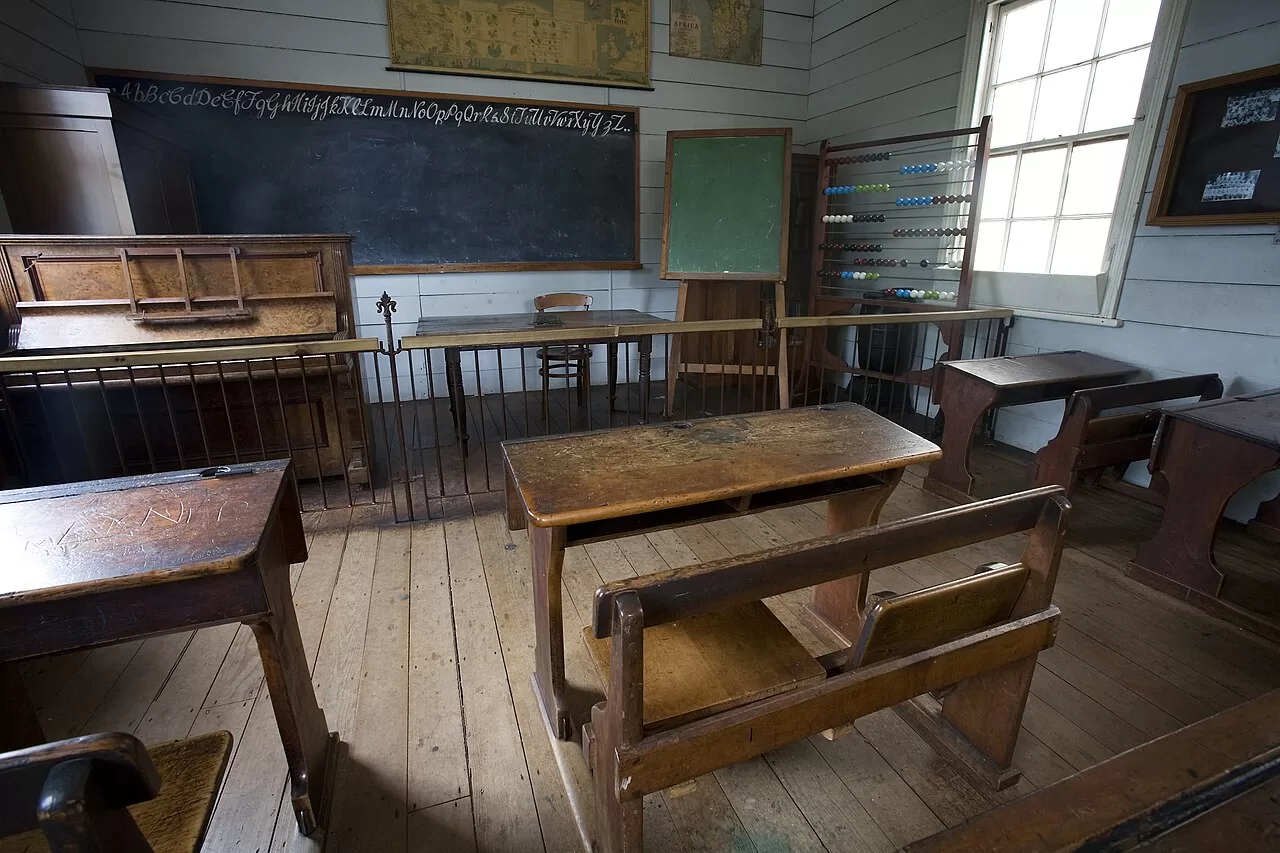
Photo: an old classroom with wooden desks. By Jorge Royan, CC BY-SA 3.0 via Wikimedia Commons.
Kuwait One, once a week.
The most useful stories we published this week, in your inbox.
No spam. Unsubscribe anytime.