
In 1934 a school in Kuwait closed its doors. It had around three hundred pupils, teaching was free, and it was the third formal school the country had known. It did not close because anyone mismanaged it, nor because the pupils stopped coming. It closed because the man who paid its teachers’ salaries out of his own pocket had lost his fortune.
And what took the fortune was not a war or a fire. It was a cultured pearl.
Two brothers from Sharq
Hussein and Shamlan, sons of Ali bin Saif Al-Roumi, were born in the Sharq district of Kuwait City into a comfortable family. Their father died in 1304 AH, corresponding to 1886, when Shamlan was about twenty-three.
What the brothers did next is what matters. They did not sit on what they inherited. They entered the pearl trade through its hardest door: buying from the divers, then travelling with the take to the selling markets in Bahrain or India. In time they became leading tawawish, second only to Hilal bin Fajhan Al-Mutairi, the wealthiest pearl merchant in the Gulf.
By the early 1920s their fortune had reached eight hundred and fifty thousand rupees. For a sense of scale: a school headmaster in Kuwait then earned a hundred rupees a month, and that was described as a large sum.
A water ship, half of it for the poor
Kuwait before oil did not have enough fresh water. Water was brought from the Shatt al-Arab at Basra by ship, and the kandari sold it around the neighbourhoods by the tin.
Shamlan and Hussein set aside a ship for this purpose called “Rangoon”, and made half of what it brought free water for the poor. Half the cargo. In a Kuwaiti summer, in a country where water was imported.
Then came the First World War, 1914 to 1918, communications were cut, merchants stopped trading and the crisis reached its peak. In those years the brothers’ diwan stayed open: they fed the poor and the destitute, in private and in public.
Five thousand rupees to the Mubarakiya
When Kuwait’s men of influence resolved to build a modern school that would take education out of the kuttab, Shamlan donated five thousand rupees to the founding of the Mubarakiya school.
But the Mubarakiya, and the Ahmadiya after it, could not hold all who wanted to learn. And Shamlan noticed something else: that many orphans were shut out of education because there was nobody to pay for them.
Al-Saada school
So he founded a school at his own expense, private, taking in Kuwait’s orphans, who learned there free of charge what others learned at the Mubarakiya and the Ahmadiya. He called it Al-Saada school.
He allocated part of his money to it. He appointed teachers, and entrusted its management to Sheikh Ahmad Al-Khamis on a salary of a hundred rupees. It opened in 1343 AH, corresponding to 1924, making it the third formal school in Kuwait. Its pupils numbered around three hundred, among them orphans and the sons of merchants and captains, and teaching was free for all of them.
It lived ten years. In 1934 Shamlan was forced to close it, no longer able to fund it after his fortune went with the collapse of the pearl trade. And the cause of that collapse is well known: the arrival of the cultured pearl.
That is the sentence worth reading twice. An orphans’ school in Kuwait closed because a factory somewhere else in the world learned to imitate what a Kuwaiti diver went to the seabed to bring up.
A third of a son’s estate, a son killed at Jahra
Shamlan had a son named Ali, killed at the Battle of Jahra in 1340 AH, corresponding to 1921, and buried near the Red Palace in Jahra.
The father donated a third of his son’s estate to the Shamlan mosque, the one with two minarets, and from that money built a khalwa and a place for ablutions. The mosque is in Mirqab, at the junction of Hilali Street — now Shuhada Street — with Abdullah Al-Mubarak Street. The Ministry of Awqaf renovated it in 1379 AH, corresponding to 1959.
Two brothers on opposite sides of one episode
In the pearl merchants’ emigration of 1910, when ten of the leading tawawish and captains left Kuwait in protest at Sheikh Mubarak Al-Sabah’s policies, Shamlan bin Ali Al-Roumi was at the front of those departing.
And Hussein, his elder brother, was in the delegation Sheikh Mubarak sent to Shamlan himself. He was also in the delegation that accompanied Mubarak to Bahrain to meet Hilal Fajhan Al-Mutairi.
Two brothers, on opposite sides of the same episode. That alone says something about how disputes were managed in a small Kuwait.
And in 1921, at the start of Sheikh Ahmad Al-Jaber Al-Sabah’s reign, Shamlan took part in Kuwait’s first council of notables, chaired by Hamad Al-Sagar.
“He who fed the thorn trees dinner”
Hussein carried a nickname that outlived him: mu’ashi al-awsaj, “he who fed the awsaj its dinner”.
The story, as one of the family’s descendants tells it, is that he was camped in the desert in the Dibdibah area and saw in the distance what he took for a group approaching, and ordered dinner prepared for them. His sons told him there was nobody there. He insisted. And when the time stretched on and nobody came he sent someone to check, and they found nothing there but awsaj trees.
So Hussein became the man who fed the trees dinner.
The two endings
Hussein bin Ali died in 1356 AH, corresponding to 1937, leaving seven sons: Ahmad, Yusuf, Ali, Abdulaziz, Abdullah, Abdulwahab and Musaed. He was among the first Kuwaitis to travel to Paris to sell pearls, twice in the early 1930s.
Shamlan bin Ali died on 14 Rabi al-Awwal 1364 AH, corresponding to 26 February 1945, aged about eighty-three. He left ten sons: Mohammed, Abdulmohsen, Ali, Salem, Khaled, Marzouq, Abdullah, Hamad, Salman and Yusuf.
And out of this family later came Ahmad Al-Bishr Al-Roumi, 1905 to 1982, the first Kuwaiti to keep a published diary, who bequeathed his private library to the public library, and whose name a school in Daiya carries today.
A note on the sources
The principal reference on this subject is The History of Pearl Diving in Kuwait by the researcher Saif Marzouq Al-Shamlan, together with material by Dr Abdulmohsen Al-Jarallah Al-Kharafi. These details were gathered on the Kuwait History Forum, and are rewritten here.
We flag one point of dispute: the published figure for the estate the father left was contested by one of the family’s descendants in the same source. We have therefore not given it, and confined ourselves to the 1920s figure, which nobody disputed. The nickname also appears in the source once as “awshaj” and once as “awsaj”, the second being the name of the tree.
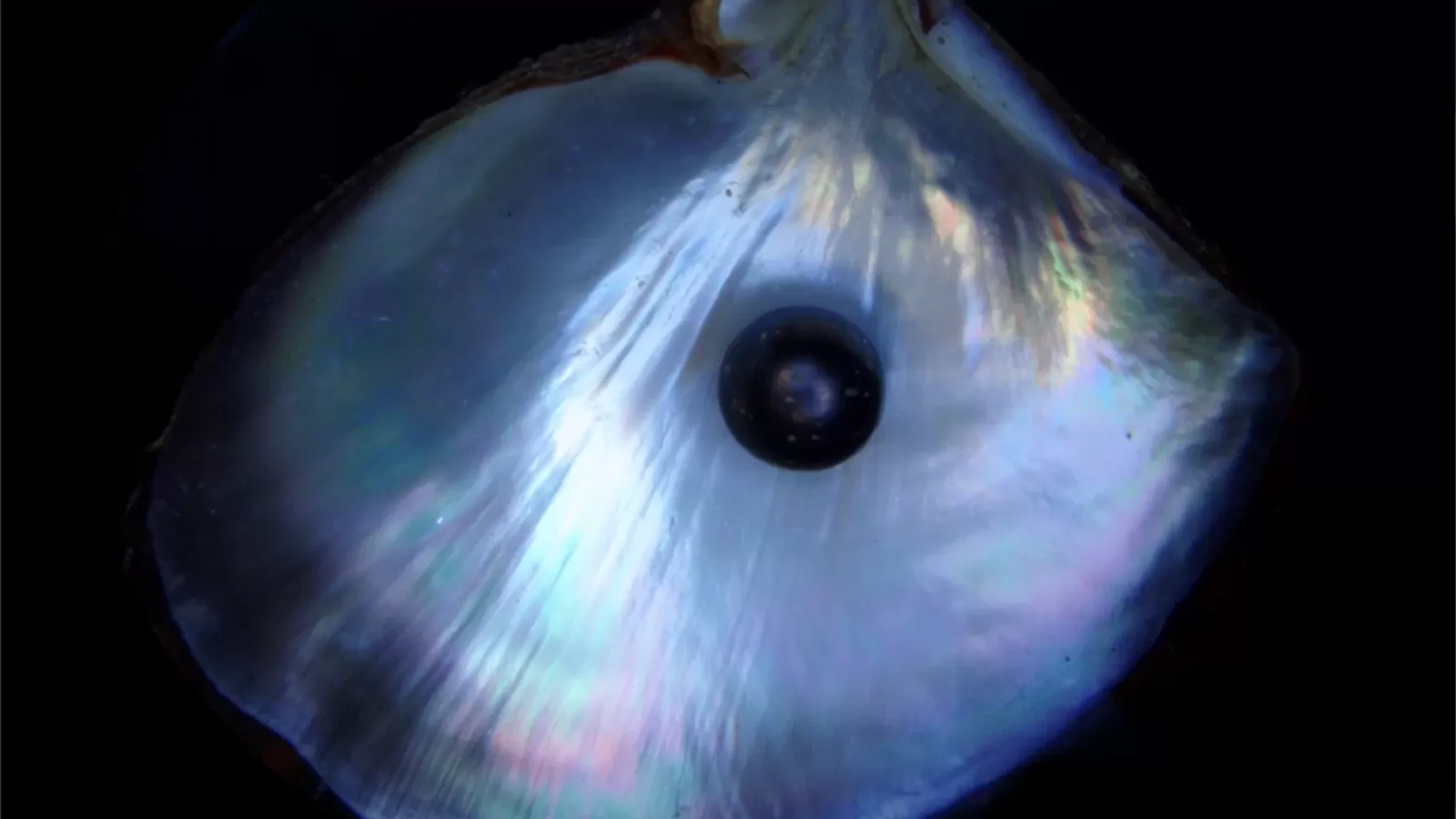
Photo: a pearl inside its shell. By Brocken Inaglory, CC BY-SA 3.0 via Wikimedia Commons.
Kuwait One, once a week.
The most useful stories we published this week, in your inbox.
No spam. Unsubscribe anytime.