At Frankfurt Airport, gates A16 and A17 in Terminal 1 now push boarding calls, gate changes and delay announcements into passengers’ own earbuds. You scan a QR code at the gate and join with whatever you are already wearing. The Bluetooth SIG ran the pilot in January 2026 and published it on 13 February 2026, calling it a small-footprint deployment it expects to widen to more gates and terminals.
Broadcast, not pairing
Ordinary Bluetooth audio is a private link between two devices. Auracast is one-way: a transmitter sends, and any number of receivers within range can pick it up at the same time. The SIG defines it as a set of specified configurations of Bluetooth broadcast audio under the Public Broadcast Profile, adopted on 12 July 2022.
Three roles do the work. The transmitter broadcasts. The receiver is your earbud or hearing aid. The assistant, usually your phone, scans for what is being broadcast nearby and shows it in a list the SIG compares to picking a Wi-Fi network in a public place. Once you choose a broadcast and the phone hands the details to your earbuds, the phone drops out of the audio path entirely.
What your hardware has to have
The SIG’s own requirement is specific: a product must support features introduced in version 5.2 of the Bluetooth Core Specification plus the Public Broadcast Profile. A version number on a box is not the test. If you own older earbuds, there is no general answer — the SIG says plainly that whether a field upgrade happens depends on the silicon already inside and on the manufacturer’s plans.
Joining is a QR scan, an NFC tap, or a button on the receiver itself when no assistant is present. A broadcast can be open or encrypted with a passcode much like a Wi-Fi key, which a venue can attach to an electronic ticket. One transmitter covers up to 30,000 square feet, depending on transmit power and antenna design.
Why hearing aid users should care
Induction loops, the assistive listening system most venues still run, are expensive to install, leak between rooms and offer little privacy. The SIG says Auracast is well positioned to become a new assistive listening system that is easier and cheaper to deploy — deliberately hedged wording, and it stops short of saying loops are finished. The Hearing Loss Association of America advises buying a hearing aid that carries both Auracast and a telecoil, and expects an international standard for Auracast venues by late 2027.
The codec changed too. The SIG reports that extensive listening tests show LC3 beating the older SBC codec on quality even at half the bit rate, which a manufacturer can spend on longer battery life or a smaller battery.
Its November 2025 round-up of live venues names Sydney Opera House, Stadium Taranaki in New Zealand with 21,000 seats and multi-language commentary, and a run of theatres, churches and hearing centres across Britain, Italy, South Korea and Switzerland.
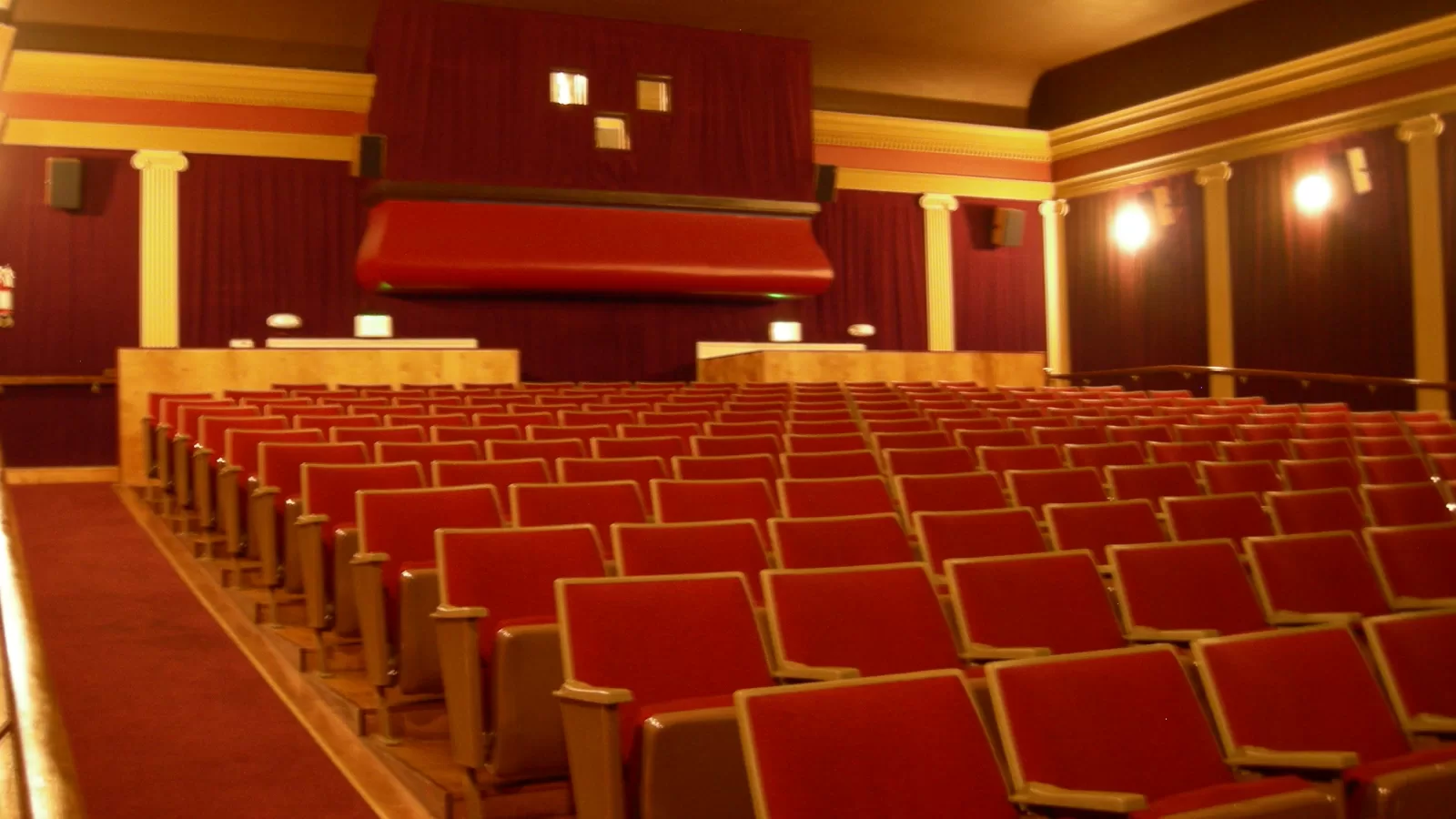
Photograph: an empty cinema auditorium — the kind of venue where a broadcast is installed, not a picture of the technology itself. Photo by Joe Mabel, licence CC BY-SA 3.0 via Wikimedia Commons.
Source: Bluetooth SIG — Auracast, How It Works and FAQ pages, Public Broadcast Profile 1.0, and the Hearing Loss Association of America.
Kuwait One, once a week.
The most useful stories we published this week, in your inbox.
No spam. Unsubscribe anytime.