
In 1935 a student in Kuwait wrote a letter to the Swiss company “Omega” asking for a single watch. He sold it, and with the proceeds ordered a second, then a third, until he became the company’s agent in a country where hardly anyone knew what an Omega was. The student’s name was Murad Yusuf Behbehani, and twelve years later he would travel to New York and return with heavier goods than watches: air conditioning, two-way radio, broadcasting and television.
How a man gets from Kuwait to New York in 1947
There was no travel agency to show him the route. The itinerary as his son Ali Murad Behbehani tells it: small aircraft to Basra, from there to Baghdad, then to Tel Aviv before the Nakba, then to Egypt, Italy, Britain, and finally a steamer taking days to New York.
All of it was financed by the British Bank of the Middle East, the only bank in Kuwait at the time, which opened a line of credit for him in an era with no civil IDs and no passports issued by any official body.
The first observation: this country needs air conditioning
The first thing he concluded was that the American invention Kuwait needed more than anywhere in the world was air conditioning. So he knocked on the door of “Carrier”, founded by Willis Carrier in 1902, and came back with the units. The first went to the ruler’s palace, and then he began selling them commercially. He earned a title that headed the group’s early paperwork: “Special Supplier to His Highness”, in the reign of Sheikh Ahmad Al-Jaber Al-Sabah.
The radio the interior refused and then requested
In New York he saw the police communicating by two-way radio, so he carried two sets home and put the idea to Sheikh Sabah Al-Salem, who was responsible for the interior before there were ministries. The idea did not take.
So Behbehani changed route: he gave a set to one of the sheikhs to use with his companions on hunting trips. Word spread among people, the news came back to Sheikh Sabah Al-Salem, and he asked for the sets, which were fitted to the police cars. The sale here was not to the body that needed it, but to the people who talked about it.
Radio and television as a way of selling, not as a media project
He was importing radio and television sets and selling them on the market, and so needed something to make them play. So he set up a small broadcasting station inside the old Kuwait wall, playing records with singers performing through the day. Then he did the same with television: he brought in transmission equipment showing sixteen-millimetre films from the American oil company, films that had not been shown in Kuwait’s cinema.
And here the trouble started. The “Cinema” company had a monopoly on the market, and people began preferring the small screen to the auditorium. Its board members submitted a complaint against Behbehani to the ruler. The end of it was that the government decided to buy the station from him, and it later became Kuwait Television.
Which is to say a station set up to sell sets became the nucleus of the state broadcaster.
Then the cars
In 1955 he brought “Volkswagen” into Kuwait. Shortly afterwards the group sold the country’s first sports car: a “Porsche 356”. The company says that was the first Porsche dealership in the Middle East, and the ninth in the world.
And here the accounts conflict, all of them from inside the same house. The official site of Behbehani Motors says the company was founded in 1957, and that Volkswagen arrived in 1955 with Porsche the following year. The group’s own official site dates the motor company’s founding to 1955 and the first Porsche dealership to 1957. And the newspaper Al-Rai, in its feature on the group’s jubilee, published a photograph of Behbehani celebrating the first Porsche he imported into Kuwait and dated it 1957. Two of the three accounts say 1957 and one says 1956, and there is no decisive tiebreaker so far.
What remains of him
He was the first Kuwaiti appointed honorary consul for Switzerland, and held the post more than forty years, granting entry visas to Kuwaitis before an official consulate opened. He was among the founders of the Kuwait Ahli Bank in 1967, and chaired it between 1986 and 2003. He died in the summer of 2005.
And the conclusion worth pausing on is not the number of dealerships, but that four things taken for granted in a Kuwaiti home today — the air conditioner, the radio, the television and the two-way set in a police car — entered the country because one merchant travelled to see for himself.
Sources: the Al-Rai feature published on 23 October 2010 for the group’s seventy-fifth anniversary, including Ali Murad Behbehani’s account; and the official sites of the Murad Yusuf Behbehani group and of Behbehani Motors. The text is relayed via the Kuwait History Forum.
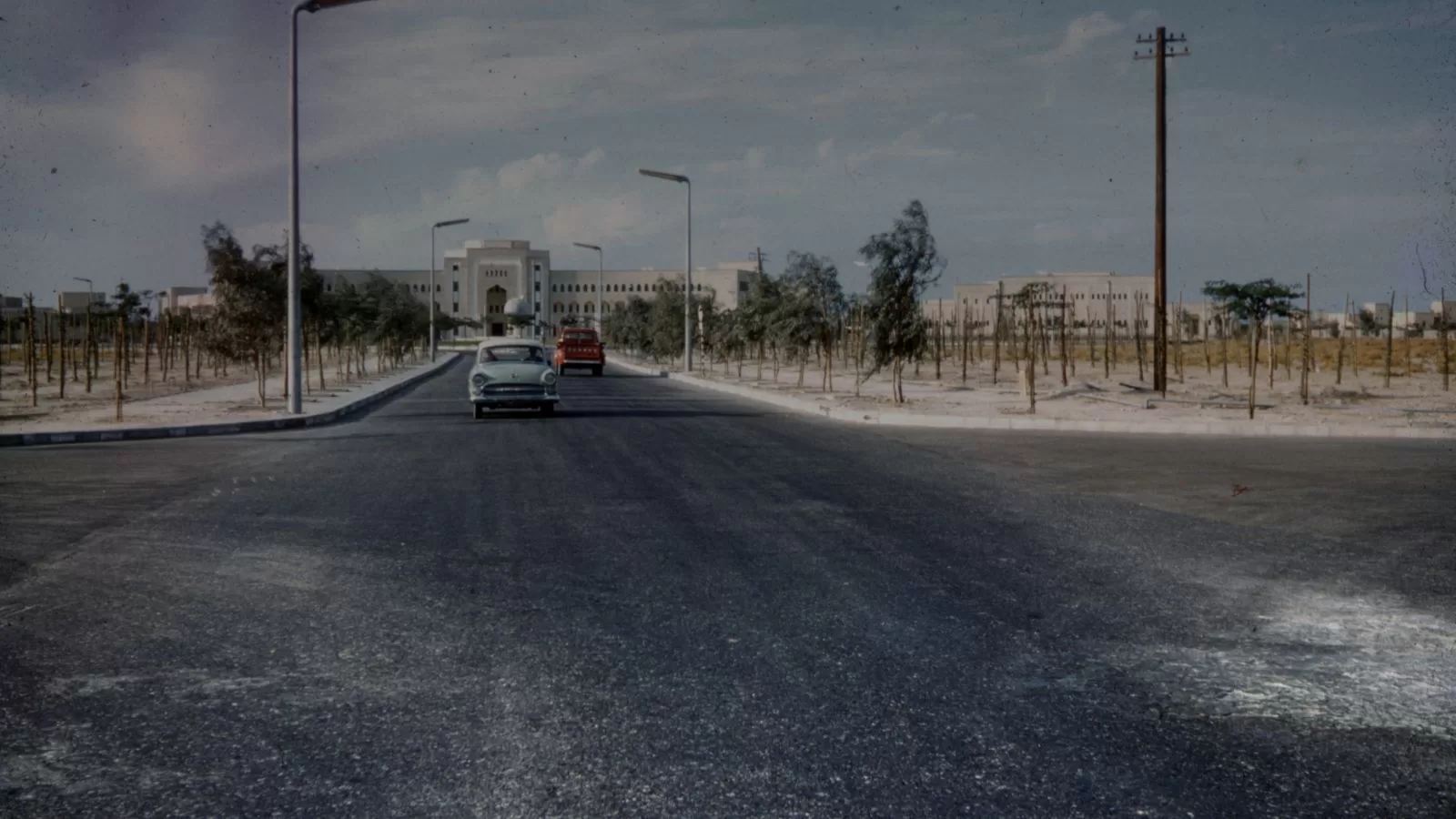
Photo: Kuwait, 1961. By brett jordan, CC BY 2.0 via Wikimedia Commons.
Kuwait One, once a week.
The most useful stories we published this week, in your inbox.
No spam. Unsubscribe anytime.