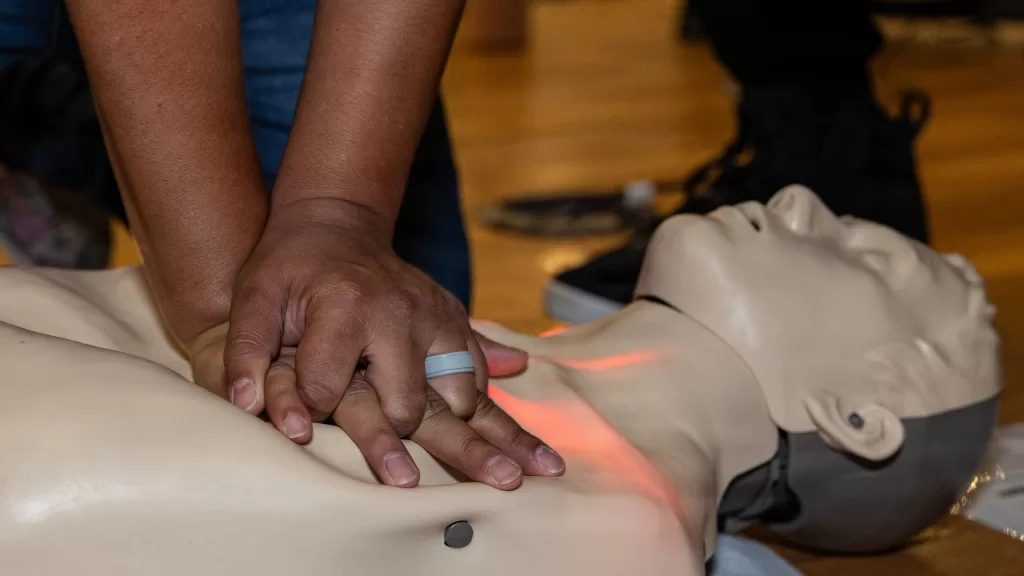
Hands-only CPR: push hard in the centre of the chest, 100 to 120 times a minute
Someone collapses and isn’t breathing normally? Call 112, send for a defibrillator, and start before the ambulance arrives.
When an adult’s heart stops in front of you, the first minutes pass before any paramedic can get there. The American Heart Association puts survival from cardiac arrest outside hospital at only about 10%, and says CPR started straight away can double or triple the odds.
The two signs to look for: no response, and no normal breathing.
What to do, in order
- Make sure the scene is safe for you and for them: traffic, live wires, fire.
- Check for a response. Tap their shoulders and ask loudly if they’re OK. If they don’t move, speak, blink or react, they’re unresponsive.
- Shout for help. Tell someone to call 112, Kuwait’s single emergency number, and to bring an AED (automated external defibrillator) if there’s one nearby. If you’re alone with an adult showing these signs, call yourself and fetch the AED if it’s close.
- Check the breathing. If they aren’t breathing, or are only gasping, start chest compressions. Gasping is not breathing.
- Push. Hard and fast in the centre of the chest, at least 5 cm (2 inches) deep, 100 to 120 times a minute. Let the chest come all the way back up after each push.
- Use the AED as soon as it arrives. Switch it on and follow the voice prompts. It decides whether a shock is needed and tells you what to do next, including when to go back to compressions.
- Keep going until the person starts breathing or moving, or a trained responder takes over. If someone else knows CPR, swap roughly every two minutes, sooner if you tire.
Where people go wrong
- Pushing too gently. At least 5 cm is deep; a soft push doesn’t move blood.
- Leaning on the chest between pushes. It has to rise fully before the next one.
- Stopping to wait for the ambulance. The compressions are what keep blood reaching the brain until it arrives.
These steps are for adults. Children and babies need a different technique, taught on a certified first-aid course.
Photo: chest compressions on a CPR training manikin, by Joseph Kreis, U.S. Marine Corps, public domain via Wikimedia Commons.
Source: American Heart Association, “Treatment of Cardiac Arrest” (heart.org), last reviewed 14 September 2026, checked 23 October 2026.
Kuwait One, once a week.
The most useful stories we published this week, in your inbox.
No spam. Unsubscribe anytime.