
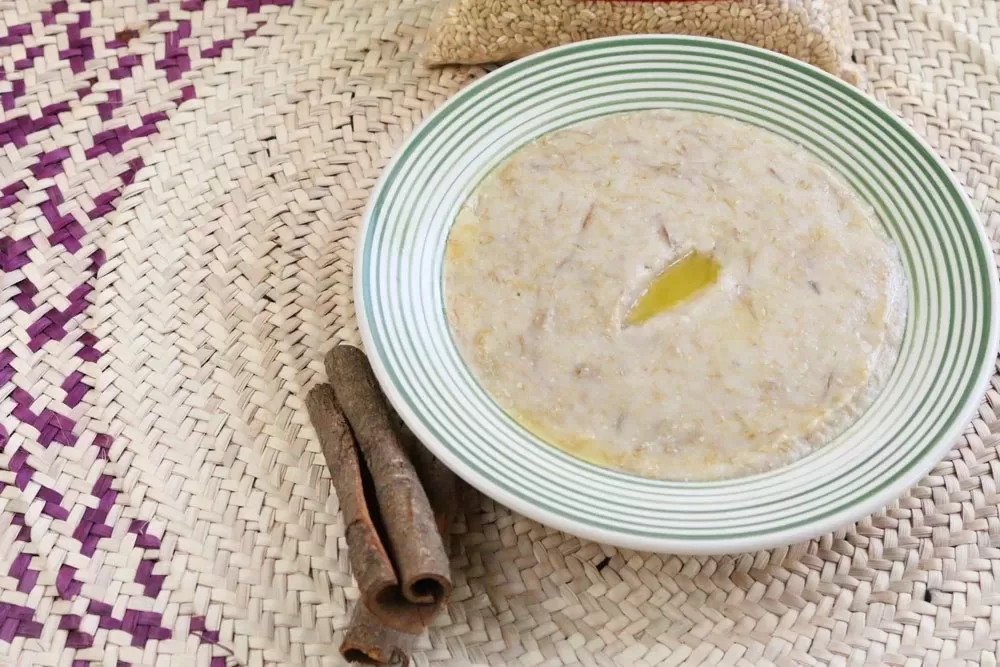
On Ramadan nights, when the smell of spice runs through the lanes, the Kuwaiti kitchen turns to one of its oldest dishes: harees. Few ingredients, deep flavour, and a strong association with company.
From the desert to the town
Harees is not Kuwait’s alone; it belongs to a wide inheritance running across the Arabian Peninsula, Persia and India. But Kuwaitis gave it their own emphasis, tying it more closely to religious and social occasions. In the past, preparation began days before Ramadan: the best wheat was bought and stored somewhere dry, and fresh meat was chosen carefully, usually young lamb for its tenderness.
The traditional method
Making harees in the old way was a collective business:
- The wheat is soaked overnight until it softens.
- It goes with the meat into a large heavy copper or aluminium pot, with plenty of water.
- The mixture is left on a low flame for several hours, stirred continuously, until the grain and the meat merge into a single creamy consistency.
- Salt goes in at the late stages, and it is finished with local ghee or butter.
The traditional tools mattered to the result, above all the long wooden paddle used to beat the wheat and meat until they dissolve into each other.
Ramadan and Eid
Harees was one of the dishes never absent from the iftar table in Ramadan, particularly in the second half of the month, when families begin exchanging invitations. At Eid al-Fitr it becomes a marker of giving: cooked in large quantities and distributed to neighbours, relatives and passers-by. Large pots were carried out to a communal kitchen or into the courtyard, where men and women worked on it together, so the cooking became the occasion in itself.
What is in it
Harees is a complete meal: wheat brings fibre and minerals, the meat brings protein and iron, and the long slow cooking makes it easy to digest — which suits the end of a fasting day.
And in practice it stands for solidarity, distributed to those in need during Ramadan and served as an invitation at Eid.
Harees today
Cooking equipment has moved on, and pressure cookers and modern kitchens are used, but many still prefer harees cooked over wood, holding that the smoke gives it something no shortcut replaces. Popular restaurants and heritage cafes have started putting it on their menus, so a newer generation can meet the dish.
Further reading: the National Council for Culture, Arts and Letters · the Center for Research and Studies on Kuwait
Kuwait One, once a week.
The most useful stories we published this week, in your inbox.
No spam. Unsubscribe anytime.