
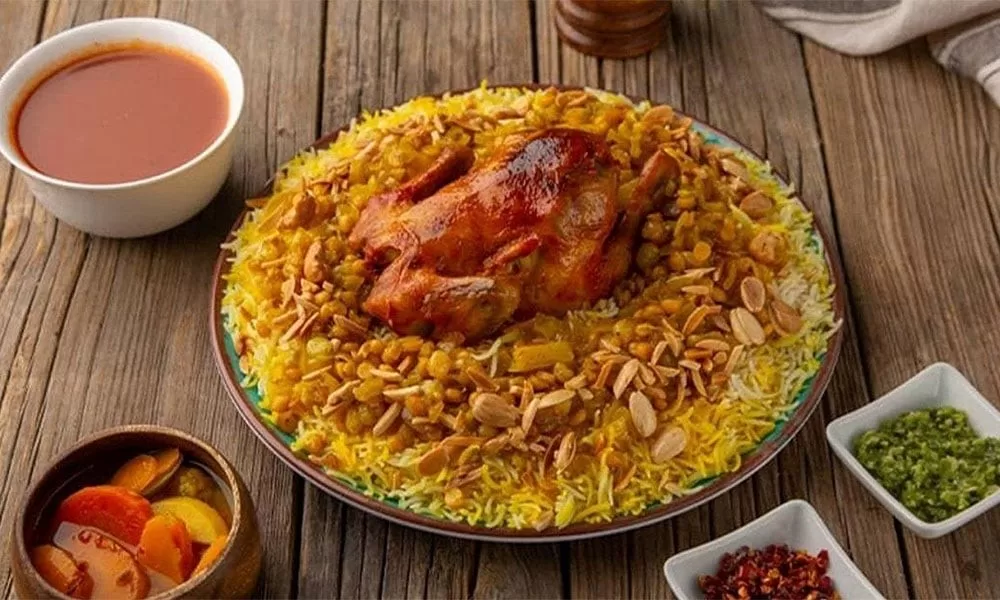
In every Kuwaiti house there is a smell that starts when the meat or chicken goes on, carries through the spices, and ends with the sound of rice breathing in a large pot. Machboos — some say michboos — is not only one of the best-known Kuwaiti dishes; it is the one that brings the family together, is served at occasions, and is missed abroad.
Where the name comes from
The word comes from the Arabic root jabs, meaning to press or compress, because the rice is pressed over the meat or chicken in the pot and cooked with it until the ingredients and their flavours run into each other. The dish is thought to share roots with kabsa rice across the Peninsula, but it developed differently in each region. In Kuwait it took on a local character that is easy to recognise.
The local secret: the fry
Ask any Kuwaiti cook about machboos and she will tell you the secret is in the fry — a mix of fried onion, garlic, tomato and black lime. That mixture goes into the meat or chicken broth after browning, and the spices are boiled into it: the household’s own blend, which differs from house to house but usually holds cardamom, cinnamon, turmeric, black pepper and clove.
Then the rice, usually long-grain basmati, cooked in the broth until it takes up all of it. And here the skill shows: the rice must not be claggy but separate, grain by grain, and the flavour balanced.
Chicken, lamb or fish?
Machboos is not one dish. Lamb machboos is usually made with mutton and counts as the choice for large occasions. Chicken machboos is the quicker, lighter option, made weekly in most homes.
And there is fish machboos, or mutabbaq, usually made with local fish such as zubaidi, hammour or nagroor. The fish is fried first and the rice cooked in the same pot so it takes the flavour, with the fried fish laid over it.
Then and now
In the past machboos was cooked over wood and took hours. The equipment has changed and the ritual has not: the whole house knows there is machboos on the fire from the smell.
Restaurants today, from the popular to the expensive, all carry it, and some give it a day of the week. And it has become the Kuwaiti kitchen’s ambassador abroad, served at Kuwaiti embassies and at cultural events as a working example of the country’s food heritage.
In the end machboos is not simply a meal. It is a piece of memory cooked daily — a dish passed down that each household marks with its own touch without changing what it is.
Further reading: the National Council for Culture, Arts and Letters · the Center for Research and Studies on Kuwait
Kuwait One, once a week.
The most useful stories we published this week, in your inbox.
No spam. Unsubscribe anytime.